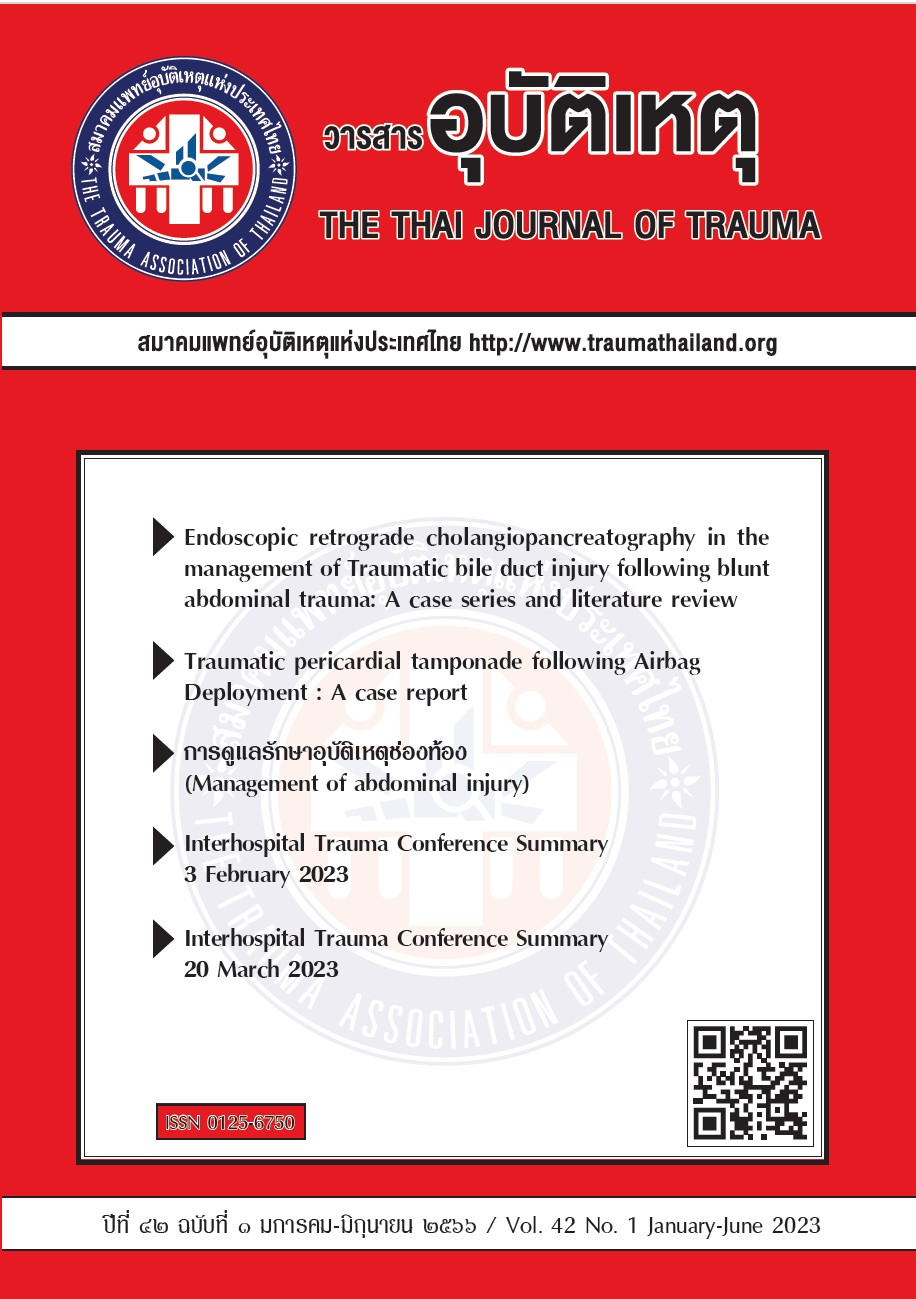
Endoscopic retrograde cholangiopancreatography in the management of Traumatic bile duct injury following blunt abdominal trauma: A case series and literature review
Keywords:
Traumatic bile duct injury, Blunt abdominal trauma, Hepatic injuryAbstract
Bile duct injuries from blunt abdominal trauma are rare. Bile leak after liver injury is not uncommon, especially in complex liver injury. Conventionally, bile duct injury was treated by surgical intervention. In recent decades, however, there had been an increase in radiologic or endoscopic intervention to treat traumatic bile duct injury. Endoscopic retrograde cholangiopancreatography (ERCP) with sphincterotomy and biliary stent insertion is an effective treatment of bile leak after liver injury. We report three cases with persistent bile leak after complex liver injury who had had a ERCP for internal biliary stent placement. The procedure was well tolerated and the patient was discharged with biliary stent. A follow-up imaging was performed 6 weeks later, a MR cholangiopancreatography (MRCP) showed a normal biliary tree, without any leakage, and the internal biliary stent was subsequently removed. All patients had a complete recovery. Based on our study results, ERCP should be considered as
first-line therapy in the management of traumatic bile leaks.
References
Meredith JW, Young JS, Bowing J, Roboussin D: Nonoperative management of blunt hepatic trauma: the exception to the rule? J Trauma 1994;36:529-34
Pachter HL, Knudson MM, Esrig B, Ross S, Hoyt D, Cogbill T, et al: Status of nonoperative management of blunt hepatic injuries in 1195: a multicenter experience with 404 patients. J Trauma 1996;40:31-8
Spinn MP, Patel MK, Cotton BA, Lukens FJ. Successful endoscopic therapy of traumatic bile leaks. Case Rep Gastroenterol. 2013;7(1):56-62.
Johnsen NV, Betzold RD, Guillamondegui OD, et al. Surgical Management of Solid Organ Injuries. Surg Clin North Am. 2017;97(5):1077-1105.
Sharma BC, Mishra SR, Kumar R, Sarin SK. Endoscopic management of bile leaks after blunt abdominal trauma. J Gastroenterol Hepatol 2009 May; 24(5):757-61
Kozar RA, Moore JB, Niles SE, Holcomb JB, Moore EE, Cothren CC, Hartwell E, Moore FA: Complications of nonoperative management of high-grade blunt hepatic injuries. J Trauma 2005;59:1066-71.
Bala M, Gazalla SA, Faroja M, Bloom AI, Zamir G, Rivkind AI, Almogy G. Complications of high grade liver injuries: management and outcome with focus on bile leaks. Scand J Trauma Resusc Emerg Med. 2012 Mar;20:20.
Burmeister S, Krige JE, Bornman PC, Nicol AJ, Navsaria P. Endoscopic treatment of persistent thoracobiliary fistulae after penetrating liver trauma. HPB (Oxford) 2009;11:171-5.
Singh V, Narasimhan KL, Verma GR, Singh G: Endoscopic management of traumatic hepatobiliary injuries. J GastroenterolHepatol 2007;22:1205-9.
Bajaj JS, Spinelli KS, Dua KS: Postoperative management of noniatrogenic traumatic bile duct injuries: role of endoscopic retrograde cholangiopancreaticography. SurgEndosc 2006;20: 974-7.
Castagnetti M, Houben C, Patel S, Devlin J, Harrison P, Karani J, Heaton N, Davenport M: Minimally invasive management of bile leaks after blunt liver trauma in children. J Pediatr Surg 2006;41:1539-44
Downloads
Published
How to Cite
Issue
Section
License
Copyright (c) 2024 THE THAI JOURNAL OF TRAUMA

This work is licensed under a Creative Commons Attribution-NonCommercial-NoDerivatives 4.0 International License.
The primary requirement for distribution is proper attribution for both the original author and The Thai Journal of Trauma. Authors submitting manuscripts to The Thai Journal of Trauma must transfer copyright to the journal, with any reproduction—partial or complete—contingent upon written authorization from the journal's editorial team. While authors retain full responsibility for their article's substantive content, the journal assumes liability only for printing-related errors. The Thai Journal of Trauma publishes articles under the Creative Commons Attribution-NonCommercial-NoDerivatives 4.0 (CC-BY-NC-ND) license, which grants permission for redistributing the work, but are prohibited from modifying the original content or using it for commercial purposes.



