Epidemiological trends of dengue at Photharam Hospital: Insights from one of ten clinical trial sites for the world’s first dengue vaccine in Thailand
Keywords:
Dengue, epidemiology, Photharam HospitalAbstract
Background: Dengue is a widespread viral disease that is transmitted by vectors and has impacted more than 120 nations. In 2019, a concerning 5.2 million dengue cases were reported, with Asia bearing 70.0% of the global burden. Moreover, half of the global population faces the risk of dengue.
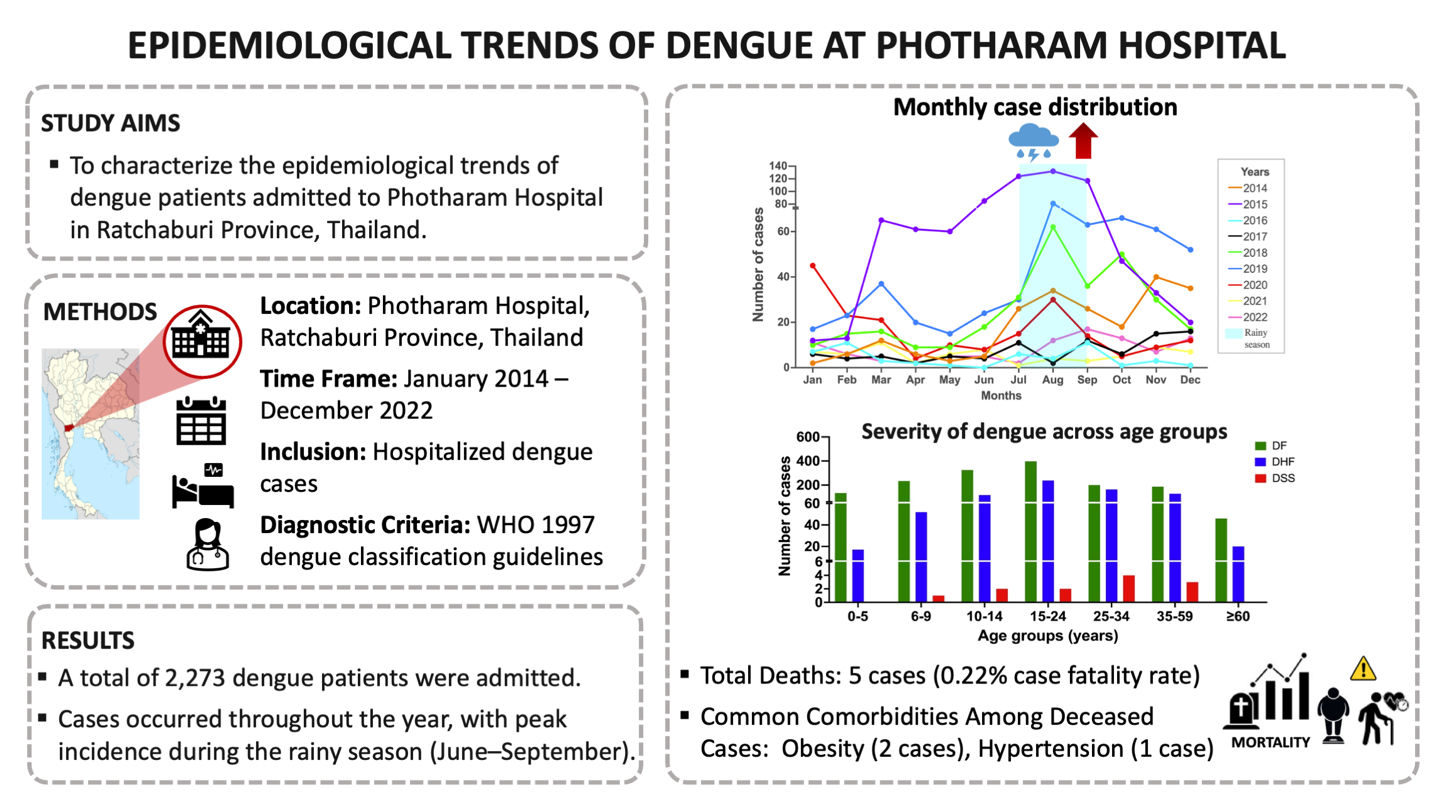
Objective: The goal of this research was to illustrate the epidemiological pattern of patients with dengue who were admitted to Photharam Hospital in Ratchaburi province, Thailand, one of the ten clinical trial sites for the world’s first dengue vaccine.
Methods: Data from patients with dengue who were admitted to Photharam Hospital, a provincial healthcare center in Ratchaburi province, Thailand, from January 2014 to December 2022, were collected and analyzed. Diagnosis of dengue subcategories was determined according to the clinical and laboratory criteria outlined by the 1997 WHO classification.
Results: A total of 2,273 patients with dengue were admitted, comprising 1,105 males (48.6%) and 1,168 females (51.4%). Of these, 882 patients (38.8%) were children aged 0–14 years, while 1,391 patients (61.2%) were aged ≥15 years, indicating a higher incidence among adults. Cases occurred throughout the year, with peaks during the rainy season from June to September. Based on the 1997 WHO classification, 1,524 cases (67.0%) were dengue fever (DF), 737 cases (32.4%) were dengue hemorrhagic fever (DHF), and 12 cases (0.5%) were dengue shock syndrome (DSS). There were five fatalities (0.22% case fatality rate), with underlying conditions including obesity, hypertension, and dyslipidemia. The median duration of illness before hospitalization was 5 days, with death occurring at a median of 3 days post-admission.
Conclusion: Our findings reveal changing epidemiology at Photharam Hospital, particularly in the age group distribution of patients with dengue. These insights are crucial for developing strategies to prevent and control dengue epidemics. The observed epidemiological trends may have relevance to regions experiencing similar changes in population demographics.
Downloads
References
Togami E, Chiew M, Lowbridge C, Biaukula V, Bell L, Yajima A, et al. Epidemiology of dengue reported in the World Health Organization's Western Pacific Region, 2013-2019. Western Pac Surveill Response J 2023;14:1-16.
https://doi.org/10.5365/wpsar.2023.14.1.973
Bhatt S, Gething PW, Brady OJ, Messina JP, Farlow AW, Moyes CL, et al. The global distribution and burden of dengue. Nature 2013;496:504-7.
https://doi.org/10.1038/nature12060
Odio CD, Aogo RA, Lowman KE, Katzelnick LC. Severe dengue progression beyond enhancement. Nat Immunol 2023;24:1967-9.
https://doi.org/10.1038/s41590-023-01680-1
Nakaviroj S. First case report of high volume therapeutic plasma exchange as a rescue therapy in dengue hemorrhagic fever with acute liver failure. Chula Med J 2021;65:335-8
https://doi.org/10.58837/CHULA.CMJ.65.3.11
Thisyakorn U, Saokaew S, Gallagher E, Kastner R, Sruamsiri R, Oliver L, et al. Epidemiology and costs of dengue in Thailand: A systematic literature review. PLoS Negl Trop Dis 2022;16:e0010966.
https://doi.org/10.1371/journal.pntd.0010966
Kittichai V, Montriwat P, Chompoosri J, Bhakdeenuan P, Pengsakul T, Tawatsin A, et al. Relationships between dengue virus infection in mosquito vector, (Aedes aegypti), dengue cases and weather conditions in Samut Sakhon Province, Thailand. Chula Med J 2015;59:347-63
https://doi.org/10.58837/CHULA.CMJ.59.4.2
Capeding MR, Tran NH, Hadinegoro SR, Ismail HI, Chotpitayasunondh T, Chua MN, et al. Clinical efficacy and safety of a novel tetravalent dengue vaccine in healthy children in Asia: a phase 3, randomised, observer-masked, placebo-controlled trial. Lancet 2014;384:1358-65.
https://doi.org/10.1016/S0140-6736(14)61060-6
Capeding MR, Chua MN, Hadinegoro SR, Hussain II, Nallusamy R, Pitisuttithum P, et al. Dengue and other common causes of acute febrile illness in Asia: an active surveillance study in children. PLoS Negl Trop Dis 2013;7:e2331.
https://doi.org/10.1371/journal.pntd.0002331
Khursheed M, Khan UR, Ejaz K, Fayyaz J, Qamar I, Razzak JA. A comparison of WHO guidelines issued in 1997 and 2009 for dengue fever - single centre experience. J Pak Med Assoc 2013;63:670-4.
Limkittikul K, Brett J, L'Azou M. Epidemiological trends of dengue disease in Thailand (2000-2011): a systematic literature review. PLoS Negl Trop Dis 2014;8:e3241.
https://doi.org/10.1371/journal.pntd.0003241
Murray NE, Quam MB, Wilder-Smith A. Epidemiology of dengue: past, present and future prospects. Clin Epidemiol2013;5:299-309.
https://doi.org/10.2147/CLEP.S34440
Tanayapong S, Pengsaa K, Thisyakorn U. Brief communication (Original). Changing epidemiology of dengue patients in Ratchaburi, Thailand. Asian Biomed 2013;7:561-6.
Thisyakorn U, Thiayakorn C. Childhood dengue diseases: a twenty years prospective study. Southeast Asian J Trop Med Public Health 2017;48 Suppl 1: 106-11.
Karyanti MR, Uiterwaal CS, Kusriastuti R, Hadinegoro SR, Rovers MM, Heesterbeek H, et al. The changing incidence of dengue haemorrhagic fever in Indonesia: a 45-year registry-based analysis. BMC Infect Dis 2014;14:412.
https://doi.org/10.1186/1471-2334-14-412
Taurel AF, Luong CQ, Nguyen TTT, Do KQ, Diep TH, Nguyen TV, et al. Age distribution of dengue cases in southern Vietnam from 2000 to 2015. PLoS Negl Trop Dis2023;17:e0011137.
https://doi.org/10.1371/journal.pntd.0011137
Infectious Disease Association of Thailand and Pediatric Infectious Disease Society of Thailand. Adult dengue. Southeast Asian J Trop Med Public Health 2015;46 Suppl 1:1-185.
Huang AT, Takahashi S, Salje H, Wang L, GarciaCarreras B, et al. Assessing the role of multiple mechanisms increasing the age of dengue cases in Thailand. Proc Natl Acad Sci U S A 2022;119: e2115790119.
https://doi.org/10.1073/pnas.2115790119
Division of infectious Diseases, Department of Internal Medicine, Faculty of Medicine, Chulalongkorn University and The Dengue Project BanpongPhotharam, Mahidol University. Severe dengue. Southeast Asian J Trop Med Public Health 2017; 48:1-233.
Bongaarts J. Human population growth and the demographic transition. Philos Trans R Soc Lond B Biol Sci2009;364:2985-90.
https://doi.org/10.1098/rstb.2009.0137
Cattarino L, Rodriguez-Barraquer I, Imai N, Cummings DAT, Ferguson NM. Mapping global variation in dengue transmission intensity. Sci Transl Med 2020;12:eaax4144.
https://doi.org/10.1126/scitranslmed.aax4144
Hadinegoro SR. The revised WHO dengue case classification: does the system need to be modified? Paediatr Int Child Health 2012;32 Suppl 1:33-8.
https://doi.org/10.1179/2046904712Z.00000000052
Zulkipli MS, Dahlui M, Jamil N, Peramalah D, Wai HVC, Bulgiba A, et al. The association between obesity and dengue severity among pediatric patients: A systematic review and meta-analysis. PLoS Negl Trop Dis 2018; 12:e0006263.
https://doi.org/10.1371/journal.pntd.0006263
Srisawat N, Jaimchariyatam N, Tantawichien T, Thisyakorn U. Dengue: Global Threat. In: Srisawat N, Jaimchariyatam N, Tantawichien T, Thisyakorn U, eds. Dengue. Bangkok:Text and Journal Publication; 2019. p.1- 3.
Srisawat N, Gubler DJ, Pangestu T, Thisyakorn U, Ismail Z, Goh D, et al. Proceedings of the 5th Asia Dengue Summit. Trop Med Infect Dis 2023;8:231.
Downloads
Published
How to Cite
Issue
Section
License
Copyright (c) 2025 Chulalongkorn Medical Journal

This work is licensed under a Creative Commons Attribution-NonCommercial-NoDerivatives 4.0 International License.