Prevalence of carbapenem-resistant Klebsiella pneumoniae in King Chulalongkorn Memorial Hospital, 2019–2023
Keywords:
Carbapenem resistance, carbapenems, Klebsiella pneumoniaeAbstract
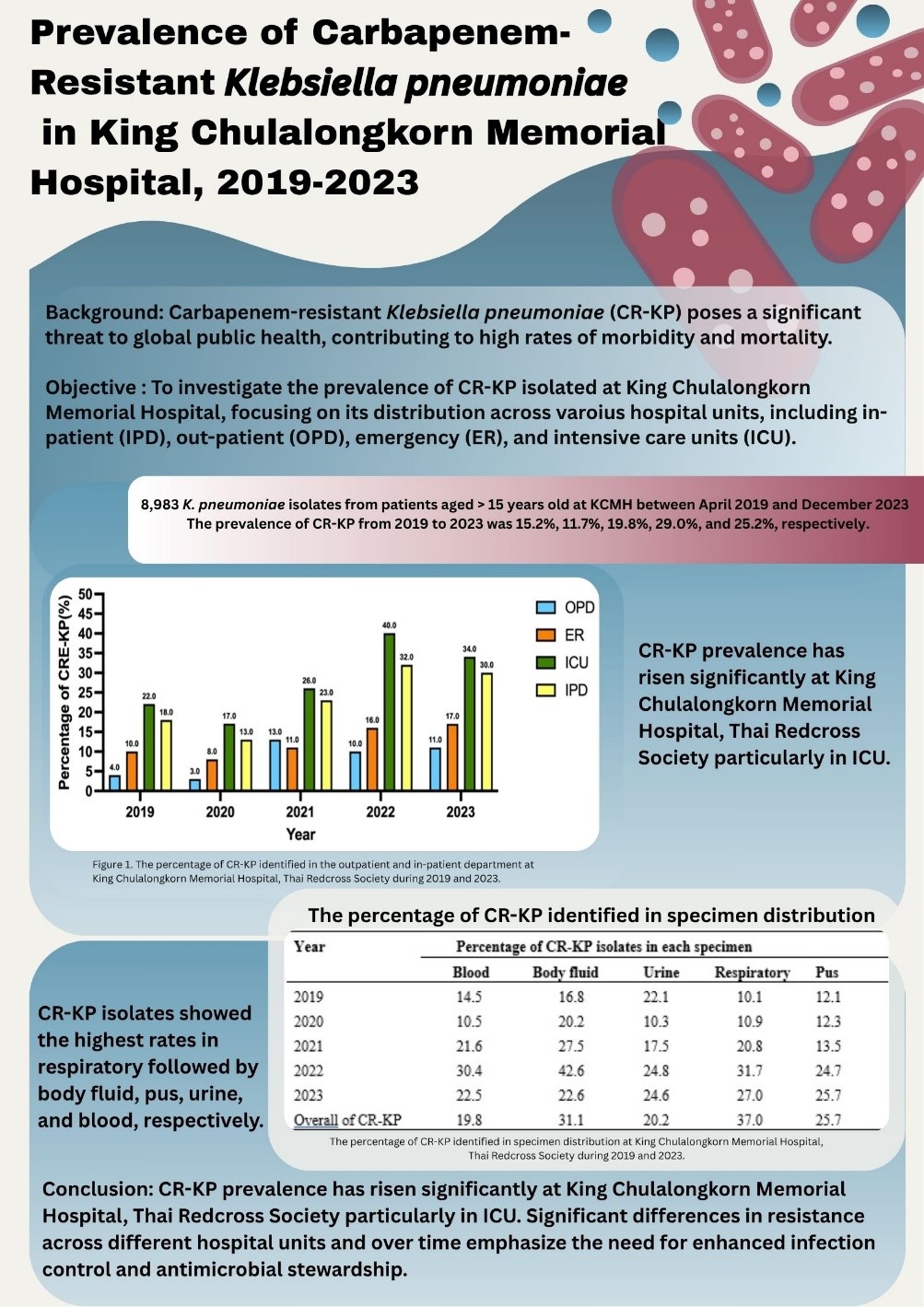
Background: Carbapenem-resistant Klebsiella pneumoniae (CR-KP) poses a significant threat to public health worldwide as it contributes to high morbidity and mortality rates.
Objective: This study aimed to investigate the prevalence of CR-KP isolated at King Chulalongkorn Memorial Hospital, Thai Red Cross Society, from April 2019 to December 2023, focusing on its distribution across various hospital units, including in-patient department (IPD), out-patient department (OPD), emergency room (ER), and intensive care unit (ICU).
Methods: A total of 8,983 K. pneumoniae isolates from patients aged > 15 years at King Chulalongkorn Memorial Hospital between April 2019 and December 2023 were studied. Antimicrobial susceptibility to carbapenems was analyzed using the chi-square test.
Results: The annual prevalence of CR-KP from 2019 to 2023 was 15.2%, 11.7%, 19.8%, 29.0%, and 25.2%, respectively. The ICU had the highest prevalence of CR-KP, followed by IPD and OPD. The resistance rates in the OPD increased 3.5–4.0-fold between 2019 and 2023, whereas the ICU and IPD rates increased 1.5–2.0- fold during the same period. Significant differences in the prevalence of CR-KP were observed across the various units and years (P < 0.01). Amikacin exhibited the highest susceptibility (90.4%–96.1%).
Conclusion: The prevalence of CR-KP has increased significantly at King Chulalongkorn Memorial Hospital, Thai Red Cross Society, particularly in the ICU. There are significant differences in resistance across the different hospital units over time, thus emphasizing the need for enhanced infection control and antimicrobial monitoring.
Downloads
References
Xu Y, Gu B, Huang M, Liu H, Xu T, Xia W, et al. Epidemiology of carbapenem resistant Enterobacteriaceae (CRE) during 2000-2012 in Asia. J Thorac Dis 2015;7:376-85.
Zhang Y, Wang Q, Yin Y, Chen H, Jin L, Gu B, et al. Epidemiology of carbapenem-resistant Enterobacteriaceae infections: report from the China CRE network. Antimicrob Agents Chemother 2018;62:e01882-17.
https://doi.org/10.1128/AAC.01882-17
Malchione MD, Torres LM, Hartley DM, Koch M, Goodman JL. Carbapenem and colistin resistance in Enterobacteriaceae in Southeast Asia: review and mapping of emerging and overlapping challenges. Int J Antimicrob Agents 2019;54:381-99.
https://doi.org/10.1016/j.ijantimicag.2019.07.019
Guh AY, Bulens SN, Mu Y, Jacob JT, Reno J, Scott J, et al. Epidemiology of carbapenem-resistant enterobacteriaceae in 7 US Communities, 2012-2013. JAMA 2015;314:1479-87.
https://doi.org/10.1001/jama.2015.12480
Vatopoulos A. High rates of metallo-beta-lactamaseproducing Klebsiella pneumoniae in Greece-a review of the current evidence. Euro Surveill 2008;13:8023.
https://doi.org/10.2807/ese.13.04.08023-en
Pirš M, Cerar Kišek T, Križan Hergouth V, Seme K, Mueller Premru M, Jeverica S, et al. Successful control of the first OXA-48 and/or NDM carbapenemaseproducing Klebsiella pneumoniae outbreak in Slovenia 2014-2016. J Hosp Infect 2019;101:142-9.
https://doi.org/10.1016/j.jhin.2018.10.022
Thongkoom P, Kanchanahareutai S, Chantrakooptungkul S, Rahule S, Pupan M, Tuntrakul P, et al. Carbapenem-resistant Enterobacteriaceae at Rajavithi Hospital: results of a microbiology laboratory program (2009-2015). J Med Assoc Thai 2017;100 (Suppl 1):S212-21.
Yungyuen T, Chatsuwan T, Plongla R, Kanthawong S, Yordpratum U, Voravuthikunchai SP, et al. Nationwide surveillance and molecular characterization of critically drug-resistant gram-negative bacteria: Results of the Research University Network Thailand Study. Antimicrob Agents Chemother 2021;65:e0067521.
https://doi.org/10.1128/AAC.00675-21
Chotiprasitsakul D, Srichatrapimuk S, Kirdlarp S, Pyden AD, Santanirand P. Epidemiology of carbapenemresistant Enterobacteriaceae: a 5-year experience at a tertiary care hospital. Infect Drug Resist 2019;12:461-8.
https://doi.org/10.2147/IDR.S192540
Elshamy AA, Aboshanab KM. A review on bacterial resistance to carbapenems: epidemiology, detection and treatment options. Future Sci OA 2020;6:FSO438.
https://doi.org/10.2144/fsoa-2019-0098
Zavascki AP, Goldani LZ, Li J, Nation RL. Polymyxin B for the treatment of multidrug-resistant pathogens: a critical review. J Antimicrob Chemother 2007;60: 1206-15.
https://doi.org/10.1093/jac/dkm357
Al-Dhaheri AS, Al-Niyadi MS, Al-Dhaheri AD, Bastaki SM. Resistance patterns of bacterial isolates to antimicrobials from 3 hospitals in the United Arab Emirates. Saudi Med J 2009;30:618-23.
Dever LA, Dermody TS. Mechanisms of bacterial resistance to antibiotics. Arch Intern Med 1991;151: 886-95.
https://doi.org/10.1001/archinte.1991.00400050040010
Aurilio C, Sansone P, Barbarisi M, Pota V, Giaccari LG, Coppolino F, et al. Mechanisms of action of carbapenem resistance. Antibiotics (Basel) 2022;11:421.
https://doi.org/10.3390/antibiotics11030421
Cantón R, Horcajada JP, Oliver A, Garbajosa PR, Vila J. Inappropriate use of antibiotics in hospitals: The complex relationship between antibiotic use and antimicrobial resistance. Enferm Infecc Microbiol Clin 2013;31 (Suppl 4):3-11.
https://doi.org/10.1016/S0213-005X(13)70126-5
Aryal PU, Thamjarungwong B, Singkhamanan K, Thongsuksai P, Ingviya N, Laohaprertthisan V, et al. Emergence of carbapenem-resistant enterobacteriaceae in a tertiary care hospital in Southern Thailand. Walailak J Sci & Tech 2020;17:1139-48.
https://doi.org/10.48048/wjst.2020.10729
Meletis G, Oustas E, Botziori C, Kakasi E, Koteli A. Containment of carbapenem resistance rates of Klebsiella pneumoniae and Acinetobacter baumannii in a Greek hospital with a concomitant increase in colistin, gentamicin and tigecycline resistance. New Microbiol 2015;38:417-21.
Yoo EH, Hong H-L, Kim EJ. Epidemiology and mortality analysis related to carbapenem-resistant enterobacterales in patients after admission to intensive care units: An observational study. Infect Drug Resist 2023;16:189-200.
https://doi.org/10.2147/IDR.S391409
Sharma K, Tak V, Nag VL, Bhatia PK, Kothari N. An observational study on carbapenem-resistant Enterobacterales (CRE) colonisation and subsequent risk of infection in an adult intensive care unit (ICU) at a tertiary care hospital in India. Infect Prev Pract 2023;5:100312.
https://doi.org/10.1016/j.infpip.2023.100312
Wu D, Cai J, Liu J. Risk factors for the acquisition of nosocomial infection with carbapenem-resistant Klebsiella pneumoniae. South Med J 2011;104:106×10.
https://doi.org/10.1097/SMJ.0b013e318206063d
Jiao Y, Qin Y, Liu J, Li Q, Dong Y, Shang Y, et al. Risk factors for carbapenem-resistant Klebsiella pneumoniae infection/colonization and predictors of mortality: a retrospective study. Pathog Glob Health 2015;109:68-74.
https://doi.org/10.1179/2047773215Y.0000000004
Kwak YG, Choi SH, Choo EJ, Chung JW, Jeong JY, Kim NJ, et al. Risk factors for the acquisition of carbapenemresistant Klebsiella pneumoniae among hospitalized patients. Microb Drug Resist 2005;11:165-9.
https://doi.org/10.1089/mdr.2005.11.165
Schwaber MJ, Klarfeld-Lidji S, Navon-Venezia S, Schwartz D, Leavitt A, Carmeli Y. Predictors of carbapenem-resistant Klebsiella pneumoniae acquisition among hospitalized adults and effect of acquisition on mortality. Antimicrob Agents Chemother 2008;52:1028-33.
https://doi.org/10.1128/AAC.01020-07
Debby BD, Ganor O, Yasmin M, David L, Nathan K, Ilana T, et al. Epidemiology of carbapenem resistant Klebsiella pneumoniae colonization in an intensive care unit. Eur J Clin Microbiol Infect Dis 2012;31:1811-7.
https://doi.org/10.1007/s10096-011-1506-5
Marchaim D, Chopra T, Bhargava A, Bogan C, Dhar S, Hayakawa K, et al. Recent exposure to antimicrobials and carbapenem-resistant Enterobacteriaceae: the role of antimicrobial stewardship. Infect Control Hosp Epidemiol 2012;33:817-30.
https://doi.org/10.1086/666642
McConville TH, Sullivan SB, Gomez-Simmonds A, Whittier S, Uhlemann AC. Carbapenem-resistant Enterobacteriaceae colonization (CRE) and subsequent risk of infection and 90-day mortality in critically ill patients, an observational study. PLoS One 2017;12: e0186195.
https://doi.org/10.1371/journal.pone.0186195
Kuloglu TO, Unuvar GK, Cevahir F, Kilic AU, Alp E. Risk factors and mortality rates of carbapenemresistant gram-negative bacterial infections in intensive care units. J Intensive Med 2024;4:347-54.
https://doi.org/10.1016/j.jointm.2023.11.007
Falagas ME, Kasiakou SK. Toxicity of polymyxins: a systematic review of the evidence from old and recent studies. Crit Care 2006;10:R27.
https://doi.org/10.1186/cc3995
Sobieszczyk ME, Furuya EY, Hay CM, Pancholi P, DellaLatta P, Hammer SM, et al. Combination therapy with polymyxin B for the treatment of multidrug-resistant gram-negative respiratory tract infections. J Antimicrob Chemother 2004;54:566-9.
Downloads
Published
How to Cite
Issue
Section
License
Copyright (c) 2025 Chulalongkorn Medical Journal

This work is licensed under a Creative Commons Attribution-NonCommercial-NoDerivatives 4.0 International License.