Comparison of lung shunt fraction calculation using Tc-99m MAA planar and SPECT/CT imaging for Y-90 radioembolization
Keywords:
LSF, planar, radioembolization, SPECT/CT, Tc-99m MAAAbstract
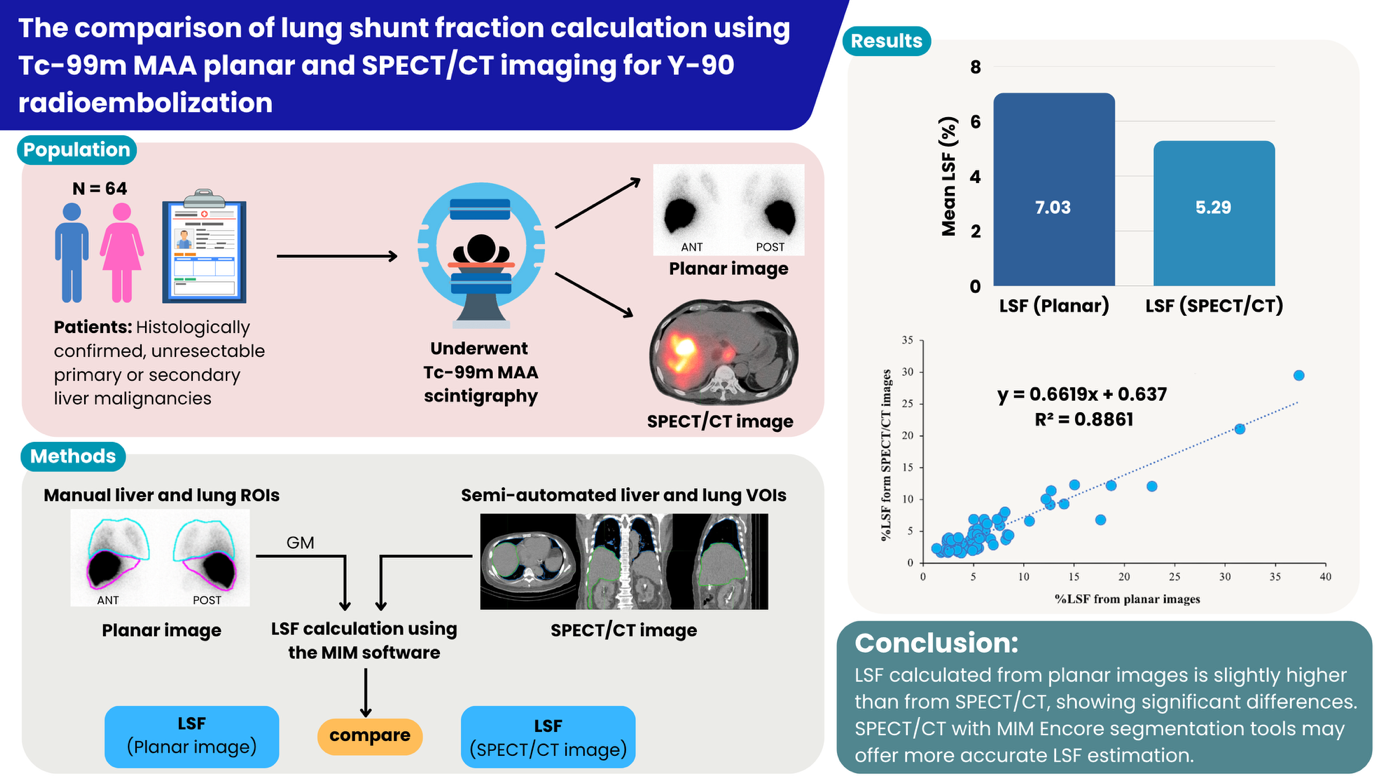
Background: The evaluation of hepatopulmonary blood vessels using technetium-99m macroaggregated albumin (Tc-99m MAA) scintigraphy before radioembolization with yttrium-90 (Y-90) microspheres is a test employed to assess and prevent radiation pneumonitis. Moreover, the lung shunt fraction (LSF) was determined from planar and single-photon emission computed tomography/computed tomography (SPECT/CT) images. This study aimed to compare LSF calculations from Tc-99m MAA planar and SPECT/CT images for Y-90 radioembolization treatment of liver tumors.
Methods: A total of 64 patients (42 males, 22 females; mean age 64.0/ ±/ 12.5 years) who underwent Tc-99m MAA scintigraphy between 2015 and 2022 were included in this study. The LSF was calculated using MIM software, with planar LSF derived from the geometric mean of lung and liver region of interest counts from anterior and posterior views, and SPECT/CT LSF from the volume of interest-based quantification. The two methods were compared using a paired t-test and Bland–Altman analysis. Intra-observer reliability was assessed using the coefficient of variation (%CV) from repeated measurements, while inter-observer reliability was evaluated using the intra-class correlation coefficient (ICC) from measurements by different investigators.
Results: The %CV for LSF remeasurements from planar and SPECT/CT images were 1.09% and 1.9%, respectively, indicating high intra-observer reliability. Inter-observer ICCs were 0.990 (planar) and 0.987 (SPECT/CT), thus confirming excellent agreement. Planar imaging yielded higher mean LSF values (7.03/ ±/ 6.57%) than those of SPECT/CT (5.3/ ±/ 4.6%), suggesting that planar methods tend to report higher LSF values.
Conclusion: This study demonstrates that LSF calculation using planar images yields significantly different results compared to those of SPECT/CT, with the LSF from planar images being slightly higher than those of SPECT/CT. Furthermore, LSF calculation using SPECT/CT combined with appropriate segmentation tools in MIM Encore software may provide more accurate results.
Downloads
References
Sung H, Ferlay J, Siegel RL, Laversanne M, Soerjomataram I, Jemal A, et al. Global cancer statistics 2020: GLOBOCAN estimates of incidence and mortality worldwide for 36 cancers in 185 countries. CA Cancer J Clin 2021;71:209-49.
https://doi.org/10.3322/caac.21660
Levillain H, Bagni O, Deroose CM, Dieudonné A, Gnesin S, Grosser OS, et al. International recommendations for personalised selective internal radiation therapy of primary and metastatic liver diseases with yttrium-90 resin microspheres. Eur J Nucl Med Mol Imaging 2021;48:1570-84.
https://doi.org/10.1007/s00259-020-05163-5
Kim SP, Cohalan C, Kopek N, Enger SA. A guide to 90Y radioembolization and its dosimetry. Phys Med 2019;68:132-45
https://doi.org/10.1016/j.ejmp.2019.09.236
Weber M, Lam M, Chiesa C, Konijnenberg M, Cremonesi M, Flamen P, et al. EANM procedure guideline for the treatment of liver cancer and liver metastases with intra-arterial radioactive compounds. Eur J Nucl Med Mol Imaging 2022;49:1682-99.
https://doi.org/10.1007/s00259-021-05600-z
Cremonesi M, Chiesa C, Strigari L, Ferrari M, Botta F, Guerriero F, et al. Radioembolization of hepatic lesions from a radiobiology and dosimetric perspective. Front Oncol 2014;4:210.
https://doi.org/10.3389/fonc.2014.00210
Wáng YX, De Baere T, Idée JM, Ballet S. Transcatheter embolization therapy in liver cancer: an update of clinical evidences. Chin J Cancer Res 2015;27:96-121.
Georgiou MF, Kuker RA, Studenski MT, Ahlman PP, Witte M, Portelance L. Lung shunt fraction calculation using Tc-99m MAA SPECT/CT imaging for Y-90 microsphere selective internal radiation therapy of liver tumors. EJNMMI Res 2021;11:96.
https://doi.org/10.1186/s13550-021-00837-z
Torkian P, Ragulojan R, Woodhead GJ, D'Souza D, Flanagan S, Golzarian J, et al. Lung shunt fraction quantification methods in radioembolization: What you need to know. British J Radiol 2022;95:20220470.
https://doi.org/10.1259/bjr.20220470
Kao YH. Dosimetric theory for tumor-to-lung shunt fraction calculation in yttrium-90 radioembolization of noncirrhotic livers. Nucl Med Commun 2014;35:331-2.
https://doi.org/10.1097/MNM.0000000000000054
Sundram FX, Buscombe JR. Selective internal radiation therapy for liver tumours. Clin Med (Lond) 2017;17: 449-53.
https://doi.org/10.7861/clinmedicine.17-5-449
Kallini JR, Gabr A, Hickey R, Kulik L, Desai K, Yang Y, et al. Indicators of Lung Shunt Fraction Determined by Technetium-99 m Macroaggregated Albumin in Patients with Hepatocellular Carcinoma. Cardiovasc Intervent Radiol 2017;40:1213-22.
https://doi.org/10.1007/s00270-017-1619-z
Tong AKT, Kao YH, Too CW, Chin KFW, Ng DCE, Chow PKH. Yttrium-90 hepatic radioembolization: clinical review and current techniques in interventional radiology and personalized dosimetry. Br J Radiol 2016;89: 20150943.
https://doi.org/10.1259/bjr.20150943
Narsinh KH, Buskirk MV, Kennedy AS, Suhail M, Alsaikhan N, Hoh CK, et al. Hepatopulmonary Shunting: A Prognostic Indicator of Survival in Patients with Metastatic Colorectal Adenocarcinoma Treated with 90Y Radioembolization. Radiology 2016;282: 281-8.
https://doi.org/10.1148/radiol.2016152100
Noipinit N, Sukprakun C, Siricharoen P, Khamwan K. Comparison of absorbed doses to the tumoral and nontumoral liver in HCC patients undergoing 99mTc-MAA and 90Y-microspheres radioembolization. Ann Nucl Med 2023;38:210-8.
https://doi.org/10.1007/s12149-023-01890-5
Leung TW, Lau WY, HO SK, Ward SC, Chow JH, Chan MS, et al. Radiation pneumonitis after selective internal radiation treatment with intraarterial 90yttriummicrospheres for inoperable hepatic tumors. Int J Radiat Oncol Biol Phys 1995;33:919-24.
https://doi.org/10.1016/0360-3016(95)00039-3
Allred JD, Niedbala J, Mikell JK, Owen D, Frey KA, Dewaraja YK. The value of 99mTc-MAA SPECT/CT for lung shunt estimation in 90Y radioembolization: a phantom and patient study. EJNMMI Res 2018;8:50.
https://doi.org/10.1186/s13550-018-0402-8
Kennedy A, Nag S, Salem R, Murthy R, McEwan AJ, Nutting C, et al. Recommendations for radioembolization of hepatic malignancies using yttrium-90 microsphere brachytherapy: a consensus panel report from the radioembolization brachytherapy oncology consortium. Int J Radiat Oncol Biol Phys 2007;68:13-23.
https://doi.org/10.1016/j.ijrobp.2006.11.060
Struycken L, Patel M, Kuo P, Hennemeyer C, Woodhead G, McGregor H. Clinical and dosimetric implications of calculating lung shunt fraction for hepatic 90Y radioembolization using SPECT/CT versus planar scintigraphy. AJR Am J Roentgenol 2022;218:728-37.
https://doi.org/10.2214/AJR.21.26663
Dittmann H, Kopp D, Kupferschlaeger J, Feil D, Groezinger G, Syha R, et al. A prospective study of quantitative spect/ct for evaluation of lung shunt fraction before sirt of liver tumors. J Nucl Med 2018;59:1366-72.
https://doi.org/10.2967/jnumed.117.205203
Gill H, Hiller J. Systematic review of lung shunt fraction quantification comparing SPECT/CT and planar scintigraphy for yttrium 90 radioembolization planning. Clin Transl Imaging 2021;9:181-8.
Downloads
Published
How to Cite
Issue
Section
License
Copyright (c) 2025 Chulalongkorn Medical Journal

This work is licensed under a Creative Commons Attribution-NonCommercial-NoDerivatives 4.0 International License.