Comparison of blood and urinary ketamine profiles among different causes of death in Thai postmortem cases
Keywords:
Drug intoxication, ketamine, postmortem, road traffic injury (RTI), ThaiAbstract
Background: Ketamine is a commonly abused substance, especially among young adults. Blood and urinary ketamine profiles are important for the interpretation of the cause of death.
Objectives: This study aimed to compare the blood and urine ketamine profiles between the different causes of death in Thai postmortem cases and to develop predictive equations for ketamine metabolism in urine.
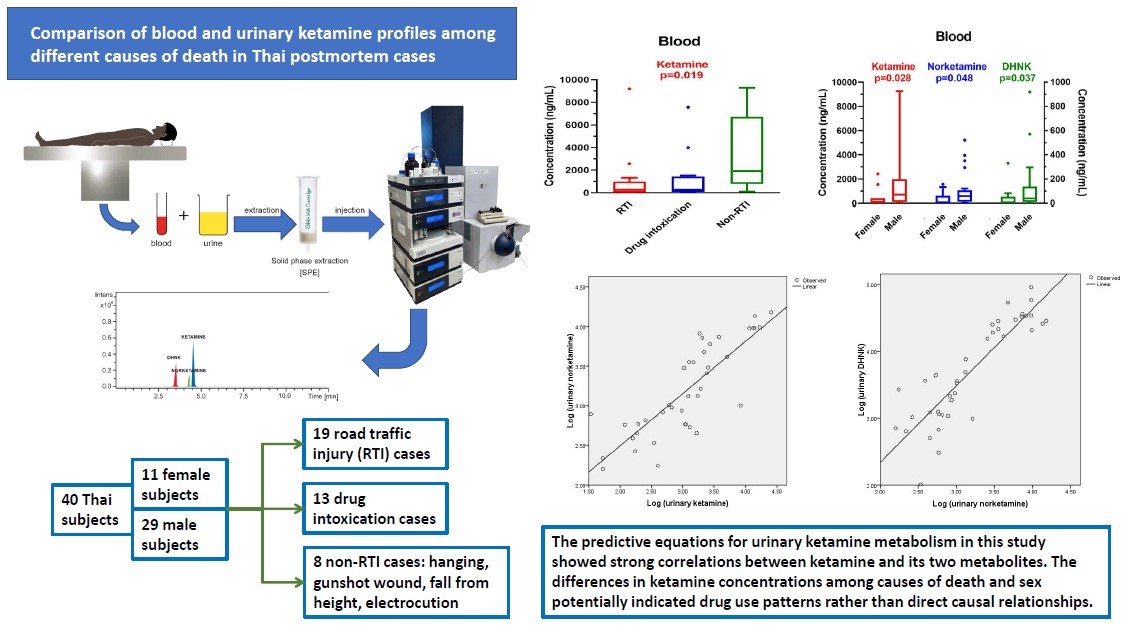
Methods: A cross-sectional study was performed in 40 Thai postmortem cases whose urine samples tested positive for ketamine. Sex, age, cause of death, manner of death, blood alcohol concentration, and concomitant drugs found with ketamine in the subjects were recorded for each case. Blood and urinary ketamine and its two metabolites (norketamine and dehydronorketamine (DHNK)) were analyzed using liquid chromatography quadrupole time-of-flight mass spectrometry. Statistical analysis was performed using the Mann–Whitney U test and Kruskal–Wallis H test.
Results: The study subjects included 11 females and 29 males with a mean age of 29.6 years. The causes of death were classified into three groups, namely the road traffic injury (RTI), drug intoxication, and non-RTI groups. The blood ketamine concentration in the non-RTI group was significantly higher than that in the RTI and drug intoxication groups. The two ketamine metabolite concentrations in the urine samples of the non-RTI group were significantly higher than those in the RTI and drug intoxication groups. Male subjects had significantly higher concentrations of blood ketamine and its metabolites than female subjects. Linear regression curves were established between urinary ketamine and norketamine (Log (urinary norketamine) = 1.175(Log (urinary ketamine)) + 0.659; r2 = 0.684) and between urinary norketamine and DHNK (Log(urinary DHNK) = 0.045(Log(urinary norketamine)) + 1.147; r2 = 0.773).
Conclusion: This study developed predictive equations for ketamine metabolism in urine, demonstrating strong correlations between ketamine and its two metabolites. The differences in the ketamine concentrations among the different causes of death and sex potentially indicate drug use patterns rather than direct causal relationships.
Downloads
References
Gitlin J, Chamadia S, Locascio JJ, Ethridge BR, Pedemonte JC, Hahm EY, et al. Dissociative and analgesic properties of ketamine are independent. Anesthesiology 2020;133:1021-8.
https://doi.org/10.1097/ALN.0000000000003529
Lynam M, Keatley D, Maker G, Coumbaros J. The prevalence of selected licit and illicit drugs in drug facilitated sexual assaults. Forensic Sci Int Synerg 2024;9:100545.
https://doi.org/10.1016/j.fsisyn.2024.100545
Palamar JJ, Salomone A. Trends and correlates of discordant reporting of drug use among nightclub/ festival attendees, 2019-2022. Clin Toxicol (Phila) 2023;61:665-73.
https://doi.org/10.1080/15563650.2023.2273770
Kanato M, Leyatikul P, Wonguppa R. Substance use among Thai teenagers, 2022. ONCB J 2022;39:33-44.
Worasuwannarak W, Sribanditmongkol P, Aramrattana A, Junkuy A, Chaijaruwanich J, Kummaraka U, et al. Trends in substance abuse detection in unnatural deaths in Thailand, 2007-2018. ONCB J 2019;35:44-51.
Schep LJ, Slaughter RJ, Watts M, Mackenzie E, Gee P. The clinical toxicology of ketamine. Clin Toxicol (Phila) 2023;61:415-28.
https://doi.org/10.1080/15563650.2023.2212125
Moore KA, Sklerov J, Levine B, Jacobs AJ. Urine concentrations of ketamine and norketamine following illegal consumption. J Anal Toxicol 2001;25:583-8.
https://doi.org/10.1093/jat/25.7.583
Vivolo-Kantor AM, Mattson CL, Zlotorzynska M. Notes from the field: ketamine detection and involvement in drug overdose deaths - United States, July 2019-June 2023. MMWR Morb Mortal Wkly Rep 2024;73:1010-2.
https://doi.org/10.15585/mmwr.mm7344a4
Scientific Working Group for Forensic Toxicology. Scientific Working Group for Forensic Toxicology (SWGTOX) standard practices for method validation in forensic toxicology. J Anal Toxicol 2013;37:452-74.
https://doi.org/10.1093/jat/bkt054
Chaves TV, Wilffert B, Sanchez ZM. Overdoses and deaths related to the use of ketamine and its analogues: a systematic review. Am J Drug Alcohol Abuse 2023;49:141-50.
https://doi.org/10.1080/00952990.2022.2132506
Corkery JM, Hung WC, Claridge H, Goodair C, Copeland CS, Schifano F. Recreational ketamine-related deaths notified to the National Programme on Substance Abuse Deaths, England, 1997-2019. J Psychopharmacol 2021;35:1324-48.
https://doi.org/10.1177/02698811211021588
Darke S, Duflou J, Farrell M, Peacock A, Lappin J. Characteristics and circumstances of death related to the self-administration of ketamine. Addiction 2021;116:339-45.
https://doi.org/10.1111/add.15154
Cheng WC, Ng KM, Chan KK, Mok VK, Cheung BK. Roadside detection of impairment under the influence of ketamine-evaluation of ketamine impairment symptoms with reference to its concentration in oral fluid and urine. Forensic Sci Int 2007;170:51-8.
https://doi.org/10.1016/j.forsciint.2006.09.001
Wang J, Huang J, Yang S, Cui C, Ye L, Wang SY, et al. Pharmacokinetics and safety of esketamine in Chinese patients undergoing painless gastroscopy in comparison with ketamine: a randomized, open-label clinical study. Drug Des Devel Ther 2019;13:4135-44.
Downloads
Published
How to Cite
Issue
Section
License
Copyright (c) 2025 Chulalongkorn Medical Journal

This work is licensed under a Creative Commons Attribution-NonCommercial-NoDerivatives 4.0 International License.