Pediatric fixed drug eruption: A case report of ofloxacin as the culprit
Keywords:
Annular erythematous lesions, FDE, fixed drug eruption, immune-mediated drug reactions, T-cell activationAbstract
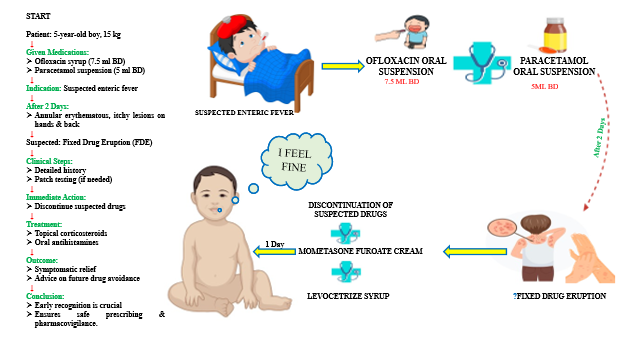
Ofloxacin, a second-generation fluoroquinolone, is a relatively rare but documented cause of fixed drug eruption (FDE). FDE is a localized cutaneous hypersensitivity reaction that is marked by recurrent, welldemarcated erythematous patches or macules, which may develop into blisters upon re-exposure to the offending agent. The underlying mechanism is immune-mediated and involves T-cell activation, cytokine release, and keratinocyte apoptosis. A 5-year-old boy weighing 15 kg was prescribed ofloxacin syrup (7.5 mL twice daily) and paracetamol suspension (5 mL twice daily) for suspected enteric fever. Within 2 days, the patient developed several annular erythematous lesions on his hands and back, which were associated with intense itching, thus raising suspicion of a drug-induced hypersensitivity reaction. Because both medications are potential triggers, a thorough clinical evaluation, including detailed history and, if necessary, patch testing, was considered essential to identify the offending agent. The suspected drug was immediately discontinued, and an alternative antibiotic was selected to manage the infection without intensifying the skin reaction. The management involved symptomatic relief with topical corticosteroids and antihistamines. This case highlights the importance of the early recognition and careful evaluation of adverse cutaneous drug reactions in children. Prompt identification and documentation of such events are critical in ensuring patient safety, guiding future therapy, and enhancing pharmacovigilance practices.
Downloads
References
Satoskar R, Rege N, Bhandarkar S. Pharmacology and pharmacotherapeutics: pharmacology and pharmacotherapeutics. 26th ed. New Delhi, India: Elsevier; 2020.
Hooper DC, Jacoby GA. Mechanisms of drug resistance in the fluoroquinolones. Drug Resist Updat 2016;29:13-25.
Gerber B, Mackenzie D, McIntyre M, Macdonald L, Becker S, LeBlanc A. Ofloxacin: A broad-spectrum fluoroquinolone for treating gram-negative and grampositive bacterial infections. Drugs Ther Perspect2017;33:151 9.
Devereux L, Scott J, Gubbins P, Wilkins R. The pharmacokinetics and pharmacodynamics of ofloxacin. Int J Antimicrob Agents 1999;12:105-9.
Mendes RE, Castanheira M, Deshpande LM, Bell JM, Jones RN. Prevalence and mechanisms of resistance to ofloxacin in Pseudomonas aeruginosa: Implications for therapy. Antimicrob Agents Chemother2007;51:857-61.
Stojanovic J, Vasiljevic Z, Jeremic D. Nephrotoxicity and hematologic toxicity associated with fluoroquinolones: A systematic review. Pharmacol Ther 2022;48:258-66.
Varma AR, Arora SP, Naqvi WM. Case report: Ofloxacin-induced fixed drug eruption. F1000Research 2024;13:181.
https://doi.org/10.12688/f1000research.142368.1
Ramani YR, Mishra SK, Rath B, Rath SS. Ofloxacin induced cutaneous reactions in children. J Clin Diagn Res 2015;9:FD01-2.
https://doi.org/10.7860/JCDR/2015/13829.6137
Sarkar MK, Dey S. A fixed-dose combination of ofloxacin-ornidazole induced fixed drug eruption: A case report. Cureus 2023;15:e35630.
https://doi.org/10.7759/cureus.35630
Rang HP, Dale MM, Ritter JM, Moore PK. Harmful effects of drugs: Pharmacology. Pharmacology. 5th ed. Churchill Livingstone ;2003.
Kamal AFF, Vardhamane SH, Saba A. A case report of ofloxacin induced fixed drug eruptions and hypersensitivity reaction. Int J Basic Clin Pharmacol 2017;6:1825-7.
https://doi.org/10.18203/2319-2003.ijbcp20172756
Torrent Rodríguez A, Font I Barceló A, Barrantes González M, Echeverria Esnal D, Soy Muner D, Martínez JA, et al. Clinically important pharmacokinetic drug-drug interactions with antibacterial agents. Rev Esp Quimioter 2024;37:299-322.
https://doi.org/10.37201/req/037.2024
Ghosh S, Chatterjee M, Majumdar S. Fixed drug eruption: Clinical presentation and review of the literature. J Dermatol 2013;40:859-65.
Finkelstein Y, McMahon M, Jacob S. Fixed drug eruption: Clinical and histopathological findings. Dermatol Online J 2006;1216-25.
Agrawal M, Tiwari M. Fixed drug eruption and its pathophysiology: A review of clinical and molecular features. Int J Dermatol 2020;59:6-13.
Doyon L, Ahmed B, Abdallah M. Fixed drug eruption: A comprehensive review of drug-induced cutaneous lesions. Dermatol Ther 2017;30:19-23.
Jha AK, Kumar S, Singh S. Role of CD8+ T cells in the pathogenesis of Fixed Drug Eruption. Arch Dermatol Res2012;304:373-6.
Kawada A, Hiruma M, Noguchi H, Banba K, Ishibashi A, Banba H, et al. Fixed drug eruption induced by ofloxacin. Contact Dermatitis 1996;34:427.
https://doi.org/10.1111/j.1600-0536.1996.tb02247.x
Manchukonda RS, Ramakrishna M. Ofloxacin/ ornidazole induced fixed drug eruptions: A case report. Int J Basic Clin Pharmacol 2016;5:534-8.
https://doi.org/10.18203/2319-2003.ijbcp20160776
Scherer K, Bircher AJ. Hypersensitivity reactions to fluoroquinolones. Curr Allergy Asthma Rep 2005;5:15-21.
https://doi.org/10.1007/s11882-005-0049-1
Shiohara T. Fixed drug eruption: Pathogenesis and diagnostic tests. Curr Opin Allergy Clin Immunol 2009;9:316-21.
https://doi.org/10.1097/ACI.0b013e32832cda4c
Rerkpattanapipat T, Chiriac AM, Demoly P. Drug provocation tests in hypersensitivity drug reactions. Curr Opin Allergy Clin Immunol 2011;11:299-304.
https://doi.org/10.1097/ACI.0b013e328348a4e9
Jhaj R, Chaudhary D, Asati D, Sadasivam B. Fixeddrug eruptions: What can we learn from a case series? Indian J Dermatol 2018;63:332-7.
https://doi.org/10.4103/ijd.IJD_481_17
Patel TK, Thakkar SH, Sharma D. Cutaneous adverse drug reactions in Indian population: A systematic review. Indian Dermatol Online J 2014;5 Suppl 2:S76-86.
https://doi.org/10.4103/2229-5178.146165
Divya B, Thankachan L. A case presentation on ofloxacin induced dermal hypersensitivity reaction. Int J Pharm Pharm Sci 2022;14:53-6.
https://doi.org/10.22159/ijpps.2022v14i3.43640
Ramineni HB, Eluri P, Vipparla K, Suryadevara V. Ofloxacin induced hypersensitivity reaction. Int J Res Med Sci 2015;3:349-51.
Downloads
Published
How to Cite
Issue
Section
License
Copyright (c) 2025 Chulalongkorn Medical Journal

This work is licensed under a Creative Commons Attribution-NonCommercial-NoDerivatives 4.0 International License.