Noninvasive way for the detection of neonatal jaundice using GBR
Keywords:
Bilirubin, hyperbilirubinemia, image processing, neonatal jaundiceAbstract
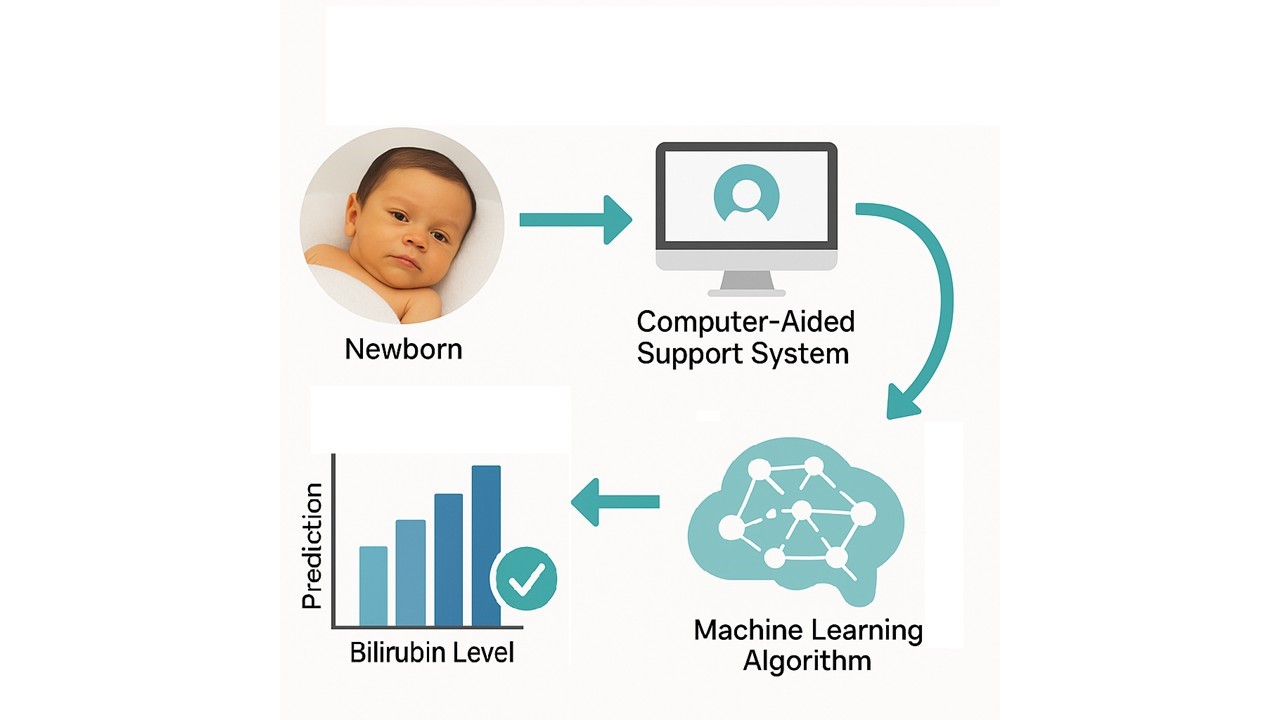
Background: Neonatal jaundice is a common condition in newborns because of excess levels of bilirubin. The traditional method for bilirubin testing is invasive, i.e., only via blood tests, which may cause neonate discomfort. Therefore, this study used machine learning algorithms to develop a noninvasive method to detect neonatal jaundice.
Objective: This study aimed to design a computer-aided support system to detect neonatal jaundice using a machine learning algorithm.
Methods: The gradient boosting regression model was used to predict the bilirubin level. Gradient boosting is a robust boosting algorithm that combines several weak learners into strong learners, in which each new model is trained to minimize a loss function, such as the mean squared error or cross-entropy of the previous model, with gradient descent.
Results: This study involves ensemble methods, which consist of non-linear methods that can improve the system’s overall accuracy. The results revealed a better correlation between the actual and predicted bilirubin levels, with an efficiency (r2) of 0.86.
Conclusion: The hybrid approach for predicting neonate bilirubin levels offers a promising noninvasive alternative to traditional blood tests. While the current model shows a positive correlation with ground truth values, further refinement is required to address the observed discrepancies.
Downloads
References
Abdulrazzak AY, Mohammed SL, Al-Naji A, Chahl J.Real-time jaundice detection in neonates based on machine learning models. BioMedInformatics 2024; 623-37.
https://doi.org/10.3390/biomedinformatics4010034
Abdulrazzak AY, Latif Mohammed S, Al-Naji A, Chahl J. Computer-aid system for automated jaundice detection. J Tech 2023;5:8-15.
https://doi.org/10.51173/jt.v5i1.1128
Sreedha B, Nair PR, Maity R. Non-invasive early diagnosis of jaundice with computer vision. Procedia Comput Sci 2022;218:1321-34.
https://doi.org/10.1016/j.procs.2023.01.111
Anggraeni MD, Fatoni A, Rahmawati E. Nartiningsih I, editors. Estimation of neonatal jaundice from the chest images captured with a smartphone. Proceedings of the Soedirman International Conference on Mathematics and Applied Sciences (SICOMAS 2021); 2022 May 25; Dordrecht, The Netherlands:Atlantis Press; 2022. p. 23-6.
https://doi.org/10.2991/apr.k.220503.005
Juliastuti E, Nadhira V, Satwika YW, Aziz NA. Zahra N, editors. Risk zone estimation of newborn jaundice based on skin color image analysis. 2019 6th International Conference on Instrumentation, Control, and Automation (ICA); 2019 31 July-2 Aug; Bandung, Indonesia: IEEE;2019. p.176-81.
https://doi.org/10.1109/ICA.2019.8916752
Munkholm SB, Krøgholt T, Ebbesen F, Szecsi PB, Kristensen SR. The smartphone camera as a potential method for transcutaneous bilirubin measurement. PLoS One2018;13:e0197938.
https://doi.org/10.1371/journal.pone.0197938
Sohani M, Kermani KK, Makki B, Riazati A, Sadati N, editors. A Neuro-Fuzzy approach to diagnosis of neonatal jaundice. Proceedings of the 1st international conference on Bio inspired models of network, information and computing systems; 2006 Dec 11-13; Cavalese, Italy: Association for Computing Machinery; 2006. p. 16-es.
https://doi.org/10.1109/BIMNICS.2006.361809
Guo G, Wang H, Bell D, Bi Y, Greer K. KNN modelbased approach in classification. Lect Notes Comput Sci 2003;2888:986-96.
https://doi.org/10.1007/978-3-540-39964-3_62
Kumar SA, Bhadri PR, Beyette FR, Clark JF, Wurster W. Non-invasive biomedical system for the quantification of bilirubin in neonates. MWSCAS 2005;2:1778-81.
https://doi.org/10.1109/MWSCAS.2005.1594466
Mansor MN, Yaacob S, Hariharan M, Basah SN, Jamil SHFSA, Khidir MLM, et al. Jaundice in newborn monitoring using color detection method. Procedia Eng 2012;29:1631-5.
https://doi.org/10.1016/j.proeng.2012.01.185
Mansor MN, Hariharan M, Basah SN, Yaacob S. New newborn jaundice monitoring scheme based on combination of pre-processing and color detection method. Neurocomputing 2013;120:258-61.
https://doi.org/10.1016/j.neucom.2012.10.034
Bhutani VK, Zipursky A, Blencowe H, Khanna R, Sgro M, Ebbesen F, et al. Neonatal hyperbilirubinemia and Rhesus disease of the newborn: incidence and impairment estimates for 2010 at regional and global levels. Pediatr Res 2013;74 Suppl 1:86-100
https://doi.org/10.1038/pr.2013.208
Laddi A, Kumar S, Sharma S, Kumar A. Non-invasive jaundice detection using machine vision. IETE J Res 2013;59:591-6.
https://doi.org/10.4103/0377-2063.123765
Aune A, Vartdal G, Jimenez Diaz G, Gierman LM, Bergseng H, Darj E. Iterative development, validation, and certification of a smartphone system to assess neonatal jaundice: Development and usability study. JMIR Pediatr Parent 2023;6:e40463.
de Greef L, Goel M, Seo MJ, Larson EC, Stout JW, Taylor JA, et al. Bilicam: using mobile phones to monitor newborn jaundice. Proceedings of the 2014 ACM International Joint Conference on Pervasive and Ubiquitous Computing. Seattle, Washington: Adjunct Publication; 2014. p. 39-42.
https://doi.org/10.1145/2638728.2638803
Polley N, Saha S, Singh S, Adhikari A, Das S, Choudhury BR, et al. Development and optimization of a noncontact optical device for online monitoring of jaundice in human subjects. J Biomed Opt 2015;20: 067001.
https://doi.org/10.1117/1.JBO.20.6.067001
Singla R, Singh S, editors. A framework for detection of jaundice in new born babies using homomorphic filtering based image processing. 2016 International Conference on Inventive Computation Technologies (ICICT); 2016 Aug 26-27; Coimbatore, India: IEEE; 2016.
https://doi.org/10.1109/INVENTIVE.2016.7830209
Aydın M, Hardalaç F, Ural B, Karap S. Neonatal Jaundice Detection System. J Med Syst 2016;40:166.
https://doi.org/10.1007/s10916-016-0523-4
Azar AT, Inbarani HH, Kumar SU, Own HS. Hybrid system based on bijective soft and neural network for Egyptian neonatal jaundice diagnosis. Int J Intell Eng Inform 2016;4:71-90.
https://doi.org/10.1504/IJIEI.2016.074506
Santhanam R, Uzir N, Raman S, Banerjee S. Experimenting XGBoost algorithm for prediction and classification of different datasets. Int J Control Theory Appl 2016;9:651-62.
Outlaw F, Meek J, MacDonald LW, Leung TS, editors. Screening for Neonatal Jaundice with a Smartphone. Proceedings of the 2017 International Conference on Digital Health; London, United Kingdom: Association for Computing Machinery; 2017. p. 241-2.
https://doi.org/10.1145/3079452.3079488
Brit H, Adendorff J, Huisamen D, Beukes D, Botha K, Herbst H, et al. The prevalence of neonatal jaundice and risk factors in healthy term neonates at National District Hospital in Bloemfontein. Afr J Prim Heal Care Fam Med 2018;10:e1-e6
https://doi.org/10.4102/phcfm.v10i1.1582
Alsaedi SA. Transcutaneous bilirubin measurements can be used to measure bilirubin levels during phototherapy. Int J Pediatr 2018;2018:4856390.
https://doi.org/10.1155/2018/4856390
Kawano S, Zin TT, Kodama Y, editors. A study on noncontact and non-invasive neonatal jaundice detection and bilirubin value prediction. 2018 IEEE 7th Global Conference on Consumer Electronics (GCCE); 2018 Oct 9-12; Nara, Japan: IEEE; 2018. p. 204-5.
https://doi.org/10.1109/GCCE.2018.8574674
Hashim W, Al-Naji A, Al-Rayahi IA, Alkhaled M, Chahl J. Neonatal jaundice detection using a computer vision system. Designs 2021;5:63.
https://doi.org/10.3390/designs5040063
Outlaw F, Nixon M, Odeyemi O, MacDonald LW, Meek J, Leung TS. Smartphone screening for neonatal jaundice via ambient-subtracted sclera chromaticity. PLoS One 2020;15:e0216970.
Downloads
Published
How to Cite
Issue
Section
License
Copyright (c) 2025 Chulalongkorn Medical Journal

This work is licensed under a Creative Commons Attribution-NonCommercial-NoDerivatives 4.0 International License.