Effectiveness of vitamin D3 in facilitating the therapeutic progression of healing diabetic foot ulcers
Keywords:
Metabolic status, vitamin D, vitamin D supplementation, wound healingAbstract
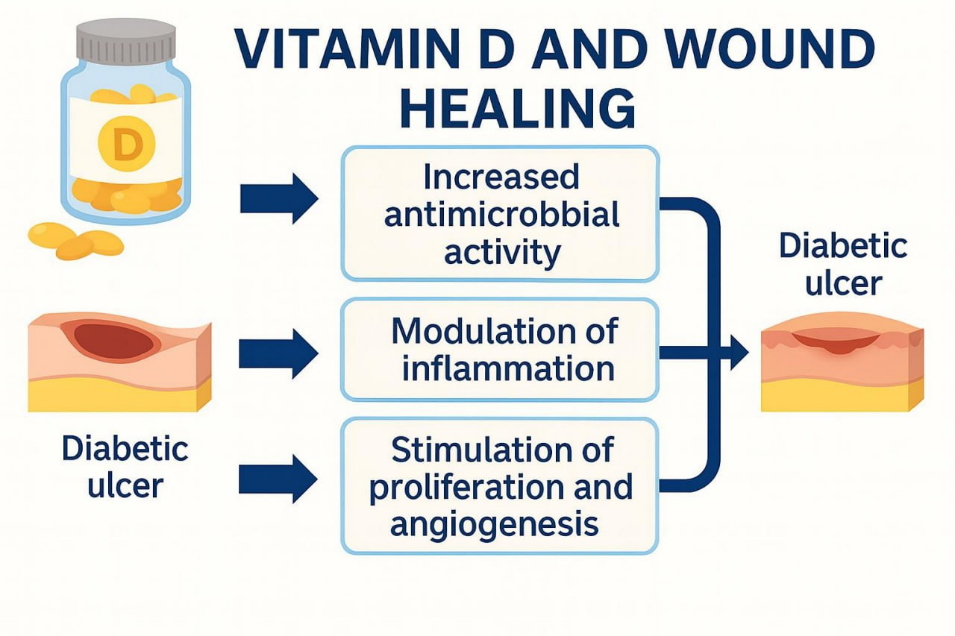
Background: Diabetes and its complications afflict a large portion of the population worldwide, and it is estimated that its prevalence in all age groups will increase from 2.8% in 2000 to 4.4% in 2030. Moreover, it is well known that vitamin D may cause rapid wound healing and exert anti-inflammatory effects.
Objective: This study aimed to investigate the efficacy of vitamin D3 on the healing of chronic diabetic foot ulcers to improve the quality of life of patients with diabetes. The present research is conducted as a randomized controlled trial.
Methods: Forty patients were randomly divided into an experimental group (vitamin D supplementation) and a control group (placebo) using a sampling method based on the inclusion criteria. The patients were evaluated for ulcer debridement every two weeks (0 (T0), 2 (T1), 4 (T2), 6 (T3), 8 (T4), 10 (T5), and 12 (T6)) after the intervention. The collected data were analyzed using SPSS-23 software.
Results: The experimental group exhibited significantly decreased ulcer length (−1.6 ± 0.8 cmvs.−0.5 ± 1.4 cm, P = 0.005), ulcer width (−1.7 ± 1.2 cmvs.−0.9 ± 1.2 cm,P = 0.025), and ulcer depth (−0.6 ± 0.5 cmvs.−0.3 ± 0.4 cm, P = 0.025) after 12 weeks of intervention compared to those of the control group. These results reveal that vitamin D had a significant relationship with all stages of the wound-healing process (P < 0.01).
Conclusions: In patients with chronic diabetic foot ulcers, the use of vitamin D supplementation can improve wound healing. Moreover, vitamin D had a significant relationship with all stages of the wound-healing process except re-epithelialization and angiogenesis.
Downloads
References
Arokiasamy P, Salvi S, Selvamani Y. Global burden of diabetes mellitus. In: Kickbusch I, Ganten D, Moeti M, editors. Handbook of global health. Cham: Springer; 2021. p. 495-538.
https://doi.org/10.1007/978-3-030-45009-0_28
Guerrero CJV, Piraquive MAB, Saboyá ELS, Pedraza JEV, Parra AMH, Álvarez RMAG, et al. The diabetic foot: a review. Int J Collab Res Intern Med Public Health 2020;12:972-7.
Chang M, Nguyen TT. Strategy for treatment of infected diabetic foot ulcers. Acc Chem Res 2021;54: 1080-93.
https://doi.org/10.1021/acs.accounts.0c00864
Pedras S, Vilhena E, Carvalho R, Pereira MG. Quality of life following a lower limb amputation in diabetic patients: a longitudinal and multicenter study. Psychiatry 2020;83:47-57.
https://doi.org/10.1080/00332747.2019.1672438
Røikjer J, Werkman NCC, Ejskjaer N, van den Bergh JPW, Vestergaard P, Schaper NC, et al. Incidence, hospitalization and mortality and their changes over time in people with a first ever diabetic foot ulcer. Diabet Med 2022;39:e14725.
https://doi.org/10.1111/dme.14725
Naemi R, Chockalingam N, Lutale JK, Abbas ZG. Predicting the risk of future diabetic foot ulcer occurrence: a prospective cohort study of patients with diabetes in Tanzania. BMJ open diabetes Res Care 2020;8:e001122.
https://doi.org/10.1136/bmjdrc-2019-001122
Rubio JA, Jiménez S, Lázaro-Martínez JL. Mortality in patients with diabetic foot ulcers: causes, risk factors, and their association with evolution and severity of ulcer. J Clin Med 2020;9:3009.
https://doi.org/10.3390/jcm9093009
Kolarić V, Svirčević V, Bijuk R, Zupančič V. Chronic complications of diabetes and quality of life. Acta Clin Croat 2022;61:520-7.
https://doi.org/10.20471/acc.2022.61.03.18
Alshammary S, Othman SA, Alshammari E, Alarfaj MA, Lardhi HA, Amer NM, et al. Economic impact of diabetic foot ulcers on healthcare in Saudi Arabia: a retrospective study. Ann Saudi Med 2020;40:425-35.
https://doi.org/10.5144/0256-4947.2020.425
Kupisz-Urbańska M, Płudowski P, MarcinowskaSuchowierska E. Vitamin D deficiency in older patients-problems of sarcopenia, drug interactions, management in deficiency. Nutrients 2021;13:1247.
https://doi.org/10.3390/nu13041247
Iqhrammullah M, Duta TF, Alina M, Qanita I, Naufal MA, Henira N, et al. Role of lowered level of serum vitamin D on diabetic foot ulcer and its possible pathomechanism: a systematic review, meta-analysis, and meta-regression. Diabet Epidemiol Manag 2024;13:100175.
https://doi.org/10.1016/j.deman.2023.100175
Wang F, Zhou L, Zhu D, Yang C. A retrospective analysis of the relationship between 25-OH-vitamin D and diabetic foot ulcer. Diabetes Metab Syndr Obes 2022;15:1347-55.
https://doi.org/10.2147/DMSO.S358170
Tang Y, Huang Y, Luo L, Xu M, Deng D, Fang Z, et al. Level of 25-hydroxyvitamin D and vitamin D receptor in diabetic foot ulcer and factor associated with diabetic foot ulcers. Diabetol Metab Syndr 2023;15:30.
https://doi.org/10.1186/s13098-023-01002-3
Rangabashyam SR, Ramalingam K, Nandhini K, Poovarasan M, Kumar P, Balasubramanian A. A prospective study on effect of vitamin-D treatment in diabetic patients with chronic foot ulcer. Int J Pharm Res 2020;12:3014-7.
https://doi.org/10.31838/ijpr/2020.12.03.428
Halschou-Jensen PM, Sauer J, Bouchelouche P, Fabrin J, Brorson S, Ohrt-Nissen S. Improved healing of diabetic foot ulcers after high-dose vitamin D: a randomized double-blinded clinical trial. Int J Low Extrem Wounds 2023;22:466-74.
https://doi.org/10.1177/15347346211020268
L Bishop E, Ismailova A, Dimeloe S, Hewison M, White JH. Vitamin D and immune regulation: antibacterial, antiviral, anti inflammatory. JBMR plus 2020;5:e10405.
https://doi.org/10.1002/jbm4.10405
Mokhtari M, Razzaghi R, Momen Heravi M. The effects of curcumin intake on wound healing and metabolic status in patients with diabetic foot ulcer: a randomized, double blind, placebo controlled trial. Phytotherapy Res 2021;35:2099-107.
https://doi.org/10.1002/ptr.6957
Karamali M, Beihaghi E, Mohammadi AA, Asemi Z. Effects of high-dose vitamin D supplementation on metabolic status and pregnancy outcomes in pregnant women at risk for pre-eclampsia. Horm Metab Res 2015;47:867-72.
https://doi.org/10.1055/s-0035-1548835
Salehpour A, Shidfar F, Hosseinpanah F, Vafa M, Razaghi M, Amiri F. Does vitamin D3 supplementation improve glucose homeostasis in overweight or obese women? A double blind, randomized, placebo controlled clinical trial. Diabet Med 2013;30:1477-81.
https://doi.org/10.1111/dme.12273
Ebadi SA, Sharifi L, Rashidi E, Ebadi SS, Khalili S, Sadeghi S, et al. Supplementation with vitamin D and insulin homeostasis in healthy overweight and obese adults: a randomized clinical trial. Obes Res Clin Pract 2021;15:256-61.
https://doi.org/10.1016/j.orcp.2021.03.004
Aliashrafi S, Ebrahimi-Mameghani M, Jafarabadi MA, Lotfi-Dizaji L, Vaghef-Mehrabany E, Arefhosseini SR. Effect of high-dose vitamin D supplementation in combination with weight loss diet on glucose homeostasis, insulin resistance, and matrix metalloproteinases in obese subjects with vitamin D deficiency: a double-blind, placebo-controlled, randomized clinical trial. Appl Physiol Nutr Metab 2020;45:1092-8.
https://doi.org/10.1139/apnm-2018-0773
Dashti F, Mousavi SM, Larijani B, Esmaillzadeh A. The effects of vitamin D supplementation on inflammatory biomarkers in patients with abnormal glucose homeostasis: a systematic review and meta-analysis of randomized controlled trials. Pharmacol Res 2021;170:105727.
https://doi.org/10.1016/j.phrs.2021.105727
Guo S, Dipietro LA. Factors affecting wound healing. J Dent Res 2010;89:219-29.
https://doi.org/10.1177/0022034509359125
Siregar FD, Hidayat W. The role of vitamin D on the wound healing process: a case series. Int Med Case Rep J 2023:16;227-32.
https://doi.org/10.2147/IMCRJ.S402005
Kurian SJ, Miraj SS, Benson R, Munisamy M, Saravu K, Rodrigues GS, et al. Vitamin D supplementation in diabetic foot ulcers: a current perspective. Cur Diabetes Rev 2021;17:512-21.
Downloads
Published
How to Cite
Issue
Section
License
Copyright (c) 2025 Chulalongkorn Medical Journal

This work is licensed under a Creative Commons Attribution-NonCommercial-NoDerivatives 4.0 International License.