Organs at risk receiving therapeutic doses during prostate cancer treatment using intensity modulated and threedimensional conformal radiotherapies: a comparative study
Keywords:
CT scans, intensity-modulated radiation therapy, organs at risk (OAR) dose, radiotherapy, three-dimensional conformal radiotherapyAbstract
Background: The radiotherapy domain imposes undesired risks of radiation exposure to normal tissues surrounding the tumor. To address this issue, treatment planning systems are being developed to obtain a perfect therapeutic method, as the organs surrounding prostate tumors are sensitive to high doses of radiation.
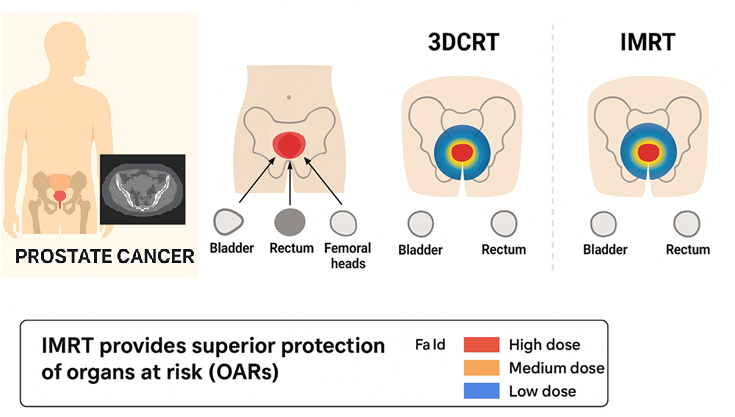
Objective: This study compared the efficiencies of three-dimensional conformal radiotherapy (3DCRT) and intensity-modulated radiation therapy (IMRT) techniques and calculated the radiation dose that actually reaches specific organs in prostate cancer patients.
Methods: This cross-sectional study, from Najaf, Iraq, involved 25 prostate tumor patients who were enrolled for treatment. They underwent computerized tomography (CT) scans, 3D-CRT using X-ray beams, and IMRTs. 3DCRT enhanced protection ability. All doses applied to the organs at risk were within the tolerance limits. An ethical pre-approval was obtained from the Institutional Review Board, No. MEC-87.
Results: IMRT better protected most radiation-sensitive normal tissues, while other organs also require shielding, depending on the patient’s status.
Conclusion: IMRT better protects most normal tissues, i.e., right and left femoral heads, and bladder, while 3DCRT better safeguards other organs, such as the rectum, depending on the patient’s status.
Downloads
References
Khan FM, Sperduto PW, Gibbons JP. Khan's Treatment Planning in Radiation Oncology: Lippincott Williams & Wilkins; 2021.
Lu W, Li Y, Huang W, Cui H, Zhang H, Yi X. Optimizing the region for evaluation of global gamma analysis for nasopharyngeal cancer (NPC) pretreatment IMRT QA by Compass: a retrospective study. Front Oncol 2022;12:859415.
https://doi.org/10.3389/fonc.2022.859415
Yi J, Han C, Zheng X, Zhou Y, Deng Z, Xie C, et al. Individual volume-based 3D gamma indices for pretreatment VMAT QA. J Appl Clin Med Phys 2017; 18:28-36.
https://doi.org/10.1002/acm2.12062
Nguyen NP, Ceizyk M, Vock J, Vos P, Chi A, Vinh-Hung V, et al. Feasibility of image-guided radiotherapy for elderly patients with locally advanced rectal cancer. PLoS One 2013;8:e71250.
https://doi.org/10.1371/journal.pone.0071250
Zhao W, Shen L, Islam MT, Qin, W, Zhang Z, Liang X. Artificial intelligence in image-guided radiotherapy: a review of treatment target localization. Quant Imaging Med Surg 2021;11:4881.
https://doi.org/10.21037/qims-21-199
Mallick S, Rath GK, Benson R. Practical Radiation Oncology: Springer; 2019.
https://doi.org/10.1007/978-981-15-0073-2
Kilpatrick SK, Ecker JL, Obstetricians ACo, Gynecologists. Severe maternal morbidity: screening and review. Am J Obstetrics Gynecol 2016;215: B17-B22.
https://doi.org/10.1016/j.ajog.2016.07.050
Tharmalingam H, Choudhury A, Van Herk M, McWilliam A, Hoskin PJ. New approaches for effective and safe pelvic radiotherapy in high-risk prostate cancer. Nat Rev Urol 2019;16:523-38.
https://doi.org/10.1038/s41585-019-0213-3
Zuppone S, Bresolin A, Spinelli AE, Fallara G, Lucianò R, Scarfò F, Cozzarini C. Pre-clinical research on bladder toxicity after radiotherapy for pelvic cancers: state-ofthe art and challenges. Front Oncol 2020;10:527121.
https://doi.org/10.3389/fonc.2020.527121
Tommasino F, Nahum A, Cella L. Increasing the power of tumour control and normal tissue complication probability modelling in radiotherapy: recent trends and current issues. Transl Cancer Res 2017;6:S807-21.
https://doi.org/10.21037/tcr.2017.06.03
Mir R, Kelly SM, Xiao Y, Moore A, Clark CH, Clementel E, et al. Organ at risk delineation for radiation therapy clinical trials: Global Harmonization Group consensus guidelines. Radiotherapy Oncol 2020;150:30-9.
https://doi.org/10.1016/j.radonc.2020.05.038
Biega³a M, Hydzik A. Analysis of dose distribution in organs at risk in patients with prostate cancer treated with the intensity-modulated radiation therapy and arc technique. J Med Physics/Assoc Med Physicists India 2016;41:198.
https://doi.org/10.4103/0971-6203.189490
Abdulwahid TA, Bakir HA, Alsabari IK. Study the possibility of theoretically reducing the number of radiation sessions for patients with skin cancer using nanoparticles. In AIP Conference Proceedings: AIP Publishing; 2020;2290:1.
https://doi.org/10.1063/5.0027548
Khan FM, Gibbons JP. Khan's the physics of radiation therapy: Lippincott Williams & Wilkins; 2014.
Abdulwahid TA, AlQurashi NAJ, Alsabari IK, Abojassim AA, Jassim AS. Effect of manipulating the radiation treatment technique on the radiotherapy sessions. J Neonatal Surg 2025;14:80-6.
https://doi.org/10.52783/jns.v14.1744
Pardo-Montero J, González-Crespo I, Gómez-Caamaño A, Gago-Arias A. Radiobiological meta-analysis of the response of prostate cancer to different fractionations: evaluation of the linear-quadratic response at large doses and the effect of risk and ADT. Cancers 2023;15:3659.
https://doi.org/10.3390/cancers15143659
Banaei A, Hashemi B, Bakhshandeh M, Mofid B. Evaluation of various common prostate IMRT techniques based on estimated tumor control and normal tissue complication probabilities in correlation with patients anatomical parameters derived from the CT scans. Polish J Med Phys Eng 2019;25:35-41.
https://doi.org/10.2478/pjmpe-2019-0006
Bayley A, Rosewall T, Craig T, Bristow R, Chung P, Gospodarowicz M, et al. Clinical application of highdose, image-guided intensity-modulated radiotherapy in high-risk prostate cancer. Int J Radiat Oncol Biol Phys 2010;77:477-83.
https://doi.org/10.1016/j.ijrobp.2009.05.006
Nagar H, Spratt DE. Prostate SBRT dose escalation (9Gy/ ×/ 5, 13.3 Gy/ ×/ 3, 24 Gy/ ×/ 1): are we making progress? Int J Radiat Oncol Biol Phys 2021;111:110-2.
https://doi.org/10.1016/j.ijrobp.2021.05.013
Diven M, Hakansson A, Liu Y, Davicioni E, Dillard A, Khani F. Dynamic changes of molecular subtype classification and genomic classifier scores in highrisk prostate cancer patients undergoing pre-operative stereotactic body radiation therapy. Int J Radiat Oncol Biol Phys 2023;117:e377.
https://doi.org/10.1016/j.ijrobp.2023.06.2484
Luxton G, Hancock SL, Boyer AL. Dosimetry and radiobiologic model comparison of IMRT and 3D conformal radiotherapy in treatment of carcinoma of the prostate. Int J Radiat Oncol Biol Phys 2004;59:267-84.
https://doi.org/10.1016/j.ijrobp.2004.01.024
Fiandra C, Filippi AR, Catuzzo P, Botticella A, Ciammella P, Franco P, et al. Different IMRT solutions vs. 3Dconformal radiotherapy in early stage Hodgkin's lymphoma: dosimetric comparison and clinical considerations. Radiat Oncol 2012;7:186.
https://doi.org/10.1186/1748-717X-7-186
Arbea L, Ramos LI, Martínez-Monge R, Moreno M, Aristu J. Intensity-modulated radiation therapy (IMRT) vs. 3D conformal radiotherapy (3DCRT) in locally advanced rectal cancer (LARC): dosimetric comparison and clinical implications. Radiat Oncol 2010;5:1-9.
https://doi.org/10.1186/1748-717X-5-17
Mesbahi A, Rasouli N, Mohammadzadeh M. Comparison of radiobiological models for radiation therapy plans of prostate cancer: three-dimensional conformal versus intensity modulated radiation therapy. J Biomed Phys Eng 2019;9:267.
https://doi.org/10.31661/jbpe.v9i3Jun.655
Yu M, Lee JH, Jang HS, Jeon DM, Cheon JS, Lee HC, Lee JH. A comparison of dosimetric parameters between tomotherapy and three-dimensional conformal radiotherapy in rectal cancer. Radiat Oncol 2013;8:181.
https://doi.org/10.1186/1748-717X-8-181
Poncyljusz M, Kukołowicz P, Chorąży J, Czyżew B, Jankowska A, Paciorkiewicz A. Comparison of 3D-CRT and IMRT techniques in radiotherapy for postprostatectomy patients with a higher risk of nodal involvement. Biuletyn Polskiego Towarzystwa Onkologicznego Nowotwory 2016;1:223-7.
https://doi.org/10.5603/NJO.2016.0079
Liu Y, Yu J, Qian L, Zhang H, Ma J. Extended field intensity-modulated radiotherapy plus concurrent nedaplatin treatment in cervical cancer. Oncol Lett 2016;11:3421-7.
https://doi.org/10.3892/ol.2016.4416
Ye L, Wu Xr, Li Km, Bai H, Zheng J, Ai Yq. Effects of bladder status on cervical cancer treatment with intensity modulated radiation therapy plans. Precis Radiat Oncol 2017;1:94-101.
https://doi.org/10.1002/pro6.25
Gonzalez VJ, Hullett CR, Burt L, Rassiah-Szegedi P, Sarkar V, Tward JD, et al. Impact of prone versus supine positioning on small bowel dose with pelvic intensity modulated radiation therapy. Adv Radiat Oncol 2017; 2:235-43.
https://doi.org/10.1016/j.adro.2017.01.005
Wu Y, Zhu B, Han J, Xu H, Gong Z, Yang Y, Lu E. A comparative dosimetric study of cervical cancer patients with para-aortic lymph node metastasis treated with volumetric modulated arc therapy vs. 9-field intensity-modulated radiation therapy. Ann Transl Med 2019;7:675.
https://doi.org/10.21037/atm.2019.10.53
Faye MD, Alfieri J. Advances in radiation oncology for the treatment of cervical cancer. Curr Oncol 2022;29:928-44.
https://doi.org/10.3390/curroncol29020079
Betzel GT, Yi BY, Niu Y, Yu CX. Is RapidArc more susceptible to delivery uncertainties than dynamic IMRT? Med Phys 2012;39:5882-90.
https://doi.org/10.1118/1.4749965
Cakir A, Akgun Z, Fayda M, Agaoglu F. Comparison of three dimensional conformal radiation therapy, intensity modulated radiation therapy and volumetric modulated arc therapy for low radiation exposure of normal tissue in patients with prostate cancer. Asian Pacific J Cancer Prev 2015;16:3365-70.
https://doi.org/10.7314/APJCP.2015.16.8.3365
Foroudi F, Wilson L, Bressel M, Haworth A, Hornby C, Pham D, et al. A dosimetric comparison of 3D conformal vs intensity modulated vs volumetric arc radiation therapy for muscle invasive bladder cancer. Radiat Oncol 2012;7:1-10.
Downloads
Published
How to Cite
Issue
Section
License
Copyright (c) 2025 Chulalongkorn Medical Journal

This work is licensed under a Creative Commons Attribution-NonCommercial-NoDerivatives 4.0 International License.