Impact of G6PD deficiency on liver damage and disease progression in hepatocellular carcinoma: a cross-sectional study in Thailand
Keywords:
G6PD deficiency, HCC, hepatocellular carcinoma, liver damage, peripheral blood G6PD activityAbstract
Background: Glucose 6-phosphate dehydrogenase (G6PD) is a key enzyme involved in the pentose phosphate pathway that produces reduced nicotinamide adenine dinucleotide phosphate to support redox homeostasis and cancer cell proliferation. While G6PD deficiency has been linked to reduced cancer risk, its influence on hepatocellular carcinoma (HCC) remains unclear.
Objectives: This study aimed to investigate the prevalence of G6PD deficiency in patients with HCC and its association with clinical parameters across the disease stages.
Methods:A cross-sectional study analyzed G6PD activity and clinical data from 174 patients with HCC, 100 patients infected with the hepatitis B virus (HBV), and 154 healthy controls. Peripheral blood G6PD activity was measured, and the clinical parameters were compared between patients with early- and advanced-stage HCC with and without G6PD deficiency.
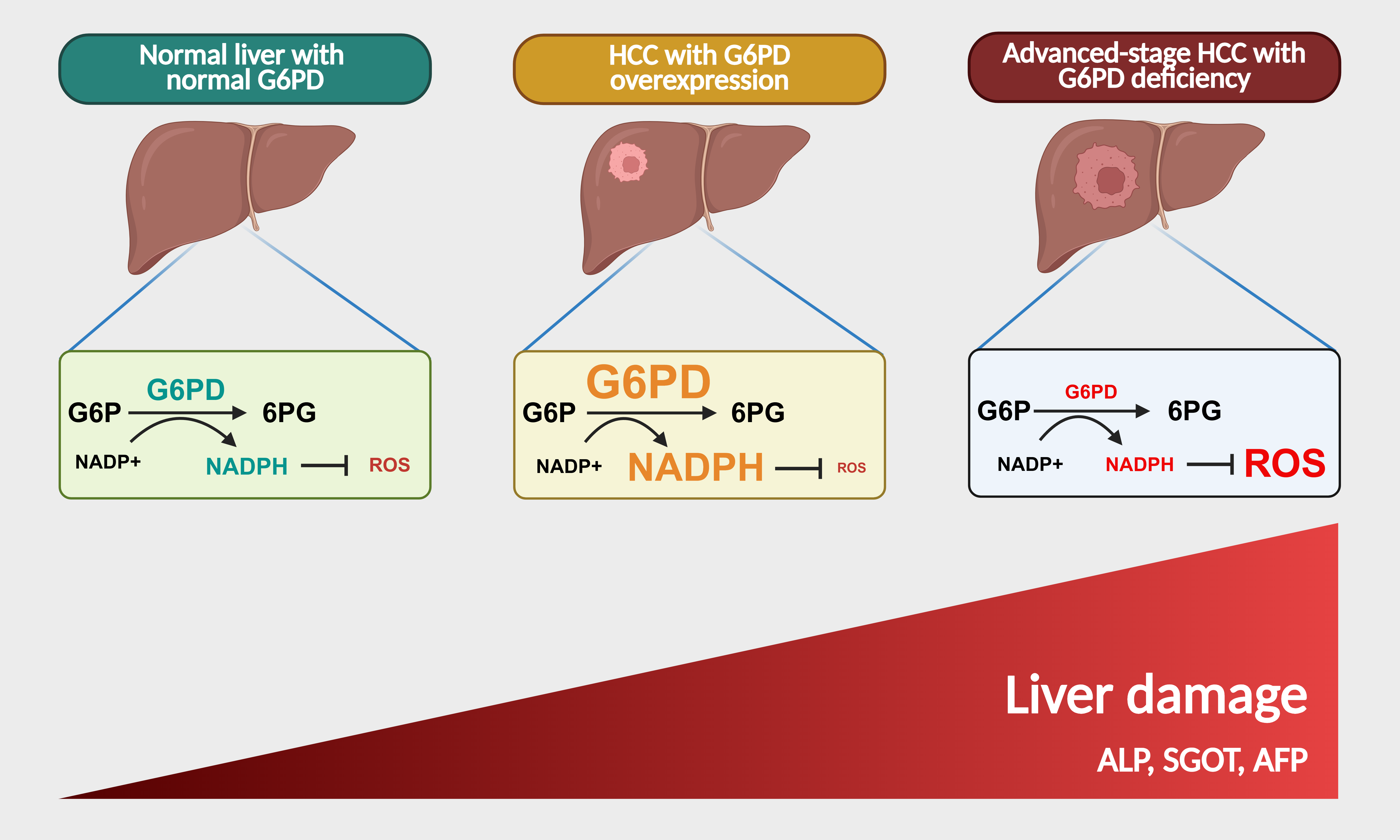
Results: The prevalence of G6PD deficiency was comparable across patients with HCC (6.9%), patients with HBV infection (6.0%), and healthy controls (6.5%) (P = 0.97), with no notable difference in clinical parameters between early- (6.7%) and advanced-stage HCC (7.0%). Median G6PD activity was significantly higher in patients with HCC (7.9 ± 2.1 U/g Hb) compared to healthy controls (7.1 ± 2.5 U/g Hb) (P < 0.05). Patients with advanced-stage HCC exhibited elevated G6PD activity (8.1 ± 2.5 U/g Hb), largely because of anemia. The patients with G6PD deficiency and HCC, particularly at the advanced stage, had elevated liver damage markers, including alkaline phosphatase (125.0 ± 68.8 U/L), serum glutamic-oxaloacetic transaminase (69.5 ± 78.0 U/L), and alpha-fetoprotein (258.8 ± 1,010.1 ng/mL) levels.
Conclusion: G6PD deficiency does not appear to reduce HCC susceptibility but is associated with increased liver damage in patients with HCC at an advanced stage. These findings highlight the potential importance of G6PD in the progression of liver cancer and the need for further research regarding its therapeutic implications.
Downloads
References
Hanahan D, Weinberg RA. Hallmarks of cancer: the next generation. Cell 2011;144:646-74.
https://doi.org/10.1016/j.cell.2011.02.013
Warburg O, Wind F, Negelein E. The Metabolism of tumors in the body. J Gen Physiol 1927;8:519-30.
https://doi.org/10.1085/jgp.8.6.519
Ma X, Wang L, Huang D, Li Y, Yang D, Li T, et al. Pololike kinase 1 coordinates biosynthesis during cell cycle progression by directly activating pentose phosphate pathway. Nat Commun 2017;8:1506.
https://doi.org/10.1038/s41467-017-01647-5
Romero-Garcia S, Lopez-Gonzalez JS, Baez-Viveros JL, Aguilar-Cazares D, Prado-Garcia H. Tumor cell metabolism: an integral view. Cancer Biol Ther 2011;12:939-48.
https://doi.org/10.4161/cbt.12.11.18140
Ahamed A, Hosea R, Wu S, Kasim V. The emerging roles of the metabolic regulator G6PD in human cancers. Int J Mol Sci 2023;24:17238.
https://doi.org/10.3390/ijms242417238
Lan T, Arastu S, Lam J, Kim H, Wang W, Wang S, et al. Glucose-6-phosphate dehydrogenase maintains redox homeostasis and biosynthesis in LKB1-deficient KRAS-driven lung cancer. Nat Commun 2024;15:5857.
https://doi.org/10.1038/s41467-024-50157-8
Hu T, Li YS, Chen B, Chang YF, Liu GC, Hong Y, et al. Elevated glucose-6-phosphate dehydrogenase expression in the cervical cancer cases is associated with the cancerigenic event of high-risk human papillomaviruses. Exp Biol Med (Maywood) 2015;240: 1287-97.
https://doi.org/10.1177/1535370214565971
Ju HQ, Lu YX, Wu QN, Liu J, Zeng ZL, Mo HY, et al. Disrupting G6PD-mediated Redox homeostasis enhances chemosensitivity in colorectal cancer. Oncogene 2017;36:6282-92.
https://doi.org/10.1038/onc.2017.227
Lu M, Lu L, Dong Q, Yu G, Chen J, Qin L, et al. Elevated G6PD expression contributes to migration and invasion of hepatocellular carcinoma cells by inducing epithelialmesenchymal transition. Acta Biochim Biophys Sin (Shanghai) 2018;50:370-80.
https://doi.org/10.1093/abbs/gmy009
Pu H, Zhang Q, Zhao C, Shi L, Wang Y, Wang J, et al. Overexpression of G6PD is associated with high risks of recurrent metastasis and poor progression-free survival in primary breast carcinoma. World J Surg Oncol 2015;13:323.
https://doi.org/10.1186/s12957-015-0733-0
Tsouko E, Khan AS, White MA, Han JJ, Shi Y, Merchant FA, et al. Regulation of the pentose phosphate pathway by an androgen receptor-mTORmediated mechanism and its role in prostate cancer cell growth. Oncogenesis 2014;3:e103.
https://doi.org/10.1038/oncsis.2014.18
Vizan P, Alcarraz-Vizan G, Diaz-Moralli S, Solovjeva ON, Frederiks WM, Cascante M. Modulation of pentose phosphate pathway during cell cycle progression in human colon adenocarcinoma cell line HT29. Int J Cancer 2009;124:2789-96.
https://doi.org/10.1002/ijc.24262
Wang J, Yuan W, Chen Z, Wu S, Chen J, Ge J, et al. Overexpression of G6PD is associated with poor clinical outcome in gastric cancer. Tumour Biol 2012;33:95-101.
https://doi.org/10.1007/s13277-011-0251-9
Wang X, Li X, Zhang X, Fan R, Gu H, Shi Y, et al. Glucose-6-phosphate dehydrogenase expression is correlated with poor clinical prognosis in esophageal squamous cell carcinoma. Eur J Surg Oncol 2015;41: 1293-9.
https://doi.org/10.1016/j.ejso.2015.08.155
Zeng T, Li B, Shu X, Pang J, Wang H, Cai X, et al. Pancancer analysis reveals that G6PD is a prognostic biomarker and therapeutic target for a variety of cancers. Front Oncol 2023;13:1183474.
https://doi.org/10.3389/fonc.2023.1183474
Cappellini MD, Fiorelli G. Glucose-6-phosphate dehydrogenase deficiency. Lancet 2008;371:64-74.
https://doi.org/10.1016/S0140-6736(08)60073-2
Patra KC, Hay N. The pentose phosphate pathway and cancer. Trends Biochem Sci 2014;39:347-54.
https://doi.org/10.1016/j.tibs.2014.06.005
Bancone G, Menard D, Khim N, Kim S, Canier L, Nguong C, et al. Molecular characterization and mapping of glucose-6-phosphate dehydrogenase (G6PD) mutations in the Greater Mekong Subregion. Malar J 2019;18:20.
https://doi.org/10.1186/s12936-019-2652-y
Cocco P, Dessi S, Avataneo G, Picchiri G, Heinemann E. Glucose-6-phosphate dehydrogenase deficiency and cancer in a Sardinian male population: a case-control study. Carcinogenesis 1989;10:813-6.
https://doi.org/10.1093/carcin/10.5.813
Ferraris AM, Broccia G, Meloni T, Forteleoni G, Gaetani GF. Glucose 6-phosphate dehydrogenase deficiency and incidence of hematologic malignancy. Am J Hum Genet 1988;42:516-20.
Pes GM, Errigo A, Soro S, Longo NP, Dore MP. Glucose- 6-phosphate dehydrogenase deficiency reduces susceptibility to cancer of endodermal origin. Acta Oncol. 2019;58:1205-11.
https://doi.org/10.1080/0284186X.2019.1616815
Dore MP, Davoli A, Longo N, Marras G, Pes GM. Glucose-6-phosphate dehydrogenase deficiency and risk of colorectal cancer in Northern Sardinia: a retrospective observational study. Medicine (Baltimore) 2016;95:e5254.
https://doi.org/10.1097/MD.0000000000005254
Pratedrat P, Chuaypen N, Nimsamer P, Payungporn S, Pinjaroen N, Sirichindakul B, et al. Diagnostic and prognostic roles of circulating miRNA-223-3p in hepatitis B virus-related hepatocellular carcinoma. PLoS One 2020;15:e0232211.
https://doi.org/10.1371/journal.pone.0232211
Pimpakan T, Mungkalasut P, Tansakul P, Chanda M, Jugnam-Ang W, Charucharana S, et al. Effect of neonatal reticulocytosis on glucose 6-phosphate dehydrogenase (G6PD) activity and G6PD deficiency detection: a cross-sectional study. BMC Pediatr 2022;22:678.
https://doi.org/10.1186/s12887-022-03740-1
Giannini EG, Farinati F, Ciccarese F, Pecorelli A, Rapaccini GL, Di Marco M, et al. Prognosis of untreated hepatocellular carcinoma. Hepatology 2015;61:184-90.
https://doi.org/10.1002/hep.27443
Qu HR, Wang CQ, Sun SJ, Zhang WW, Liu CH, Du XS, et al. Bioinformatics identification of lactate-associated genes in hepatocellular carcinoma: G6PD's role in immune modulation. Cancer Med 2025;14:e70801.
https://doi.org/10.1002/cam4.70801
Abdullah A, Kumbrink J, Liokatis P, Mock A, Abdullah A, Dewenter I, et al. The role of glucose-6-phosphate dehydrogenase in skin cancer metabolism: a paradigm shift in treatment Approaches. Cancers (Basel) 2024;17:48.
https://doi.org/10.3390/cancers17010048
Moreadith RW, Lehninger AL. Purification, kinetic behavior, and regulation of NAD(P)+ malic enzyme of tumor mitochondria. J Biol Chem 1984;259:6222-7.
https://doi.org/10.1016/S0021-9258(20)82129-2
Riganti C, Gazzano E, Polimeni M, Aldieri E, Ghigo D. The pentose phosphate pathway: an antioxidant defense and a crossroad in tumor cell fate. Free Radic Biol Med. 2012;53:421-36.
https://doi.org/10.1016/j.freeradbiomed.2012.05.006
Ho HY, Cheng ML, Chiu DT. Glucose-6-phosphate dehydrogenase-from oxidative stress to cellular functions and degenerative diseases. Redox Rep 2007;12:109-18.
https://doi.org/10.1179/135100007X200209
Anantasomboon P, Chanda M, Jugnam-Ang W, Witoonpanich P, Cheepsunthorn P, Nuchprayoon I, et al. Evaluating the performance of automated UV enzymatic assay for screening of glucose 6-phosphate dehydrogenase deficiency. Int J Lab Hematol. 2019;41:192-9.
https://doi.org/10.1111/ijlh.12943
Nuchprayoon I, Sanpavat S, Nuchprayoon S. Glucose-6-phosphate dehydrogenase (G6PD) mutations in Thailand: G6PD Viangchan (871G>A) is the most common deficiency variant in the Thai population. Hum Mutat 2002;19:185.
https://doi.org/10.1002/humu.9010
Dore MP, Vidili G, Marras G, Assy S, Pes GM. Inverse Association between glucose 6 phosphate dehydrogenase deficiency and hepatocellular carcinoma. Asian Pac J Cancer Prev 2018;19:1069-73.
Zhang Y, Xu Y, Lu W, Li J, Yu S, Brown EJ, et al. G6PDmediated increase in de novo NADP(+) biosynthesis promotes antioxidant defense and tumor metastasis. Sci Adv 2022;8:eabo0404.
https://doi.org/10.1126/sciadv.abo0404
Mullen NJ, Singh PK. Nucleotide metabolism: a pancancer metabolic dependency. Nat Rev Cancer 2023;23:275-94.
https://doi.org/10.1038/s41568-023-00557-7
Cho ES, Cha YH, Kim HS, Kim NH, Yook JI. The pentose phosphate pathway as a potential target for cancer therapy. Biomol Ther (Seoul) 2018;26:29-38.
https://doi.org/10.4062/biomolther.2017.179
Nakamura M, Nagase K, Yoshimitsu M, Magara T, Nojiri Y, Kato H, et al. Glucose-6-phosphate dehydrogenase correlates with tumor immune activity and programmed death ligand-1 expression in Merkel cell carcinoma. J Immunother Cancer 2020;8:e001679.
Downloads
Published
How to Cite
Issue
Section
License
Copyright (c) 2025 Chulalongkorn Medical Journal

This work is licensed under a Creative Commons Attribution-NonCommercial-NoDerivatives 4.0 International License.