A rare variation in the branching pattern of the axillary artery: a case report
Keywords:
Anatomical variation, arteria profunda brachii, axillary artery, circumflex humeral arteriesAbstract
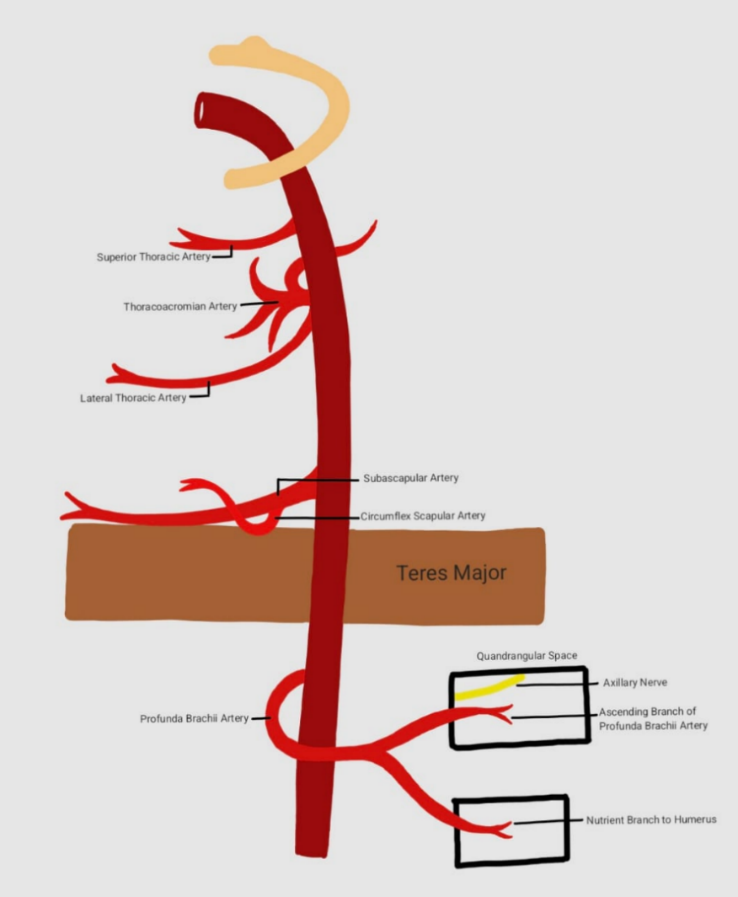
This report presents a rare anatomical variation that was observed during the routine dissection of a male cadaver. The third part of the left axillary artery revealed a complete absence of the anterior and posterior circumflex humeral arteries. An unusual ascending branch originated from the arteria profunda brachii, a branch of the brachial artery. This aberrant branch divided further into a deltoid branch, which accompanied the axillary nerve through the quadrangular space to supply the deltoid muscle and terminated at the shoulder joint, and a nutrient branch, which supplied the head of the humerus. To the best of our knowledge, this variation has not been previously reported. Recognition of such vascular anomalies is important for surgeons, radiologists, and anatomists to prevent intraoperative complications and ensure the accurate interpretation of imaging.
Downloads
References
Standring S. Shoulder girdle and arm. In: Standring S, editor. Gray's Anatomy: The Anatomical Basis of Clinical Practice. 42th ed. London: Churchill Livingstone Elsevier; 2008. p. 920-921.
Datta AK. Essentials of Human Anatomy: Superior and Inferior Extremities. 5th ed. Kolkata: Current Books International; 2017.
Samuel VP, Vollala VR, Nayak S, Rao M, Bolla SR, Pammidi N. A rare variation in the branching pattern of the axillary artery. Indian J Plast Surg 2006;39:222-3.
https://doi.org/10.4103/0970-0358.29559
Huelke DF. Variation in the origins of the branches of the axillary artery. Anat Rec 1959;135:33-41.
https://doi.org/10.1002/ar.1091350105
Patnaik VVG, Kalsey G, Singla Rajan K. Branching pattern of axillary artery-a morphological study. J Anat Soc India 2000;49:127-32.
VijayaBhaskar P, Ritesh R, Shankar PR. Anomalous branching of the axillary artery: a case report. Kathmandu Univ Med J (KUMJ) 2006;4:517-9
Vasudha S, Theresa J, Sampath M, Rajanigandha V, Shruti S. Abnormal branching of the axillary artery: subscapular common trunk. a case report. Int J Morphol 2008;26:963-6.
https://doi.org/10.4067/S0717-95022008000400029
Pellegerini A. Le arteriae subclavia e axillaris nell'uomo studiate col metodo statistico. Arch Ital Anat Embriol 1906;5:205-66.
Ramesh RT, Shetty P, Suresh R. Abnormal branching pattern of the axillary artery and its clinical significance. Int J Morphol 2008;26:389-92.
https://doi.org/10.4067/S0717-95022008000200022
Lee JH, Choi IJ, Kim DK. Variation in the Division of the axillary artery: a case report. Korean J Anat 2009: 69-71
Daimi SR, SiddiquI AU, Wabale RN. Variations in the branching pattern of axillary artery with high origin of radial artery. IJAV 2010;3:76-7.
Wheeless CR, Nunley JA, Urbaniak JR. Wheeless' textbook of orthopaedic. Towson, Maryland: Data Trace Internet; 2016.
Singh V. Development of blood vessels and lymphatic system. In: Singh V, editor. Textbook of clinical embryology.3rd ed. New Delhip: Elsevier; 2022. P. 252- 273.
Hamilton WJ, Mossman HW. Cardiovascular system. In: Schoenwolf GC, Larsen WJ, editors. Larsen's human embryology. 4th ed. Philadelphia: Churchill Livingstone; 2009.
Downloads
Published
How to Cite
Issue
Section
License
Copyright (c) 2025 Chulalongkorn Medical Journal

This work is licensed under a Creative Commons Attribution-NonCommercial-NoDerivatives 4.0 International License.