Etiologies, management, and outcomes of pediatric stroke at a tertiary care center in Thailand
Keywords:
Acute ischemic stroke, cerebral sinus venous thrombosis, hemorrhagic stroke, pediatric strokeAbstract
Background: Recent developments in neuroimaging and treatments, such as thrombolysis and endovascular thrombectomy, have improved pediatric stroke diagnosis and management. However, limited contemporary data exist on stroke characteristics related to the clinical outcomes among Thai children.
Objectives: This study aimed to examine the clinical characteristics, investigations, treatments, and outcomes in pediatric Thai patients with stroke.
Methods: Children aged 28 days to 18 years with “cerebrovascular disease” recorded as the ICD-10 code and inpatient records from January 2011 to September 2022 were enrolled. The outcomes included disability at discharge (modified Rankin scale (mRS) grade 4–5), in-hospital mortality, and 2-year recurrent stroke rate.
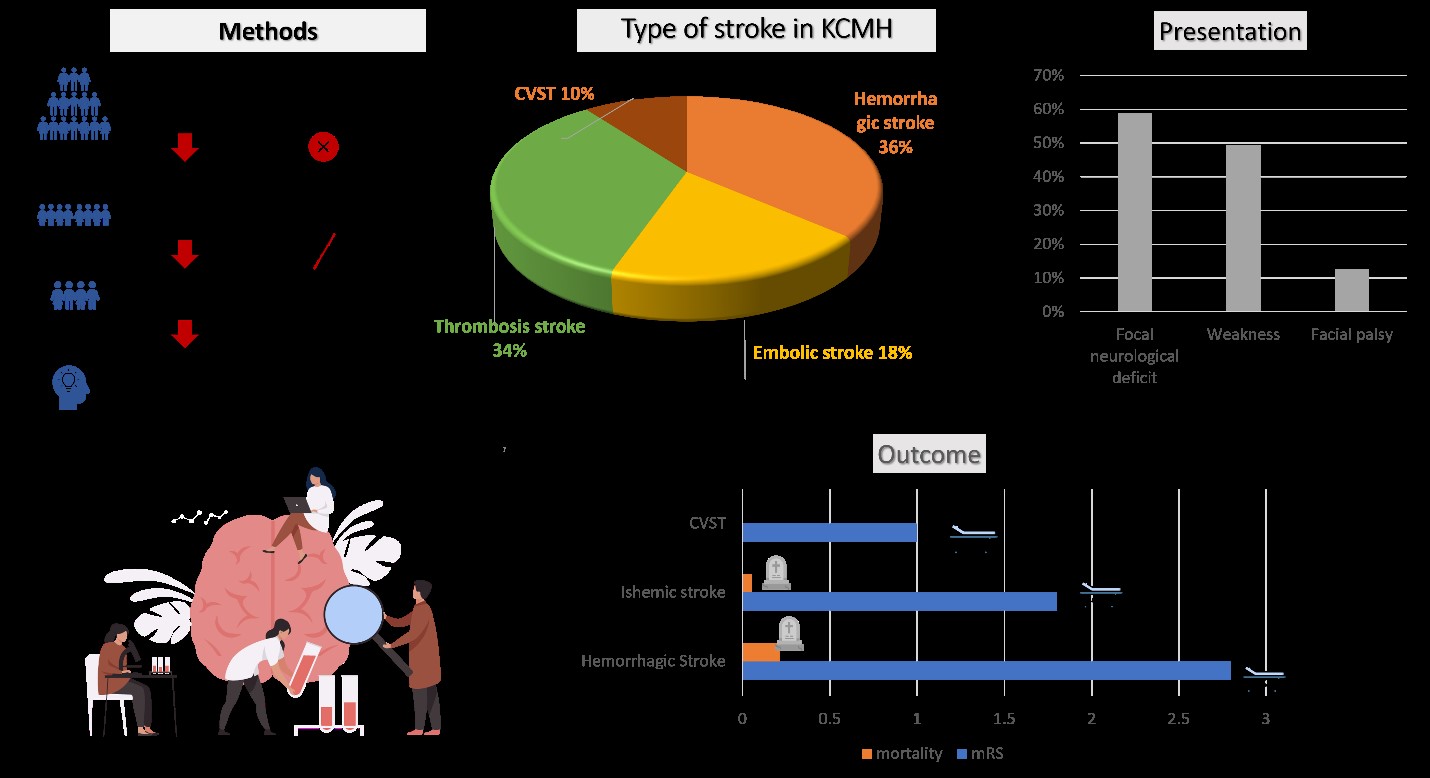
Results: Of the 206 included patients, 53.4% had ischemic stroke, 36.4% had hemorrhagic stroke, and 10.2% had cerebral venous sinus thrombosis. The main presentations were weakness (49.5%), headache (35.4%), and altered consciousness (26.2%). The most prevalent etiologies for each stroke type were moyamoya vasculopathy in acute ischemic stroke, arteriovenous malformation in hemorrhagic stroke, and medicationrelated conditions such as L-asparaginase and oral contraceptive use in cerebral sinus venous thrombosis. Hemorrhagic stroke had the highest mean mRS (2.8 ± 2.2, P < 0.001) and in-hospital mortality (21.3%, P < 0.001). Only one case underwent endovascular thrombectomy.
Conclusion: Pediatric stroke in Thai children presents with diverse etiologies and clinical manifestations, with hemorrhagic stroke exhibiting the highest disability and mortality rates. These findings emphasize the need for targeted research into early diagnostic protocols, risk stratification tools, and the feasibility of advanced interventions such as endovascular thrombectomy in pediatric populations.
Downloads
References
Oleske DM, Cheng X, Jeong A, Arndt TJ. Pediatric acute ischemic stroke by age-group: a systematic review and meta-analysis of published studies and hospitalization records. Neuroepidemiology 2021;55:331-41.
https://doi.org/10.1159/000518281
deVeber GA, Kirton A, Booth FA, Yager JY, Wirrell EC, Wood E, et al. Epidemiology and outcomes of arterial ischemic stroke in children: The canadian pediatric ischemic stroke registry. Pediatr Neurol 2017; 69:58-70.
https://doi.org/10.1016/j.pediatrneurol.2017.01.016
Tuckuviene R, Christensen AL, Helgestad J, Johnsen SP, Kristensen SR. Paediatric arterial ischaemic stroke and cerebral sinovenous thrombosis in Denmark 1994-2006: a nationwide population-based study. Acta Paediatr 2011;100:543-9.
https://doi.org/10.1111/j.1651-2227.2010.02100.x
Hollist M, Au K, Morgan L, Shetty PA, Rane R, Hollist A, et al. Pediatric stroke: overview and recent updates. Aging Dis 2021;12:1043-55.
https://doi.org/10.14336/AD.2021.0219
Fox C. Pediatric ischemic stroke. Continuum (Minneap Minn) 2023;29:566-83.
https://doi.org/10.1212/CON.0000000000001239
Auvichayapat N, Tassniyom S, Hantragool S, Auvichayapat P. The etiology and outcome of cerebrovascular diseases in Northeastern Thai children. J Med Assoc Thai 2007;90:2058-62.
Ferriero DM, Fullerton HJ, Bernard TJ, Billinghurst L, Daniels SR, DeBaun MR, et al. Management of stroke in neonates and children: a scientific statement from the American Heart Association/American Stroke Association. Stroke 2019;50:e51-e96.
https://doi.org/10.1161/STR.0000000000000183
Grinnon ST, Miller K, Marler JR, Lu Y, Stout A, Odenkirchen J, et al. National Institute of Neurological Disorders and Stroke common data element project - approach and methods. Clin Trials 2012;9:322-9.
https://doi.org/10.1177/1740774512438980
Sacco RL, Kasner SE, Broderick JP, Caplan LR, Connors JJ, Culebras A, et al. An updated definition of stroke for the 21st century: a statement for healthcare professionals from the American Heart Association/ American Stroke Association. Stroke 2013;44:2064-89.
https://doi.org/10.1161/STR.0b013e318296aeca
Kim J, Thayabaranathan T, Donnan GA, Howard G, Howard VJ, Rothwell PM, et al. Global Stroke Statistics 2019. Int J Stroke 2020;15:819-38.
https://doi.org/10.1177/1747493020909545
Thayabaranathan T, Kim J, Cadilhac DA, Thrift AG, Donnan GA, Howard G, et al. Global stroke statistics 2022. Int J Stroke 2022;17:946-56.
https://doi.org/10.1177/17474930221123175
George MG. Risk factors for ischemic stroke in younger adults: a focused update. Stroke 2020;51:729-35.
https://doi.org/10.1161/STROKEAHA.119.024156
Chiang KL, Cheng CY. Epidemiology, risk factors and characteristics of pediatric stroke: a nationwide population-based study. QJM 2018;111:445-54.
https://doi.org/10.1093/qjmed/hcy066
Ndondo AP, Hammond CK. Management of pediatric stroke - challenges and perspectives from resourcelimited settings. Semin Pediatr Neurol 2022;44:100996.
https://doi.org/10.1016/j.spen.2022.100996
Chung B, Wong V. Pediatric stroke among Hong Kong Chinese subjects. Pediatrics 2004;114:e206-12.
https://doi.org/10.1542/peds.114.2.e206
Donahue MJ, Dlamini N, Bhatia A, Jordan LC. Neuroimaging advances in pediatric stroke. Stroke 2019;50:240-8.
https://doi.org/10.1161/STROKEAHA.118.020478
Al-Mufti F, Schirmer CM, Starke RM, Chaudhary N, De Leacy R, Tjoumakaris SI, et al. Thrombectomy in special populations: report of the Society of Neurointerventional Surgery Standards and Guidelines Committee. J Neurointerv Surg 2022;14:1033-41.
https://doi.org/10.1136/neurintsurg-2021-017888
Dicpinigaitis AJ, Gandhi CD, Pisapia J, Muh CR, Cooper JB, Tobias M, et al. Endovascular thrombectomy for pediatric acute ischemic stroke. Stroke 2022;53:1530-9.
https://doi.org/10.1161/STROKEAHA.121.036361
Mallick AA, Ganesan V, Kirkham FJ, Fallon P, Hedderly T, McShane T, et al. Childhood arterial ischaemic stroke incidence, presenting features, and risk factors: a prospective population-based study. Lancet Neurol 2014;13:35-43.
https://doi.org/10.1016/S1474-4422(13)70290-4
Kanitkar SA, Kalyan M, Gaikwad AN, Makadia A, Shah H. Limb girdle muscular dystrophy (LGMD): case report. J Clin Diagn Res 2015;9:OD08-9.
https://doi.org/10.7860/JCDR/2015/10107.5486
Felling RJ, Hassanein SMA, Armstrong J, Aversa L, Billinghurst L, Goldenberg NA, et al. Treatment and outcome of childhood cerebral sinovenous thrombosis. Neurol Clin Pract 2020;10:232-44.
https://doi.org/10.1212/CPJ.0000000000000720
Kopyta I, Cebula A, Sarecka-Hujar B. Early deaths after arterial ischemic stroke in pediatric patients: incidence and risk factors. Children (Basel) 2021;8:471.
Downloads
Published
How to Cite
Issue
Section
License
Copyright (c) 2026 Chulalongkorn Medical Journal

This work is licensed under a Creative Commons Attribution-NonCommercial-NoDerivatives 4.0 International License.