Elucidation of hub genes and pathway associated with gut microbiome dysbiosis-linked irritable bowel disease and Alzheimer’s disease via data analytic approaches
Keywords:
Functional gastrointestinal disorders, gut-brain axis, gut dysregulation, inflammatory bowel diseaseAbstract
Background:Recent studies have highlighted the relationship between gut microbiome and Alzheimer’s disease (AD), revealing how gut microbial balance impacts conditions ranging from inflammatory bowel diseases to neurological disorders. The emerging field of the gut-brain axis suggests that the production of microbial metabolites influences AD progression. However, there is limited understanding of molecular mechanisms involved in neurological disease when gut microbiome dysbiosis occurs, especially in irritable bowel disease (IBD).
Objective:This study aimed to identify hub genes and pathways associated with gut microbiome dysbiosis in IBD and AD through data analytics approaches.
Methods:Public gene expression datasets on gut microbiome dysbiosis, and AD were obtained from the GEO and pre-processed for gene symbol annotation. Differentially expressed genes were identified withP< 0.05 and Log2FC≥1. Functional genomics analysis using DAVID (P< 0.05 and FDR < 0.05) was performed.Validated protein-protein interactions for differentially expressed genes (P< 0.05) were integrated into a comprehensive network using GeneMANIA and STRING.
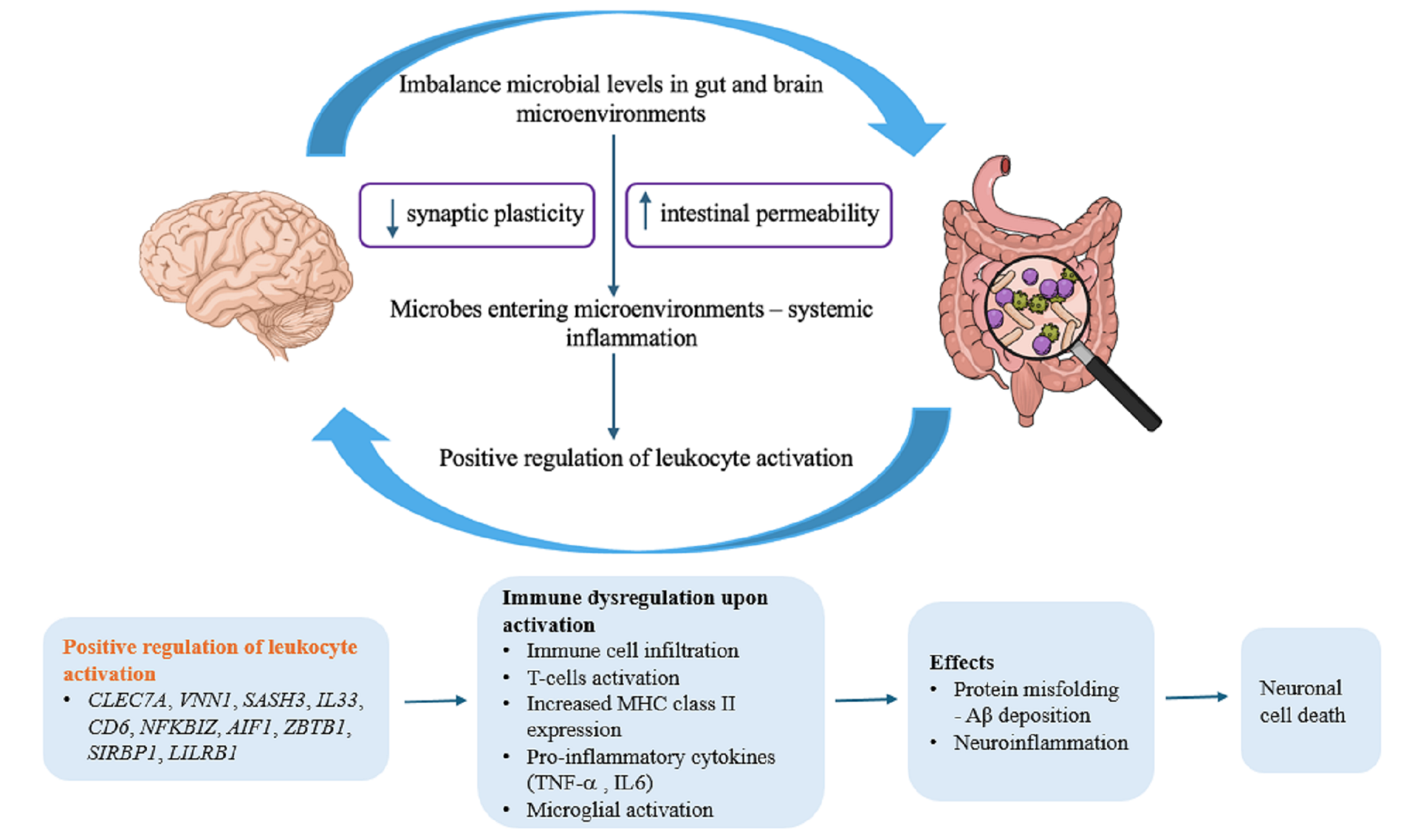
Results:In total, AD and inflammatory bowel disease samples shared 1,715 genes in common. The top 10 common hub genes involved in positive regulation of leukocyte activation (CLEC7A, VNN1, SASH3, IL33,CD6, NFKBIZ, AIF1, ZBTB1, SIRBP1, LILRB1) were selected from the protein-protein interactions based on their top scores.
Conclusion:This study discovered that AD and IBD share hub genes in their pathogenesis mainly through positive regulation of leukocyte activation in the gut-brain axis that involves immune cell trafficking associated with inflammatory activation in IBD and microglia activation in AD, leading to neuroinflammation and neurodegeneration. The finding provides an insight into anti-neuroinflammatory therapeutic development targeting genes and molecular pathways within GBA.
Downloads
References
Obrenovich M, Reddy VP. Special issue: microbiota-gut-brain axis. Microorganisms 2022;10:309.
https://doi.org/10.3390/microorganisms10020309
Williams GM, Tapsell LC, Beck EJ. Gut health, the microbiome and dietary choices: An exploration of consumer perspectives. Nutr Diet 2023; 80:85-94.
https://doi.org/10.1111/1747-0080.12769
Fan Y, Pedersen O. Gut microbiota in human metabolic health and disease. Nat Rev Microbiol 2021;19:55-71.
https://doi.org/10.1038/s41579-020-0433-9
Gomaa EZ. Human gut microbiota/microbiome in health and diseases: a review. Antonie Van Leeuwenhoek 2020;113:2019-40.
https://doi.org/10.1007/s10482-020-01474-7
Black CJ, Drossman DA, Talley NJ, Ruddy J, Ford AC. Functional gastrointestinal disorders: advances in understanding and management. Lancet 2020;396: 1664-74.
https://doi.org/10.1016/S0140-6736(20)32115-2
Wei L, Singh R, Ro S, Ghoshal UC. Gut microbiota dysbiosis in functional gastrointestinal disorders: Underpinning the symptoms and pathophysiology. JGH Open 2021;5:976-87.
https://doi.org/10.1002/jgh3.12528
Navidinia M, Goudarzi M, Seyfi E. The clinical outcomes of gut-brain axis (GBA) microbiota influence on psychiatric disorders. Iran J Microbiol 2023;15:1-9.
https://doi.org/10.18502/ijm.v15i1.11912
Tang W, Zhu H, Feng Y, Guo R, Wan D. The impact of gut microbiota disorders on the blood-brain barrier. Infect Drug Resist 2020;13:3351-63.
https://doi.org/10.2147/IDR.S254403
Friedland RP, Chapman MR. The role of microbial amyloid in neurodegeneration. PLoS Pathog 2017;13: e1006654.
https://doi.org/10.1371/journal.ppat.1006654
Friedland RP, Haribabu B. Neurodegenerative diseases: from gut-brain axis to brain microbiome. Frontiers in Aging Neuroscience. 2023;15:1171955.
https://doi.org/10.3389/fnagi.2023.1171955
Seira Curto J, Surroca Lopez A, Casals Sanchez M, Tic I, Fernandez Gallegos MR, Sanchez de Groot N. Microbiome impact on amyloidogenesis. Front Mol Biosci 2022;9:926702.
https://doi.org/10.3389/fmolb.2022.926702
Patel H, Hodges AK, Curtis C, Lee SH, Troakes C, Dobson RJB, et al. Transcriptomic analysis of probable asymptomatic and symptomatic alzheimer brains. Brain Behav Immun 2019;80:644-56.
https://doi.org/10.1016/j.bbi.2019.05.009
Sood S, Gallagher IJ, Lunnon K, Rullman E, Keohane A, Crossland H, et al. A novel multi-tissue RNA diagnostic of healthy ageing relates to cognitive health status. Genome Biol 2015;16:185.
https://doi.org/10.1186/s13059-015-0750-x
Swan C, Duroudier NP, Campbell E, Zaitoun A, Hastings M, Dukes GE, et al. Identifying and testing candidate genetic polymorphisms in the irritable bowel syndrome (IBS): association with TNFSF15 and TNFα. Gut 2013;62:985-94.
https://doi.org/10.1136/gutjnl-2011-301213
Bjerrum JT, Hansen M, Olsen J, Nielsen OH. Genomewide gene expression analysis of mucosal colonic biopsies and isolated colonocytes suggests a continuous inflammatory state in the lamina propria of patients with quiescent ulcerative colitis. Inflamm Bowel Dis 2010;16:999-1007.
https://doi.org/10.1002/ibd.21142
Wang D, Zhang X, Du H. Inflammatory bowel disease: A potential pathogenic factor of Alzheimer's disease. Prog Neuropsychopharmacol Biol Psychiatry 2022; 119:110610.
https://doi.org/10.1016/j.pnpbp.2022.110610
Chen C, Zhou Y, Wang H, Alam A, Kang SS, Ahn EH, et al. Gut inflammation triggers C/EBPβ/δ secretase dependent gut to brain propagation of Aβ and Tau fibrils in Alzheimer's disease. EMBO J 2021;40:e106320.
https://doi.org/10.15252/embj.2020106320
Funderburg NT, Stubblefield Park SR, Sung HC, Hardy G, Clagett B, Ignatz-Hoover J, et al. Circulating CD4+ and CD8+ T cells are activated in inflammatory bowel disease and are associated with plasma markers of inflammation. Immunology 2013;140:87-97.
https://doi.org/10.1111/imm.12114
Neurath MF. Targeting immune cell circuits and trafficking in inflammatory bowel disease. Nat Immunol 2019;20:970-9.
https://doi.org/10.1038/s41590-019-0415-0
Liu J, Zhang X, Cheng Y, Cao X. Dendritic cell migration in inflammation and immunity. Cell Mol Immunol 2021;18:2461-71.
https://doi.org/10.1038/s41423-021-00726-4
Vesperini D, Montalvo G, Qu B, Lautenschläger F. Characterization of immune cell migration using microfabrication. Biophys Rev 2021;13:185-202.
https://doi.org/10.1007/s12551-021-00787-9
Colonna M, Butovsky O. Microglia function in the central nervous system during health and neurodegeneration. Ann Rev Immunol 2017;35:441-68.
https://doi.org/10.1146/annurev-immunol-051116-052358
Muzio L, Viotti A, Martino G. Microglia in neuroinflammation and neurodegeneration: from understanding to therapy. Front Neurosci 2021;15: 742065.
https://doi.org/10.3389/fnins.2021.742065
Katsel P, Haroutunian V. Is Alzheimer disease a failure of mobilizing immune defense? Lessons from cognitively fit oldest-old. Dialogues Clin Neurosci 2019;21:7-19.
https://doi.org/10.31887/DCNS.2019.21.1/vharoutunian
De Vlieger L, Vandenbroucke RE, Van Hoecke L. Recent insights into viral infections as a trigger and accelerator in alzheimer's disease. Drug Discov Today 2022;27: 103340.
https://doi.org/10.1016/j.drudis.2022.103340
Wisniewski A, Kirchgesner J, Seksik P, Landman C, Bourrier A, Nion-Larmurier I, et al. Increased incidence of systemic serious viral infections in patients with inflammatory bowel disease associates with active disease and use of thiopurines. United European Gastroenterol J 2019;8:303-13.
https://doi.org/10.1177/2050640619889763
Lee SH, Kwon JE, Cho ML. Immunological pathogenesis of inflammatory bowel disease. Intest Res 2018;16:26-42.
https://doi.org/10.5217/ir.2018.16.1.26
Chi H, Chang HY, Sang TK. neuronal cell death mechanisms in major neurodegenerative diseases. Int J Mol Sci 2018;19:3082.
https://doi.org/10.3390/ijms19103082
Kalra RS, Kandimalla R, Bk B. Editorial: Apoptosis, autophagy, and mitophagy dysfunction in Alzheimer's disease: Evolving emergence and mechanisms. Front Mol Neurosci 2022;15:10499.
https://doi.org/10.3389/fnmol.2022.1049914
Nunes T, Bernardazzi C, de Souza HS. Cell death and inflammatory bowel diseases: apoptosis, necrosis, and autophagy in the intestinal epithelium. BioMed Res Int 2014;2014:218493.
https://doi.org/10.1155/2014/218493
McDaniel DK, Eden K, Ringel VM, Allen IC. Emerging roles for noncanonical nf-κb signaling in the modulation of inflammatory bowel disease pathobiology. Inflamm Bowel Dis 2016;22:2265-79.
https://doi.org/10.1097/MIB.0000000000000858
Kasembeli MM, Bharadwaj U, Robinson P, Tweardy DJ. Contribution of STAT3 to inflammatory and fibrotic diseases and prospects for its targeting for treatment. Int J Mol Sci 2018;19:2299.
https://doi.org/10.3390/ijms19082299
Lauretti E, Dincer O, Praticò D. Glycogen synthase kinase-3 signaling in Alzheimer's disease. Biochim Biophys Acta Mol Cell Res 2020;1867:118664.
https://doi.org/10.1016/j.bbamcr.2020.118664
Holter M, Newbern J, Anderson T, Neisewander J, Mehta S. Specific Functions of ERK/MAPK Signaling in Brain Development and Neurocognition. 2019.
Zhang X, Huo C, Liu Y, Su R, Zhao Y, Li Y. Mechanism and disease association with a ubiquitin conjugating E2 enzyme: UBE2L3. Front Immunol 2022;13:793610.
https://doi.org/10.3389/fimmu.2022.793610
Xiao Y, Huang Q, Wu Z, Chen W. Roles of protein ubiquitination in inflammatory bowel disease.Immunobiol 2020;225:152026.
https://doi.org/10.1016/j.imbio.2020.152026
Bukhari Z, Gu L, Nederstigt AE, Cope LJ, Bolhuis DL, Harvey K, et al. Design of linked-domain prot inhibitors of UBE2D as tools to study cellular ubiquitination. bioRxiv [Preprint] 2024; 2024.09.02. 610852.
https://doi.org/10.1101/2024.09.02.610852
Degenhardt F, Mayr G, Wendorff M, Boucher G, Ellinghaus E, Ellinghaus D, et al. Transethnic analysis of the human leukocyte antigen region for ulcerative colitis reveals not only shared but also ethnicityspecific disease associations. Hum Mol Genet 2021;30:356-69.
https://doi.org/10.1093/hmg/ddab017
Griciuc A, Tanzi RE. The role of innate immune genes in Alzheimer's disease. Curr Opin Neurol 2021;34: 228-36.
https://doi.org/10.1097/WCO.0000000000000911
Tam JH, Seah C, Pasternak SH. The Amyloid Precursor Protein is rapidly transported from the Golgi apparatus to the lysosome and where it is processed into betaamyloid. Mol Brain 2014;7:54.
https://doi.org/10.1186/s13041-014-0054-1
Buggia-Prévot V, Thinakaran G. Significance of transcytosis in Alzheimer's disease: BACE1 takes the scenic route to axons. Bioessays 2015;37:888-98.
https://doi.org/10.1002/bies.201500019
Williams ET, Chen X, Otero PA, Moore DJ. Understanding the contributions of VPS35 and the retromer in neurodegenerative disease. Neurobiol Dis 2022;170:105768.
https://doi.org/10.1016/j.nbd.2022.105768
Zhang S, Wu D, Xu Q, You L, Zhu J, Wang J, et al. The protective effect and potential mechanism of NRXN1 on learning and memory in ADHD rat models. Exp Neurol 2021; 344:113806.
https://doi.org/10.1016/j.expneurol.2021.113806
Sinsky J, Pichlerova K, Hanes J. Tau protein interaction partners and their roles in alzheimer's disease and other tauopathies. Int J Mol Sci 2021;22:9207.
https://doi.org/10.3390/ijms22179207
Brunello CA, Merezhko M, Uronen RL, Huttunen HJ. Mechanisms of secretion and spreading of pathological tau protein. Cell Mol Life Sci 2020;77:1721-44.
https://doi.org/10.1007/s00018-019-03349-1
Vahidnezhad H, Youssefian L, Anbardar MH, Zeinali S, Farahani RA, Uitto J. Very-early-onset inflammatory bowel disease in a patient with junctional epidermolysis bullosa with a homozygous mutation in the α6 integrin gene (ITGA6). Inflamm Bowel Dis 2021;27:1865-9.
https://doi.org/10.1093/ibd/izab141
Trzeciak-Jędrzejczyk A, Makosiej R, Kolejwa M, Głowacka E, Czkwianianc E. The role of adhesion molecules in inflammatory bowel disease in children. Assessment of the possible risk of cardiovascular complications. Prz Gastroenterol 2017;12:181-5.
https://doi.org/10.5114/pg.2017.70480
Kang Y, Park H, Choe BH, Kang B. The Role and Function of Mucins and Its Relationship to Inflammatory Bowel Disease. Front Med (Lausanne) 2022;9:848344.
https://doi.org/10.3389/fmed.2022.848344
Verna G, De Santis S, Islam BN, Sommella EM, Licastro D, Zhang L, et al. A missense mutation in Muc2 promotes gut microbiome- and metabolome-dependent colitis-associated tumorigenesis. J Clin Invest 2025;136:e196712.
https://doi.org/10.1172/JCI196712
Lee EG, Tulloch J, Chen S, Leong L, Saxton AD, Kraemer B, et al. Redefining transcriptional regulation of the APOE gene and its association with Alzheimer's disease. Taguchi Y-h, editor. PLoS One 2020;15: e0227667.
https://doi.org/10.1371/journal.pone.0227667
Liang T, Wu Z, Li J, Wu S, Shi W, Wang L. The emerging double-edged sword role of exosomes in Alzheimer's disease. Front Aging Neurosci 2023;15:1209115.
https://doi.org/10.3389/fnagi.2023.1209115
Panwar S, Sharma S, Tripathi P. Role of barrier integrity and dysfunctions in maintaining the healthy gut and their health outcomes. Front Physiol 2021;12:715611.
https://doi.org/10.3389/fphys.2021.715611
Eshleman EM, Shao TY, Woo V, Rice T, Engleman L, Didriksen BJ, et al. Intestinal epithelial HDAC3 and MHC class II coordinate microbiota-specific immunity. J Clin Invest 2023;133:e162190.
https://doi.org/10.1172/JCI162190
Hegazy AN, West NR, Stubbington MJT, Wendt E, Suijker KIM, Datsi A, et al. Circulating and tissueresident CD4 + T cells with reactivity to intestinal microbiota are abundant in healthy individuals and function is altered during inflammation. Gastroenterology 2017;153:1320-37.
https://doi.org/10.1053/j.gastro.2017.07.047
Zhan Y, Murad Al-Nusaif, Ding C, Li Z, Dong C. The potential of the gut microbiome for identifying Alzheimer's disease diagnostic biomarkers and future therapies. Front Neurosci 2023;17:1130730.
https://doi.org/10.3389/fnins.2023.1130730
Cattaneo A, Cattane N, Galluzzi S, Provasi S, Lopizzo N, Festari C, et al. Association of brain amyloidosis with pro-inflammatory gut bacterial taxa and peripheral inflammation markers in cognitively impaired elderly. Neurobiol Aging 2017;49:60-8.
https://doi.org/10.1016/j.neurobiolaging.2016.08.019
Luczynski P, McVey Neufeld KA, Oriach CS, Clarke G, Dinan TG, Cryan JF. Growing up in a bubble: using germ-free animals to assess the influence of the gut microbiota on brain and behavior. Int J Neuropsychopharmacol 2016;19:pyw020.
https://doi.org/10.1093/ijnp/pyw020
Sun Y, Sommerville NR, Liu JYH, Ngan MP, Poon D, Ponomarev ED, et al. Intra gastrointestinal amyloid β1-42. oligomers perturb enteric function and induce Alzheimer's disease pathology. J Physiol 2020;598: 4209-23.
https://doi.org/10.1113/JP279919
Wang WY, Tan MS, Yu JT, Tan L. Role of proinflammatory cytokines released from microglia in Alzheimer's disease. Ann Transl Med 2015;3:136.
Lu Q, Yang MF, Liang YJ, Xu J, Xu HM, Nie YQ, et al. Immunology of Inflammatory Bowel Disease: Molecular Mechanisms and Therapeutics. J Inflamm Res 2022; 15:1825-44.
https://doi.org/10.2147/JIR.S353038
Lloyd-Price J, Arze C, Ananthakrishnan AN, Schirmer M, Avila-Pacheco J, Poon TW, et al. Multi-omics of the gut microbial ecosystem in inflammatory bowel diseases. Nature. 2019;569:655-62.
https://doi.org/10.1038/s41586-019-1237-9
Swer NM, Venkidesh BS, Murali TS, Mumbrekar KD. Gut microbiota-derived metabolites and their importance in neurological disorders. Mol Biol Rep 2023;50:1663-75.
https://doi.org/10.1007/s11033-022-08038-0
Pereira A, Gutiérrez-Cózar R, Suarez B, et al. Experimental and genetic evidence for the impact of CD5 and CD6 expression and variation in inflammatory bowel disease. Front Immunol 2022;13:966184.
https://doi.org/10.3389/fimmu.2022.966184
Park SC, Jeen YT. Genetic studies of inflammatory bowel disease-focusing on Asian patients. Cells 2019;8:404.
https://doi.org/10.3390/cells8050404
Kurimoto M, Watanabe T, Kamata K, Minaga K, Kudo M. IL-33 as a critical cytokine for inflammation and fibrosis in inflammatory bowel diseases and pancreatitis. Front Physiol 2021;12:781012.
https://doi.org/10.3389/fphys.2021.781012
Kinney JW, Bemiller SM, Murtishaw AS, Leisgang AM, Salazar AM, Lamb BT. Inflammation as a central mechanism in Alzheimer's disease. Alzheimers Dement (N Y) 2018;4:575-90.
https://doi.org/10.1016/j.trci.2018.06.014
Murphy EP, Crean D. NR4A1-3 nuclear receptor activity and immune cell dysregulation in rheumatic diseases. Front Med (Lausanne) 2022;9:874182.
https://doi.org/10.3389/fmed.2022.874182
Farr L, Ghosh S, Moonah S. Role of MIF Cytokine/ CD74 receptor pathway in protecting against injury and promoting repair. Front Immunol 2020;11:1273.
https://doi.org/10.3389/fimmu.2020.01273
Chen R, Wang X, Dai Z, Wang Z, Wu W, Hu Z, et al. TNFSF13 is a novel onco-inflammatory marker and correlates with immune infiltration in gliomas. Front Immunol 2021;12:713757.
https://doi.org/10.3389/fimmu.2021.713757
Wang F, Liang Y, Wang QW. Interpretable machine learning-driven biomarker identification and validation for Alzheimer's disease. Sci Rep 2024;14:30770.
https://doi.org/10.1038/s41598-024-80401-6
Wang MH, Friton JJ, Raffals LE, Leighton JA, Pasha SF, Picco MF, et al. Novel genetic risk variants can predict anti-tnf agent response in patients with inflammatory bowel disease. J Crohns Colitis 2019; 13:1036-43.
https://doi.org/10.1093/ecco-jcc/jjz017
Papoutsopoulou S, Burkitt MD, Bergey F, England H, Hough R, Schmidt L, et al. Macrophage-specific NF- κB activation dynamics can segregate inflammatory bowel disease patients. Front Immunol 2019;10:2168.
https://doi.org/10.3389/fimmu.2019.02168
Sun E, Motolani A, Campos L, Lu T. The pivotal role of NF-kB in the pathogenesis and therapeutics of alzheimer's disease. Int J Mol Sci.2022;23:8972.
https://doi.org/10.3390/ijms23168972
Guo L, Li X, Gould T, Wang ZY, Cao W. T cell aging and Alzheimer's disease. Front Immunol 2023;14: 1154699.
https://doi.org/10.3389/fimmu.2023.1154699
Oflazoglu E, Grewal IS, Gerber H. Targeting CD30/ CD30L in oncology and autoimmune and inflammatory diseases. Adv Exp Med Biol 2009;647:174-85.
https://doi.org/10.1007/978-0-387-89520-8_12
Mei C, Wang X, Meng F, Zhang X, Gan L, Wang Y, et al. CD30L+ classical monocytes play a pro-inflammatory role in the development of ulcerative colitis in patients. Mol Immunol 2021;138:10-9.
https://doi.org/10.1016/j.molimm.2021.06.016
Pero R, Lembo F, Palmieri EA, Vitiello C, Fedele M, Fusco A, et al. PATZ Attenuates the RNF4-mediated enhancement of androgen receptor-dependent transcription. J Biol Chem 2002;277:3280-5.
https://doi.org/10.1074/jbc.M109491200
Lei Y, Renyuan Z. Effects of androgens on the amyloid-β protein in alzheimer's disease. Endocrinology 2018;159:3885-94.
https://doi.org/10.1210/en.2018-00660
Traish A, Bolanos J, Nair S, Saad F, Morgentaler A. Do androgens modulate the pathophysiological pathways of inflammation? Appraising the contemporary evidence. J Clin Med 2018;7:549.
https://doi.org/10.3390/jcm7120549
Jacenik D, Fichna J, Małecka-Wojciesko E, Mokrowiecka A. Protease-activated receptors - key regulators of inflammatory bowel diseases progression. J Inflamm Res 2021;14:7487-97.
https://doi.org/10.2147/JIR.S335502
Berson E, Frye BM, Perna A, Phongpreecha T, Shome S, Clarke G, et al. Effects of mediterranean vs. western diets on the cerebral cortical pre synaptic proteome in nonhuman primates. Alzheimers Dement. 2025;20 Suppl1:e089274.
https://doi.org/10.1002/alz.089274
Praest P, Luteijn RD, Brak-Boer IGJ, Lanfermeijer J,Hoelen H, Ijgosse L, et al. The influence of TAP1 and TAP2 gene polymorphisms on TAP function and itsinhibition by viral immune evasion proteins. Mol Immunol 2018;101:55-64.
https://doi.org/10.1016/j.molimm.2018.05.025
Yu Y, Chen M, Zhu H, Zhuo MX, Chen P, Mao Y, et al. STAT1 epigenetically regulates LCP2 and TNFAIP2 by recruiting EP300 to contribute to the pathogenesis of inflammatory bowel disease. Clin Epigenetics 2021;13:127.
https://doi.org/10.1186/s13148-021-01101-w
Wang Z, Peng M. A novel prognostic biomarker LCP2 correlates with metastatic melanoma infiltrating CD8+ T cells. Sci Rep 2021;11:9164.
https://doi.org/10.1038/s41598-021-88676-9
Stojanovic M, Wu Z, Stiles CE, Miljic D, Soldatovic I, Pekic S, et al. Circulating aryl hydrocarbon receptorinteracting protein (AIP) is independent of GH secretion. Endocr Connect 2019;8:326-37.
https://doi.org/10.1530/EC-19-0082
Bungsu I, Kifli N, Ahmad SR, Ghani H, Cunningham AC. Herbal plants: the role of AhR in mediating immunomodulation. Front Immunol 2021;12:697663.
https://doi.org/10.3389/fimmu.2021.697663
Salminen A. Activation of aryl hydrocarbon receptor (AhR) in Alzheimer's disease: role of tryptophan metabolites generated by gut host-microbiota. J Mol Med (Berl) 2023;101:201-22.
https://doi.org/10.1007/s00109-023-02289-5
Liang T, Zhang Y, Wu S, Chen Q, Wang L. The role of NLRP3 inflammasome in Alzheimer's disease and potential therapeutic targets. Front Pharmacol 2022;13:845185.
https://doi.org/10.3389/fphar.2022.845185
Zhen Y, Zhang H. NLRP3 inflammasome and inflammatory bowel disease. Front Immunol 2019; 10:276.
Downloads
Published
How to Cite
Issue
Section
License
Copyright (c) 2026 Chulalongkorn Medical Journal

This work is licensed under a Creative Commons Attribution-NonCommercial-NoDerivatives 4.0 International License.