Emotional intelligence: The road to the development of professionalism
Keywords:
Emotional intelligence, medical professional development, medical professionalism, professional identity formation, professionalismAbstract
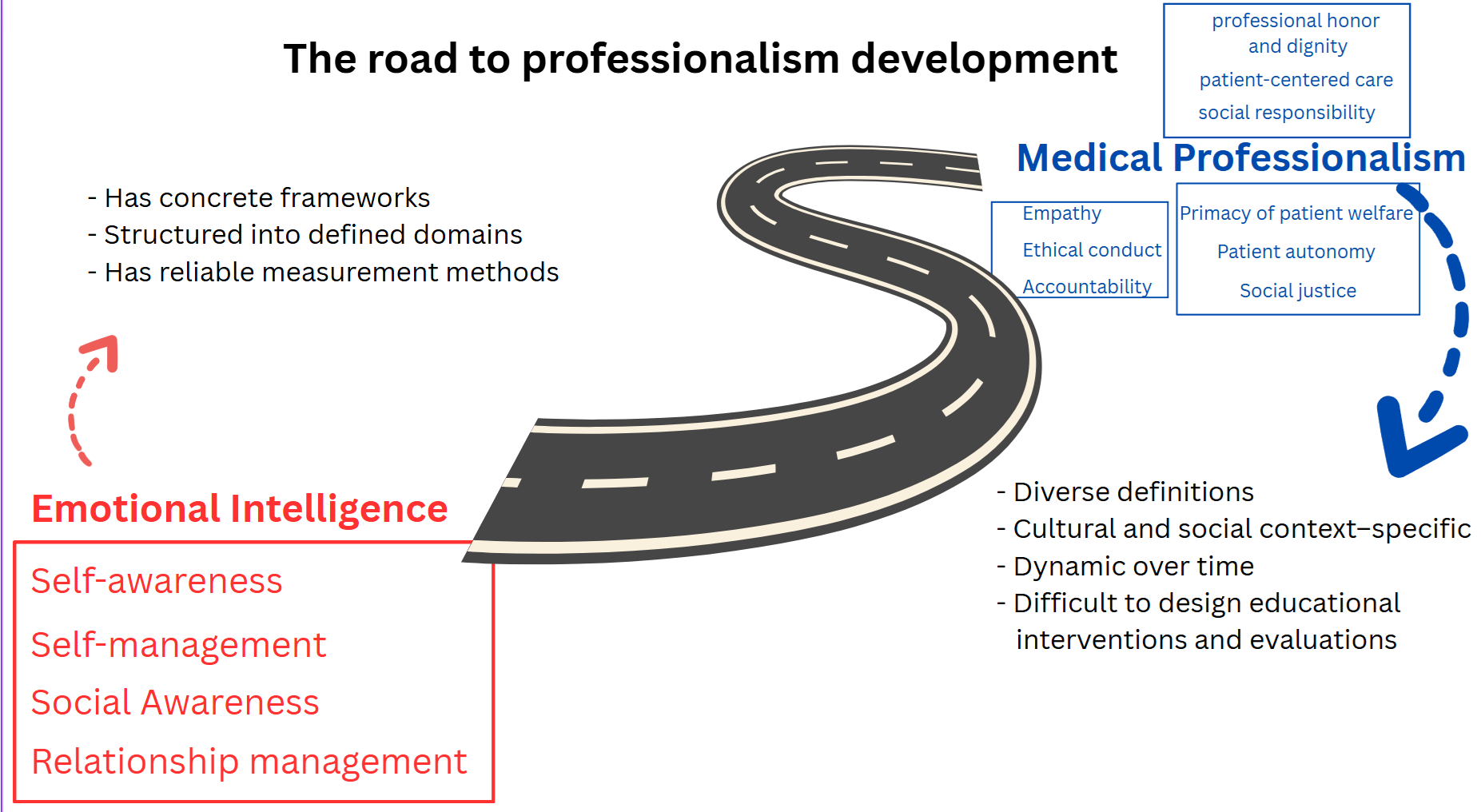
The development of medical professionalism poses a considerable challenge in medical education, eventhough it is essential for medical practitioners. The dynamics and ambiguity of medical professionalism cause difficulty in setting specific learning objectives, creating validated assessment methods, and designing effective teaching methodologies. Meanwhile, emotional intelligence is an expanding area of study in medical education. There is a substantial connection between medical professionalism and emotional intelligence,and certain attributes of emotional intelligence contribute to the development of professionalism. Numerousreports have illustrated emotional intelligence development and assessment in health professions education,and thus, emotional intelligence is potentially a path to developing medical professionalism.
Downloads
References
Cruess RL, Cruess SR, Boudreau JD, Snell L, Steinert Y. Reframing medical education to support professional identity formation. Acad Med 2014;89:1446-51.
https://doi.org/10.1097/ACM.0000000000000427
Mount GR, Kahlke R, Melton J, Varpio L. A critical review of professional identity formation interventions in medical education. Acad Med 2022;97:S96-S106.
https://doi.org/10.1097/ACM.0000000000004904
McNulty JP, Politis Y. Empathy, emotional intelligence and interprofessional skills in healthcare education. J Med Imaging Radiat Sci 2023;54:238-46.
https://doi.org/10.1016/j.jmir.2023.02.014
Akter S, Salam MM, Yousuf R, Al-Mahmood AK, Salam A. Ethical principles in medicine: a deeper reflection on autonomy, beneficence, nonmaleficence, andj in current medical practice. Int J Hum Health Sci 2025;9:834.
https://doi.org/10.31344/ijhhs.v9i3.834
ABIM Foundation; ACP-ASIM Foundation; European Federation of Internal Medicine. Medical professionalism in the new millennium: a physician charter. Ann Intern Med 2002;136:243-6.
https://doi.org/10.7326/0003-4819-136-3-200202050-00012
Thai Medical Council. Professional standards for medical practitioners 2012. Nonthaburi: Thai Medical Council; 2012.
Birden H, Glass N, Wilson I, Harrison M, Usherwood T, Nass D. Teaching professionalism in medical education: a Best Evidence Medical Education (BEME) systematic review. Med Teach 2013;35:e1252-66.
https://doi.org/10.3109/0142159X.2013.789132
Krishna LKR, Kwok HYF, Ravindran N, Tan XY, Soh J, Wan DWJ, et al. A systematic scoping review of mentoring support on professional identity formation. BMC Med Educ 2024;24:1380.
https://doi.org/10.1186/s12909-024-06357-3
Brown MEL, Coker O, Heybourne A, Finn GM. Exploring the hidden curriculum's impact on medical students: professionalism, identity formation and the need for transparency. Med Sci Educ 2020;30:1107-21.
https://doi.org/10.1007/s40670-020-01021-z
Lewin LO, McManamon A, Stein MTO, Chen DT. Minding the form that transforms: using Kegan's model of adult development to understand personal and professional identity formation in medicine. Acad Med 2019;94:1299-304.
https://doi.org/10.1097/ACM.0000000000002741
Kiyan Tsunami C, Henríquez-Trujillo AR, FerreiraMeyers K, Mwanda Z, Rimal J, Pozu-Franco J, et al. Guidelines for integrating actionable A-SMART learning outcomes into the backward design process. MedEdPublish (2016). 2024;14:242.
https://doi.org/10.12688/mep.20606.1
Chatterjee D, Corral J. How to write well-defined learning objectives. J Educ Perioper Med 2017;19:E610.
https://doi.org/10.46374/volxix-issue4-chatterjee
Quinn, JF, White BAA. Cultivating leadership in medicine. Preliminary ed. Dubuque, IA: Kendall Hunt Publishing; 2019.
Salovey P, Mayer JD. Emotional intelligence. Imagin Cogn Pers 1990;9:185-211.
https://doi.org/10.2190/DUGG-P24E-52WK-6CDG
Wu M, Xu W, Yao Y, Zhang L, Guo L, Fan J, et al. Mental health status of students' parents during COVID-19 pandemic and its influence factors. Gen Psychiatr. 2020;33:e100250.
https://doi.org/10.1136/gpsych-2020-100250
Rueda P, Pérez-Romero N, Victoria Cerezo M, Fernández-Berroca P. The role of emotional intelligence in adolescent bullying: a systematic review. Psicol Educ 2021;28:53-9.
https://doi.org/10.5093/psed2021a29
Cherry MG, Fletcher I, O'Sullivan H, Dornan T. Emotional intelligence in medical education: a critical review. Med Educ 2014;48:468-78.
https://doi.org/10.1111/medu.12406
Toriello HV, Van de Ridder JMM, Brewer P, Mavis B, Allen R, Arvidson C, et al. Emotional intelligence in undergraduate medical students: a scoping review. Adv Health Sci Educ Theory Pract 2022;27:167-87.
https://doi.org/10.1007/s10459-021-10079-2
Papathanasiou IV, Fradelos EC, Nikolaou E, Tsaras K, Kontopoulou L, Malli F. Emotional intelligence and professional boredom among nursing personnel in Greece. J Pers Med 2021;11:750.
https://doi.org/10.3390/jpm11080750
Shi M, Du T. Associations of emotional intelligence and gratitude with empathy in medical students. BMC Med Educ 2020;20:116.
Downloads
Published
How to Cite
Issue
Section
License
Copyright (c) 2026 Chulalongkorn Medical Journal

This work is licensed under a Creative Commons Attribution-NonCommercial-NoDerivatives 4.0 International License.