Sequential presentation of diabetic ketoacidosis, acute ischemic stroke, and ST-elevation in myocardial infarction: a case report
Keywords:
Brain ischemia, cardio-cerebral infarction, critical care, diabetic ketoacidosis, myocardial infarctionAbstract
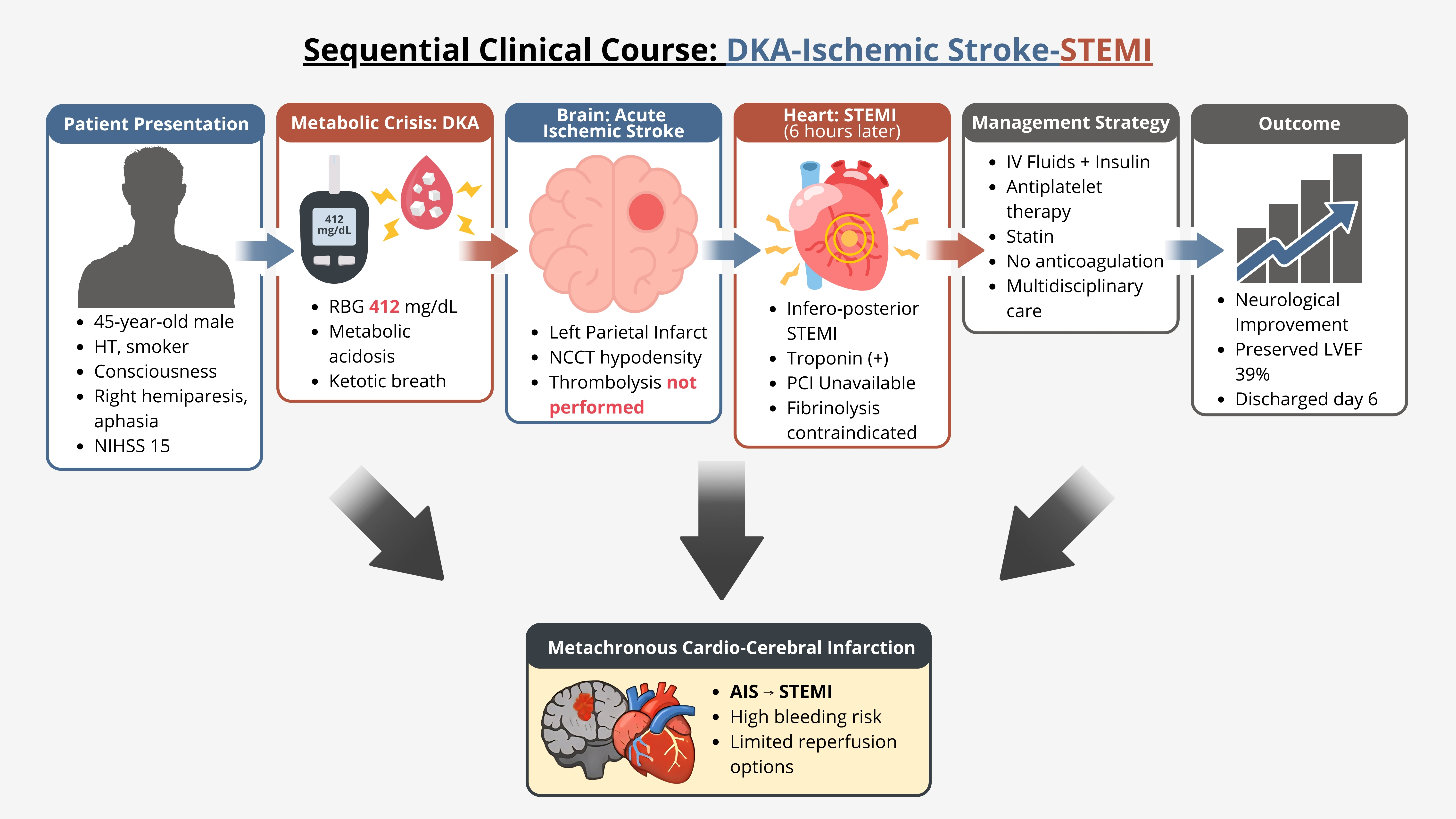
Cardio-cerebral infarction is the simultaneous occurrence of acute ischemic stroke (AIS) and acute myocardial infarction (AMI), and it is a rare and life-threatening emergency. Management thereof is more challenging when it is accompanied by metabolic complications such as diabetic ketoacidosis (DKA). Here, we report a case of a 45- year-old man with hypertension and a history of chronic smoking, who was found unresponsive with right-sided hemiparesis. He was well when last seen 6 hours before arrival. Upon examination, he was hypertensive, tachypneic, had a ketotic breath odor, a Glasgow Coma Scale of 12, and a National Institutes of Health Stroke Scale score of 15. Laboratory results confirmed DKA, with a random blood glucose of 412 mg/dL and metabolic acidosis, and a noncontrast brain computed tomography revealed an acute infarct in the left parietal lobe. Initial management included intravenous fluids, insulin, and clopidogrel. Six hours after admission, he developed sudden chest pain radiating to the jaw with diaphoresis; an electrocardiogram revealed inferior–posterior ST-segment elevation. He was treated with intravenous morphine and dual antiplatelet therapy. Echocardiography on day 2 revealed akinetic left ventricular anterior segments and a reduced ejection fraction (39.0%). This case emphasizes the need for the rapid, multidisciplinary management of concurrent DKA, AIS, and ST-elevation myocardial infarction. Careful timing of the interventions to balance bleeding, thrombolysis, and hemodynamic risks, combined with the coordinated input from neurologists, cardiologists, and endocrinologists, enabled patient stabilization and discharge on day 6 with improved neurological and cardiac outcomes.
Downloads
References
Akinseye OA, Shahreyar M, Heckle MR, Khouzam RN. Simultaneous acute cardio-cerebral infarction: is there a consensus for management? Ann Transl Med 2018;6:7-7.
https://doi.org/10.21037/atm.2017.11.06
Engel Gonzalez P, Omar W, Patel K V, de Lemos JA, Bavry AA, Koshy TP, et al. Fibrinolytic strategy for ST-segment-elevation myocardial infarction: a contemporary review in context of the COVID-19 pandemic. Circ Cardiovasc Interv 2020;13:e009622.
https://doi.org/10.1161/CIRCINTERVENTIONS.120.009622
Kim S, Chung H, Lee Y, Yoon BA, Kim DH, Jeong JH, et al. Is the mechanism of synchronous cardiocerebral infarction (CCI) different from that of metachronous CCI? J Neurocritical Care 2023;16:77-84.
https://doi.org/10.18700/jnc.230029
Gagnier JJ, Kienle G, Altman DG, Moher D, Sox H, Riley D, et al. The CARE guidelines: consensus-based clinical case reporting guideline development. J Med Case Rep 2013;7:223.
https://doi.org/10.1186/1752-1947-7-223
Powers WJ, Rabinstein AA, Ackerson T, Adeoye OM, Bambakidis NC, Becker K, et al. Guidelines for the early management of patients with acute ischemic stroke: 2019 update to the 2018 guidelines for the early management of acute ischemic stroke: a guideline for healthcare professionals from the American Heart Association/American Stroke . Stroke 2019;50: e344-418.
https://doi.org/10.1161/STR.0000000000000211
van Poppel LM, Majoie CBLM, Marquering HA, Emmer BJ. Associations between early ischemic signs on noncontrast CT and time since acute ischemic stroke onset: A scoping review. Eur J Radiol 2022;155:110455.
https://doi.org/10.1016/j.ejrad.2022.110455
Alshoabi S, Alnajmani R, Shamsuddin M, Gameraddin M. Early signs of middle cerebral artery infarction on multidetector computed tomography: Review of 20 cases. Brain Circ 2019;5:27-31.
https://doi.org/10.4103/bc.bc_28_18
de Castillo LLC, Diestro JDB, Tuazon CAM, Sy MCC, Añonuevo JC, San Jose MCZ. Cardiocerebral infarction: a single institutional series. J Stroke Cerebrovasc Dis 2021;30:1-8.
https://doi.org/10.1016/j.jstrokecerebrovasdis.2021.105831
Tuohinen SS, Rankinen J, Skyttä T, Huhtala H, Virtanen V, Kellokumpu-Lehtinen PL, et al. Associations between ECG changes and echocardiographic findings in patients with acute non-ST elevation myocardial infarction. J Electrocardiol 2018;51:188-94.
https://doi.org/10.1016/j.jelectrocard.2017.11.007
Schindler TH, Arai AE, Berry C, Sykes R, Nieman K, Kitagawa K, et al. Myocardial blood flow assessment and reporting for ischemic heart disease: Cardiac PET, MR, CT, and echocardiography. JACC Cardiovasc
Imaging. JACC Cardiovasc Imaging. 2026;19:378-411.
https://doi.org/10.1016/j.jcmg.2025.08.022
Aggarwal G, Patlolla SH, Aggarwal S, Cheungpasitporn W, Doshi R, Sundaragiri PR, et al. Temporal trends, predictors, and outcomes of acute ischemic stroke in acute myocardial infarction in the United States. J Am Heart Assoc 2021;10:1-18.
https://doi.org/10.1161/JAHA.120.017693
Lee K, Park W, Seo KD, Kim H. Which one to do first?: a case report of simultaneous acute ischemic stroke and myocardial infarction. J Neurocritical Care 2021;14:109-12.
https://doi.org/10.18700/jnc.210030
de la Torre C, Wagner JS, Xu J. Concurrent cardiocerebral infarction - A case report and literature review. The neurohospitalist 2024;14:74-8.
https://doi.org/10.1177/19418744231193181
Grela I, Peterson TR. Synchronous acute ischemic stroke and acute myocardial infarction: a case report. Cureus 2025;17:e80054.
https://doi.org/10.7759/cureus.80054
Wu C, Li L, Wang S, Zeng J, Yang J, Xu H, et al. Fibrinolytic therapy use for ST segment elevation myocardial infarction and long term outcomes in China/ : 2 year results from the China acute myocardial infarction registry. BMC Cardiovasc Disord 2023; 1-10.
https://doi.org/10.1186/s12872-023-03105-1
Gopar-Nieto R, González-Pacheco H, Arias-Mendoza A, Briseño-De-la-cruz JL, Araiza-Garaygordobil D, Sierra-Lara-martínez D, et al. Non-reperfused STelevation myocardial infarction: notions from a lowto-middle-income country. Arch Cardiol Mex 2023;93:4-12.
https://doi.org/10.24875/ACME.M23000368
Byrne RA, Rossello X, Coughlan Jj, Barbato E, Berry C, Chieffo A, et al. 2023 ESC guidelines for the management of acute coronary syndromes: developed by the task force on the management of acute coronary syndromes of the European society of cardiology (ESC). Eur Hear J Acute Cardiovasc Care 2024;44:3720-826.
Kovács KB, Bencs V, Hudák L, Oláh L, Csiba L. Hemorrhagic transformation of ischemic strokes. Int J Mol Sci 2023;24:14067
Downloads
Published
How to Cite
Issue
Section
License
Copyright (c) 2026 Chulalongkorn Medical Journal

This work is licensed under a Creative Commons Attribution-NonCommercial-NoDerivatives 4.0 International License.