Perspective in the biomedical sciences field: Education and career
Keywords:
Biomedical science, biomedical laboratory scientists, biomedicine, career pathways, educationAbstract
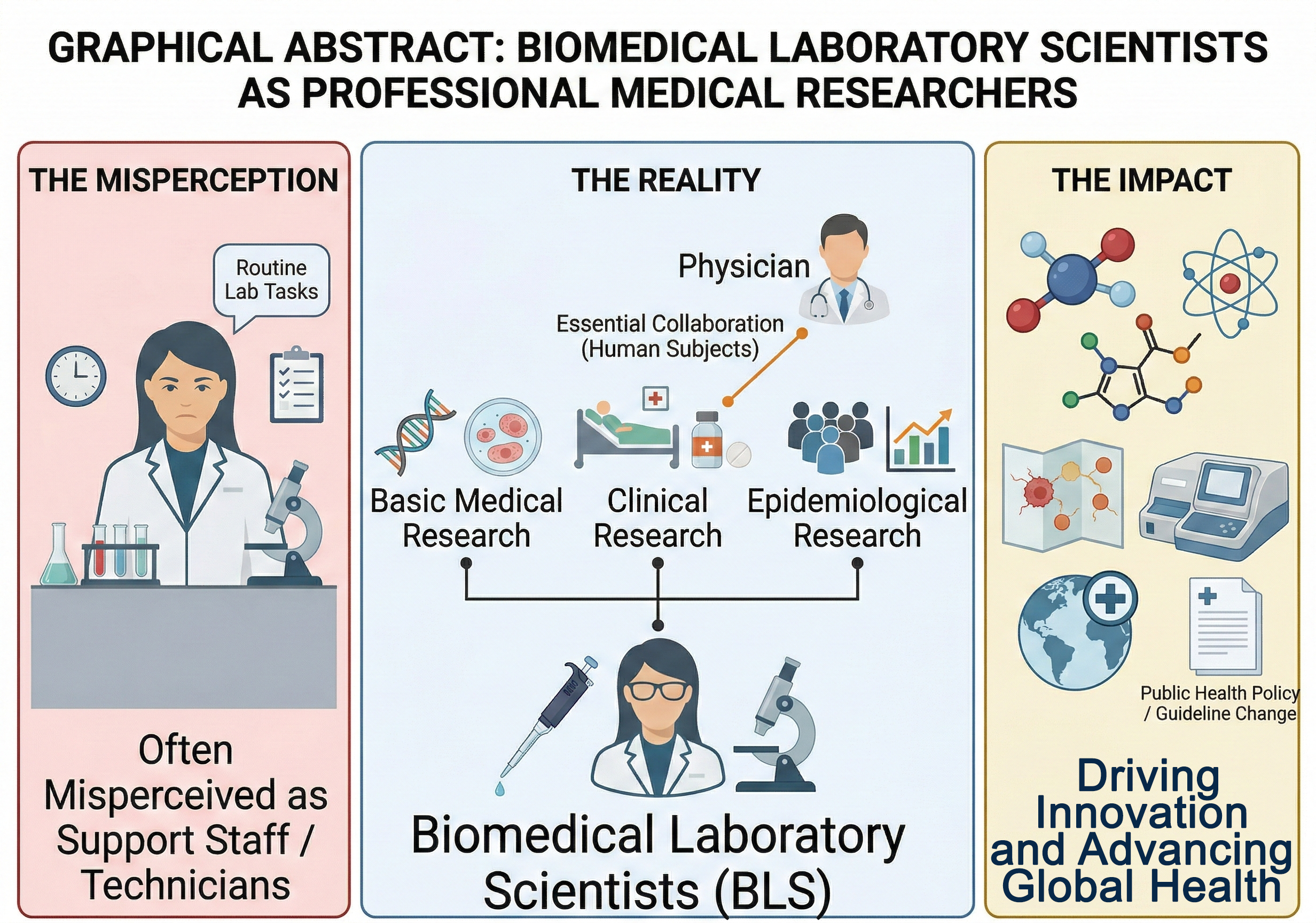
The biomedical sciences are a dynamic, multidisciplinary field that is pivotal to advancing human health through research, education, and innovation. This review explores the evolving landscape of biomedical education and its related career pathways, driven by technological advancements, interdisciplinary integration, and global health demands. A literature search was performed using the PubMed, Scopus, and Web of Science databases for articles published between 2009 and 2024. Search terms included “biomedical science education,” “biomedical laboratory scientist,” “BLS career,” “biomedical engineering,” and “biomedicine.” The inclusion criteria were peer-reviewed articles in English addressing biomedical education, career pathways, or workforce development. Whereas the exclusion criteria included non-English publications, editorials, and conference abstracts without the full text being available. We examine the distinctions between biomedical science, biomedicine, and biomedical engineering and present their historical origins and contemporary roles. The education and career trajectories of biomedical laboratory scientists (BLS) are analyzed, emphasizing the diverse competencies, core curricula, and the impact of regional policies on professional qualifications. Furthermore, emerging trends and ethical/regulatory challenges are discussed. The identified key trends include the emergence of artificial intelligence, nanotechnology, synthetic biology, and digital health, which are shaping research. BLS require core scientific competencies, as well as skills such as bioinformatics and entrepreneurship. In addition, there are differences in BLS qualifications and education worldwide, and collaboration between BLS and physicians is essential in clinical research. By synthesizing recent literature, this review identifies key opportunities and challenges in preparing BLS for impactful careers and offers recommendations to optimize education and workforce development in this rapidly changing field. Collaboration and responsible innovation are critical for promoting scientific discovery and improving global health.
Downloads
References
Scheffler RW, Strasser BJ. Biomedical sciences, history and sociology of. In: Wright JD, editor. International encyclopedia of the social & behavioral sciences. 2nd ed. Amsterdam: Elsevier; 2015. p. 663-9
https://doi.org/10.1016/B978-0-08-097086-8.85045-X
Weerarathna IN, Kumar P, Luharia A, Mishra G. Engineering with biomedical sciences changing the horizon of healthcare: a review. Bioengineered 2024;15:2401269.
https://doi.org/10.1080/21655979.2024.2401269
Fuhrmann CN. Enhancing graduate and postdoctoral education to create a sustainable biomedical workforce. Hum Gene Ther 2016;27:871-9.
https://doi.org/10.1089/hum.2016.154
Gunn JS, Ledford CH, Mousetes SJ, Grever MR. Biomedical science undergraduate major: a new pathway to advance research and the health professions. Teach Learn Med 2018;30:184-92.
https://doi.org/10.1080/10401334.2017.1361827
Sohrabi C, Mathew G, Franchi T, Kerwan A, Griffin M, Del Mundo JSD, Ali SA, Agha M, Agha R. Impact of the coronavirus (COVID-19) pandemic on scientific research and implications for clinical academic training- A review. Int J Surg 2021;86:57-63.
https://doi.org/10.1016/j.ijsu.2020.12.008
Raynaud M, Goutaudier V, Louis K, Al-Awadhi S, Dubourg Q, Truchot A, et al. Impact of the COVID-19 pandemic on publication dynamics and non-COVID-19 research production. BMC Med Res Methodol2021;21:255.
https://doi.org/10.1186/s12874-021-01404-9
Ibrahim K, Ahmad-Annuar A. COVID-19 pandemic:Lessons learned for undergraduate research training.Biochem Mol Biol Educ 2022;50:476-8.
https://doi.org/10.1002/bmb.21665
Lowy I. Historiography of Biomedicine: "Bio," "Medicine," and In Between. Isis 2011;102:116-22.
https://doi.org/10.1086/658661
Keating P, Cambrosio A. Biomedical Platforms:Realigning the Normal and the Pathological in LateTwentieth-Century Medicine. Cambridge, MA: MIT Press; 2003.
https://doi.org/10.7551/mitpress/1622.001.0001
Hales AP. Biomedicine relies heavily on biological macro-molecules. EJBI 2021;17:76-7.
Froshauer S. Careers at biotech start-ups and in entrepreneurship. Cold Spring Harb Perspect Biol 2017;9:a032938.
https://doi.org/10.1101/cshperspect.a032938
Ribeiro IM, de Souza Barroso ME, Kampke EH, Braga LTF, Campagnaro BP, Meyrelles SDS. Infrared laser therapy decreases systemic oxidative stress and inflammation in hypercholesterolemic mice with periodontitis. Lipids Health Dis 2023;22:171.
https://doi.org/10.1186/s12944-023-01934-9
Stollenwerk MM, Gustafsson A, Edgren G, Gudmundsson P, Lindqvist M, Eriksson T. Core competencies for a biomedical laboratory scientist - a Delphi study. BMC Med Educ 2022;22:476.
https://doi.org/10.1186/s12909-022-03509-1
Plebani M, Laposata M, Lippi G. A manifesto for the future of laboratory medicine professionals. Clin Chim Acta 2019;489:49-52.
https://doi.org/10.1016/j.cca.2018.11.021
Mason JL, Johnston E, Berndt S, Segal K, Lei M, Wiest JS. Labor and skills gap analysis of the biomedical research workforce. FASEB J 2016;30:2673-83.
https://doi.org/10.1096/fj.201500067R
IFBLS. Guidelines regarding Core Competence and Core Curriculum. International Federation of Biomedical Laboratory Science (IFBLS); Adopted 2012, Updated 2016.
Meyers FJ, Pomeroy C. Creating the future biomedical research workforce. Sci Transl Med 2011;3:102fs5.
https://doi.org/10.1126/scitranslmed.3003209
Zimmerman AM. Navigating the path to a biomedical science career. PLoS One 2018;13:e0203783.
https://doi.org/10.1371/journal.pone.0203783
Sousa MJ. Entrepreneurship skills development in higher education courses for teams leaders. Adm Sci 2018;8:18.
https://doi.org/10.3390/admsci8020018
Bustin SA, Jellinger KA. Advances in molecular medicine: unravelling disease complexity and pioneering precision healthcare. Int J Mol Sci 2023; 24:14168.
https://doi.org/10.3390/ijms241814168
Rohrig B, Du Prel JB, Wachtlin D, Blettner M. Types of study in medical research: part 3 of a series on evaluation of scientific publications. Dtsch Arztebl Int 2009;106:262-8.
https://doi.org/10.3238/arztebl.2009.0262
Fontanarosa PB, DeAngelis CD. Basic science and translational research in JAMA. JAMA 2002;287:1728.
https://doi.org/10.1001/jama.287.13.1728
Bonetta L. Biomedical science: putting research into practice. Nature 2010;467:995-6.
https://doi.org/10.1038/nj7318-995a
Flier JS. The diversity of institutions conducting biomedical research. Perspect Biol Med 2023;66: 58-88.
https://doi.org/10.1353/pbm.2023.0004
Topol EJ. High-performance medicine: the convergence of human and artificial intelligence. Nat Med. 2019;25:44-56.
https://doi.org/10.1038/s41591-018-0300-7
Wu Z, Guo M, Jin X, Chen J, Liu B. CFAGO: crossfusion of network and attributes based on attention mechanism for protein function prediction. Bioinformatics 2023;39:btad123.
https://doi.org/10.1093/bioinformatics/btad123
Hald Albertsen C, Kulkarni JA, Witzigmann D, Lind M, Petersson K, Simonsen JB. The role of lipid components in lipid nanoparticles for vaccines and gene therapy. Adv Drug Deliv Rev 2022;188:114416.
https://doi.org/10.1016/j.addr.2022.114416
Lin J, Ma K, Chen H, Chen Z, Xing B. Influence of different types of nanomaterials on soil enzyme activity: A global meta-analysis. Nano Today 2022; 42:101345.
https://doi.org/10.1016/j.nantod.2021.101345
Claggett J, Petter S, Joshi A, Ponzio T, Kirkendall E. An infrastructure framework for remote patient monitoring interventions and research. J Med Internet Res 2024;26:e51234.
Honeyford K, Expert P, Mendelsohn EE, et al. Challenges and recommendations for high quality research using electronic health records. Front Digit Health 2022;4:940330.
https://doi.org/10.3389/fdgth.2022.940330
Mulvihill JJ, Capps B, Joly Y, Lysaght T, Zwart HA, Chadwick R. Ethical issues of CRISPR technology and gene editing through the lens of solidarity. Br Med Bull 2017;122:17-29.
Downloads
Published
How to Cite
Issue
Section
License
Copyright (c) 2026 Chulalongkorn Medical Journal

This work is licensed under a Creative Commons Attribution-NonCommercial-NoDerivatives 4.0 International License.