The use of electronic notifications to improve guideline adherence in amiodarone adverse reaction monitoring
Keywords:
Adverse event, amiodarone, guideline adherenceAbstract
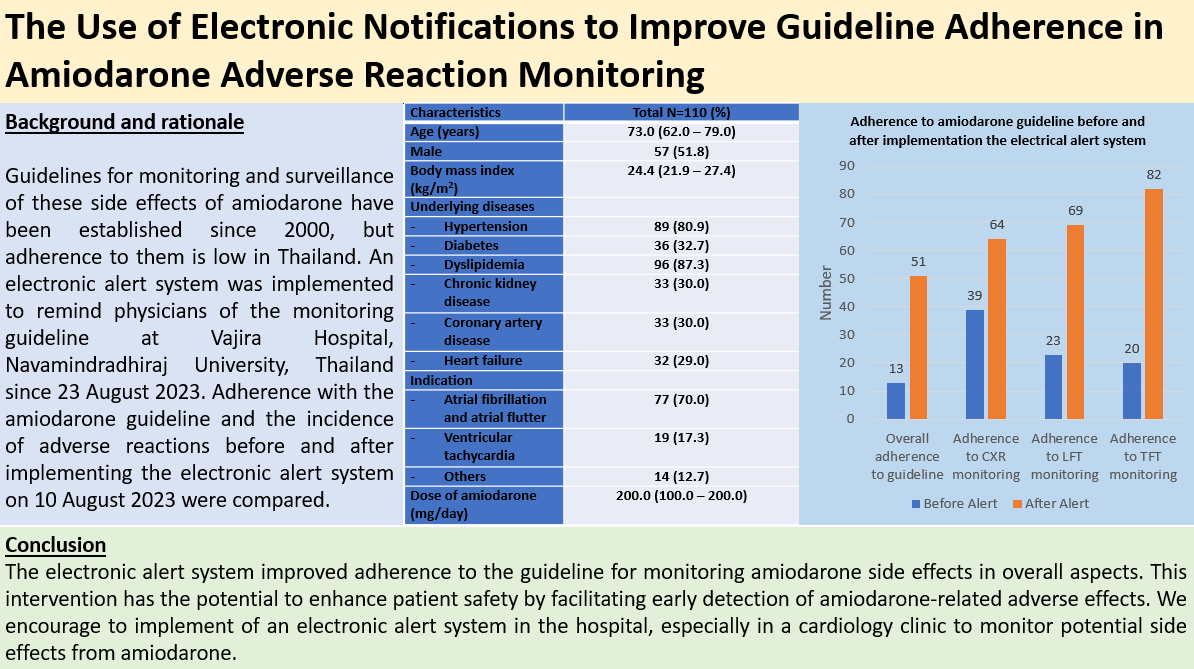
Background:Amiodarone is an anti-arrhythmic drug that can cause side effects on the thyroid, liver, lungs, vision, and nervous system. Guidelines for monitoring and surveillance of these side effects have been in place since 2000, but adherence to them remains low in many countries,including Thailand. An electronic alert system has been implemented at Vajira Hospital,Navamindradhiraj University, Thailand, to remind physicians of the monitoring guideline since August 2023.
Objectives:This study aimed to compare adherence with the amiodarone guideline before and after implementing an electronic notification system and to evaluate the incidence of amiodarone-related adverse reactions.
Methods:This cohort study used electronic medical records of patients who visited the outpatient department at Vajira Hospital, Thailand, and received amiodarone for at least 1 month between February 2022 and February 2025. Adherence to the amiodarone guideline and incidence of adverse reactions were compared before and after implementing the electronic alert system in August 2023. The primary outcome was to compare adherence before and after the implementation of an electronic notification system. The secondary outcome was to assess the incidence of amiodarone-related side effects.
Results: We screened 201 patients who received amiodarone during that period, but only 110 patients received amiodarone continuously through the period of the electronic notification system(August 2023). The overall adherence to the amiodarone guideline increased from 11.8% to 46.4%(adjusted relative risk 3.92, 95% confidence interval [2.13–7.21]) following the implementation of the electronic alert system. Adherence to chest x-ray, liver function tests, and thyroid function tests also improved substantially after the intervention. The most common adverse reaction suspected from amiodarone usage was abnormal thyroid-stimulating hormone (TSH) levels. The incidence of abnormal TSH levels increased from 18.2% before the notification system to 23.6% after,although the difference was not significant.
Conclusion: The electronic alert system improved adherence to the guideline for monitoring amiodarone side effects in overall aspects. This intervention has the potential to enhance patient safety by facilitating the early detection of amiodarone-related adverse effects. We encourage the implementation of an electronic alert system in hospitals, particularly in the cardiology clinic, to monitor for potential amiodarone-related side effects.
Downloads
References
Zimetbaum P. Antiarrhythmic drug therapy for atrial fibrillation. Circulation 2012;125:381-9.
https://doi.org/10.1161/CIRCULATIONAHA.111.019927
Batcher EL, Tang XC, Singh BN, Singh SN, Reda DJ, Hershman JM. Thyroid function abnormalities during amiodarone therapy for persistent atrial fibrillation. Am J Med 2007;120:880-5.
https://doi.org/10.1016/j.amjmed.2007.04.022
Vorperian VR, Havighurst TC, Miller S, January CT. Adverse effects of low dose amiodarone: a meta-analysis. J Am Coll Cardiol 1997;30:791-8.
https://doi.org/10.1016/S0735-1097(97)00220-9
Lewis JH, Ranard RC, Caruso A, Jackson LK, Mullick F, Ishak KG, et al. Amiodarone hepatotoxicity: prevalence and clinicopathologic correlations among 104 patients. Hepatology 1989;9:679-85.
https://doi.org/10.1002/hep.1840090504
Martin WJ 2nd, Rosenow EC 3rd. Amiodarone pulmonary toxicity. Recognition and pathogenesis (Part I). Chest 1988;93:1067-75.
https://doi.org/10.1378/chest.93.5.1067
Goldschlager N, Epstein AE, Naccarelli G, Olshansky B, Singh B. Practical guidelines for clinicians who treat patients with amiodarone. Practice Guidelines Subcommittee, North American Society of Pacing and Electrophysiology. Arch Intern Med 2000;160:1741-8.
https://doi.org/10.1001/archinte.160.12.1741
Goldschlager N, Epstein AE, Naccarelli GV, Olshansky B, Singh B, Collard HR, et al. A practical guide for clinicians who treat patients with amiodarone: 2007. Heart Rhythm 2007;4:1250-9.
https://doi.org/10.1016/j.hrthm.2007.07.020
Epstein AE, Olshansky B, Naccarelli GV, Kennedy JI Jr, Murphy EJ, Goldschlager N. Practical management guide for clinicians who treat patients with amiodarone. Am J Med 2016;129:468-75.
https://doi.org/10.1016/j.amjmed.2015.08.039
Lavon O, Goldman R. Adherence to monitoring guidelines of amiodarone adverse reactions. Health Serv Res Manag Epidemiol 2019;6:2333392819844635.
https://doi.org/10.1177/2333392819844635
Rankin S, Elder DH, Ogston S, George J, Lang CC, Choy AM. Population-level incidence and monitoring of adverse drug reactions with long-term amiodarone therapy. Cardiovasc Ther 2017;35:e12258.
https://doi.org/10.1111/1755-5922.12258
Ghazi L, Yamamoto Y, Riello RJ, Coronel-Moreno C, Martin M, O'Connor KD, et al. Electronic alerts to improve heart failure therapy in outpatient practice: a cluster randomized trial. J Am Coll Cardiol 2022;79:2203-13.
https://doi.org/10.1016/j.jacc.2022.03.338
Von Elm E, Altman DG, Egger M, Pocock SJ, Gotzsche PC, Vandenbroucke JP, et al. The Strengthening the Reporting of Observational Studies in Epidemiology (STROBE) Statement: guidelines for reporting observational studies. Int J Surg 2014;12:1495-9.
https://doi.org/10.1016/j.ijsu.2014.07.013
Footracer KG. Alert fatigue in electronic health records. JAAPA 2015;28:41.
https://doi.org/10.1097/01.JAA.0000465221.04234.ca
McGreevey JD 3rd, Mallozzi CP, Perkins RM, Shelov E, Schreiber R. Reducing alert burden in electronic health records: state of the art recommendations from four health systems. Appl Clin Inform 2020;11:1-12.
Downloads
Published
How to Cite
Issue
Section
License
Copyright (c) 2026 Chulalongkorn Medical Journal

This work is licensed under a Creative Commons Attribution-NonCommercial-NoDerivatives 4.0 International License.