Psychosocial predictors of depression and anxiety in Thai stroke caregivers
Keywords:
Anxiety, depression, ischemic stroke, mental problems, psychiatry, stressAbstract
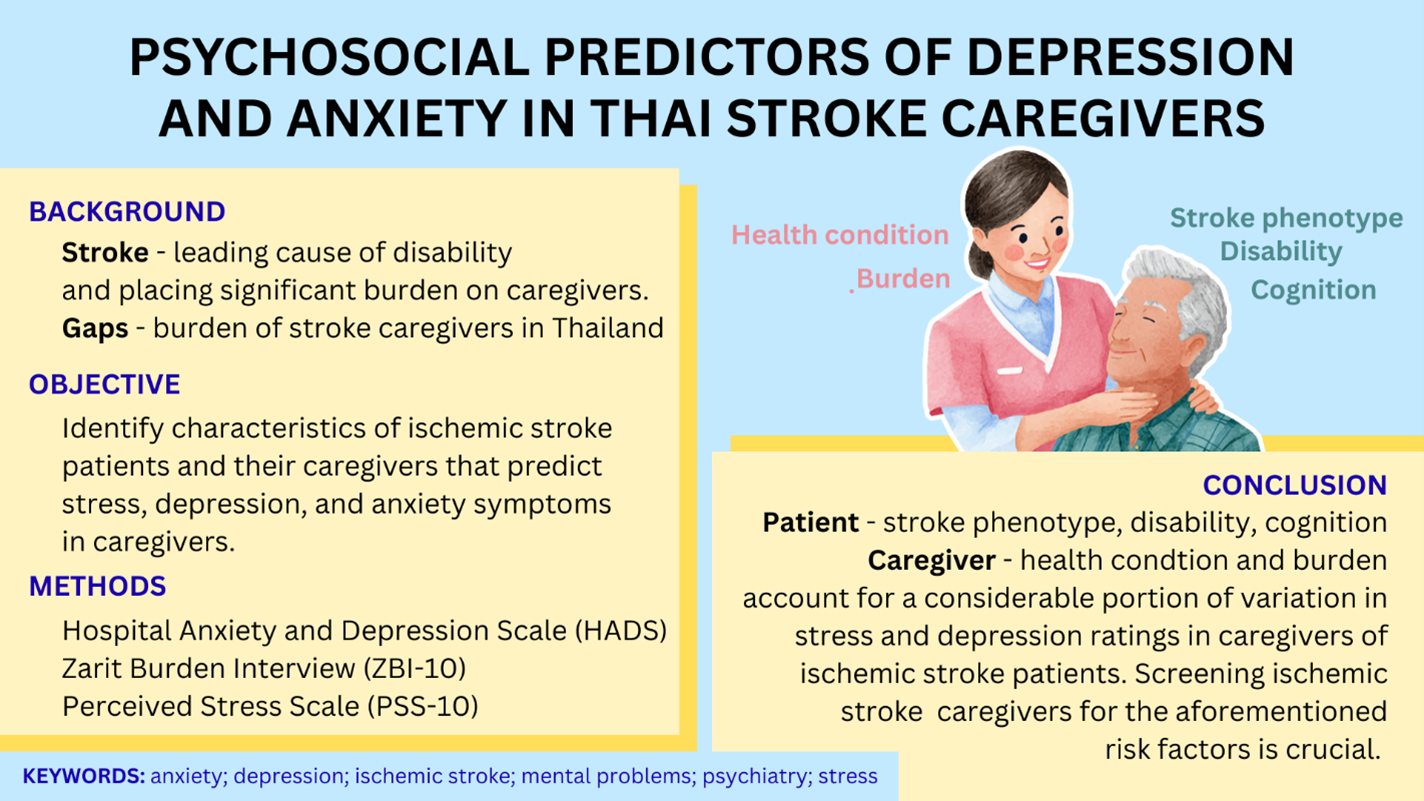
Background: Stroke is a leading cause of disability and places a considerable burden on caregivers worldwide. However, studies on the burden of stroke caregivers in Thailand remain limited.
Objective: This study aimed to identify characteristics of patients with ischemic stroke and their caregivers that may predict distress, depression, and anxiety symptoms in the caregivers.
Methods: The Hospital Anxiety and Depression Scale (HADS), Zarit Burden Interview (22-item F), and Perceived Stress Scale (PSS-10) were used to measure the caregivers’ burden, stress, depression, and anxiety symptoms. Furthermore, we used partial least squares structural equation modeling (PLS-SEM) to establish a multistep mediation model.
Results: Ninety-seven stroke patients and their caregivers were included in this study. The regression on ZBI-personal strain and stroke of other identified etiology explained 15.0% of the variation in the HADS depression score. We observed that the caregiver’s underlying condition and the patients’ National Institutes of Health Stroke Scale (NIHSS) explained 13.6% of the variation in the caregiver’s overall ZBI score. The total ZBI score, the presence of lacunar circulatory infarction in the patients, and the caregiver’s underlying condition explained 40.9% of the variation in the caregivers’ overall PSS score. Moreover, PLS analysis revealed that the NIHSS and the caregiver’s underlying medical condition had substantial indirect effects on the HADS score, mediated by the ZBI score.
Conclusions: The patient’s disability, reliance, cognition, and stroke phenotypes, as well as the caregiver’s health condition and burden, account for a considerable portion of variation in the stress and depression ratings in caregivers of patients with ischemic stroke. Therefore, screening ischemic stroke caregivers for the aforementioned risk factors is crucial.
Downloads
References
Ovbiagele B, Goldstein LB, Higashida RT, Howard VJ, Johnston SC, Khavjou OA, et al. Forecasting the future of stroke in the United States: a policy statement from the American Heart Association and American Stroke Association. Stroke 2013;44:2361-75.
https://doi.org/10.1161/STR.0b013e31829734f2
GBD 2017 DALYs and HALE Collaborators. Global, regional, and national disability-adjusted life-years (DALYs) for 359 diseases and injuries and healthy life expectancy (HALE) for 195 countries and territories, 1990-2017: a systematic analysis for the Global Burden of Disease Study 2017. Lancet 2018;392:1859-922.
https://doi.org/10.1016/S0140-6736(18)32335-3
Greenwood N, Mackenzie A. Informal caring for stroke survivors: meta-ethnographic review of qualitative literature. Maturitas 2010;66:268-76.
https://doi.org/10.1016/j.maturitas.2010.03.017
Visser-Meily A, Post M, van de Port I, Maas C, Forstberg-Wärleby G, Lindeman E. Psychosocial functioning of spouses of patients with stroke from initial inpatient rehabilitation to 3 years poststroke: course and relations with coping strategies. Stroke 2009;40:1399-404.
https://doi.org/10.1161/STROKEAHA.108.516682
Malhotra R, Chei CL, Menon EB, Chow WL, Quah S, Chan A, et al. Trajectories of positive aspects of caregiving among family caregivers of stroke-survivors: the differential impact of stroke-survivor disability. Top Stroke Rehabil 2018;25:261-8.
https://doi.org/10.1080/10749357.2018.1455369
Patten SB, Williams JV, Lavorato DH, Wang JL, McDonald K, Bulloch AG. Descriptive epidemiology of major depressive disorder in Canada in 2012. Can J Psychiatry 2015;60:23-30.
https://doi.org/10.1177/070674371506000106
Graf R, LeLaurin J, Schmitzberger M, Freytes IM, Orozco T, Dang S, et al. The stroke caregiving trajectory in relation to caregiver depressive symptoms, burden, and intervention outcomes. Top Stroke Rehabil 2017;24:488-95.
https://doi.org/10.1080/10749357.2017.1338371
Em S, Bozkurt M, Caglayan M, Ceylan Cevik F, Kaya C, Oktayoglu P, et al. Psychological health of caregivers and association with functional status of stroke patients. Top Stroke Rehabil 2017;24:323-9.
https://doi.org/10.1080/10749357.2017.1280901
Tsai YC, Pai HC. Burden and cognitive appraisal of stroke survivors' informal caregivers: An assessment of depression model with mediating and moderating effects. Arch Psychiatr Nurs 2016;30:237-43.
https://doi.org/10.1016/j.apnu.2015.11.007
Jessup NM, Bakas T, McLennon SM, Weaver MT. Are there gender, racial or relationship differences in caregiver task difficulty, depressive symptoms and life changes among stroke family caregivers? Brain Inj 2015;29:17-24.
https://doi.org/10.3109/02699052.2014.947631
Hu P, Yang Q, Kong L, Hu L, Zeng L. Relationship between the anxiety/depression and care burden of the major caregiver of stroke patients. Medicine (Baltimore) 2018;97:e12638.
https://doi.org/10.1097/MD.0000000000012638
Denno MS, Gillard PJ, Graham GD, DiBonaventura MD, Goren A, Varon SF, et al. Anxiety and depression associated with caregiver burden in caregivers of stroke survivors with spasticity. Arch Phys Med Rehabil 2013;94:1731-6.
https://doi.org/10.1016/j.apmr.2013.03.014
Hultman MT, Everson-Rose SA, Tracy MF, Lindquist R, Hadidi NN. Associations between characteristics of stroke survivors and caregiver depressive symptoms: a critical review. Top Stroke Rehabil 2019;26:528-37.
https://doi.org/10.1080/10749357.2019.1641010
Loh AZ, Tan JS, Zhang MW, Ho RC. The Global prevalence of anxiety and depressive symptoms among caregivers of stroke survivors. J Am Med Dir Assoc 2017;18:111-6.
https://doi.org/10.1016/j.jamda.2016.08.014
McCurley JL, Funes CJ, Zale EL, Lin A, Jacobo M, Jacobs JM, et al. Preventing chronic emotional distress in stroke survivors and their informal caregivers. Neurocrit Care 2019;30:581-9.
https://doi.org/10.1007/s12028-018-0641-6
Maggio MG, Corallo F, De Francesco M, De Cola MC, De Luca R, Manuli A, et al. Understanding the family burden and caregiver role in stroke rehabilitation: insights from a retrospective study. Neurol Sci 2024;45:5347-53.
https://doi.org/10.1007/s10072-024-07668-5
Oosterveer DM, Mishre RR, van Oort A, Bodde K, Aerden LA. Anxiety and low life satisfaction associate with high caregiver strain early after stroke. J Rehabil Med 2014;46:139-43.
https://doi.org/10.2340/16501977-1250
Boerboom W, Jacobs EA, Khajeh L, van Kooten F, Ribbers GM, Heijenbrok-Kal MH. The relationship of coping style with depression, burden, and life dissatisfaction in caregivers of patients with subarachnoid haemorrhage. J Rehabil Med 2014;46:321-6.
https://doi.org/10.2340/16501977-1273
Cohen S, Kamarck T, Mermelstein R. A global measure of perceived stress. J Health Soc Behav 1983;24:385-96.
https://doi.org/10.2307/2136404
Wongpakaran N, Wongpakaran T. The Thai version of the PSS-10: An investigation of its psychometric properties. Biopsychosoc Med 2010;4:6.
https://doi.org/10.1186/1751-0759-4-6
Bédard M, Molloy DW, Squire L, Dubois S, Lever JA, O'Donnell M. The Zarit Burden Interview: a new short version and screening version. Gerontologist 2001;41:652-7.
https://doi.org/10.1093/geront/41.5.652
Cheah WK, Han HC, Chong MS, Anthony PV, Lim WS. Multidimensionality of the Zarit Burden Interview across the severity spectrum of cognitive impairment: an Asian perspective. Int Psychogeriatr 2012;24:1846-54.
https://doi.org/10.1017/S104161021200110X
Silpakit O, Silpakit C, Chomchuen R. Psychometric study of the Thai version of Zarit Burden Interview in psychiatric caregivers. J Ment Health Thai 2015;23:12-24. (in Thai)
Zigmond AS, Snaith RP. The hospital anxiety and depression scale. Acta Psychiatr Scand 1983;67:361-70.
https://doi.org/10.1111/j.1600-0447.1983.tb09716.x
Bjelland I, Dahl AA, Haug TT, Neckelmann D. The validity of the Hospital Anxiety and Depression Scale. An updated literature review. J Psychosom Res 2002;52:69-77.
https://doi.org/10.1016/S0022-3999(01)00296-3
Nilchaikovit T, Lotrakul M, Phisansuthideth U. Development of Thai version of hospital anxiety and depression scale in cancer patients. J Psychiatr Assoc Thai 1996;41:18-30. (in Thai)
Yang Y, Wang A, Zhao X, Wang C, Liu L, Zheng H, et al. The Oxfordshire Community Stroke Project classification system predicts clinical outcomes following intravenous thrombolysis: a prospective cohort study. Ther Clin Risk Manag 2016;12:1049-56.
https://doi.org/10.2147/TCRM.S107053
Adams HP Jr, Bendixen BH, Kappelle LJ, Biller J, Love BB, Gordon DL, et al. Classification of subtype of acute ischemic stroke. Definitions for use in a multicenter clinical trial. TOAST. Trial of Org 10172 in Acute Stroke Treatment. Stroke 1993;24:35-41
https://doi.org/10.1161/01.STR.24.1.35
Harrison JK, McArthur KS, Quinn TJ. Assessment scales in stroke: clinimetric and clinical considerations. Clin Interv Aging 2013;8:201-11.
https://doi.org/10.2147/CIA.S32405
Balu S. Differences in psychometric properties, cut-off scores, and outcomes between the Barthel Index and Modified Rankin Scale in pharmacotherapy-based stroke trials: systematic literature review. Curr Med Res Opin 2009;25:1329-41.
https://doi.org/10.1185/03007990902875877
Nasreddine ZS, Phillips NA, Bédirian V, Charbonneau S, Whitehead V, Collin I, et al. The Montreal Cognitive Assessment, MoCA: a brief screening tool for mild cognitive impairment. J Am Geriatr Soc 2005;53:695-9.
https://doi.org/10.1111/j.1532-5415.2005.53221.x
Train The Brain Forum Committee. Thai mental state examination (TMSE). Siriraj Hospital Gazette 1993;45:359-74. (in Thai)
Hemrungrojn S, Tangwongchai S, Charoenboon T, Panasawat M, Supasitthumrong T, Chaipresertsud P, Maleevach P, Likitjaroen Y, Phanthumchinda K, Maes M. Use of the Montreal Cognitive Assessment Thai Version to discriminate amnestic mild cognitive impairment from alzheimer's disease and healthy controls: machine learning results. Dement Geriatr Cogn Disord 2021;50:183-94.
https://doi.org/10.1159/000517822
Shmueli G, Sarstedt M, Hair JF, Cheah J, Ting H, Vaithilingam S, et al. Predictive model assessment in PLS-SEM: Guidelines for Using PLSpredict. Eur J Mark 2019;53:2322-47.
https://doi.org/10.1108/EJM-02-2019-0189
Wei W, Li S, San F, Zhang S, Shen Q, Guo J, et al. Retrospective analysis of prognosis and risk factors of patients with stroke by TOAST. Medicine (Baltimore) 2018;97:e0412.
https://doi.org/10.1097/MD.0000000000010412
Tooth L, McKenna K, Barnett A, Prescott C, Murphy S. Caregiver burden, time spent caring and health status in the first 12 months following stroke. Brain Inj 2005;19:963-74.
https://doi.org/10.1080/02699050500110785
Haley WE, Allen JY, Grant JS, Clay OJ, Perkins M, Roth DL. Problems and benefits reported by stroke family caregivers: results from a prospective epidemiological study. Stroke 2009;40:2129-33.
https://doi.org/10.1161/STROKEAHA.108.545269
Robertson JJ, Long B. Suffering in silence: Medical error and its impact on health care providers. J Emerg Med 2018;54:402-9.
https://doi.org/10.1016/j.jemermed.2017.12.001
Corrigan PW, Watson AC. Understanding the impact of stigma on people with mental illness. World Psychiatry 2002;1:16-20.
Werner Seidler A, Afzali MH, Chapman C, Sunderland M, Slade T. The link between social support networks and depression in the 2007 National Survey of Mental Health and Well Being. Soc Psychiatry Psychiatr Epidemiol 2017;52:1463-73.
Downloads
Published
How to Cite
Issue
Section
License
Copyright (c) 2026 Chulalongkorn Medical Journal

This work is licensed under a Creative Commons Attribution-NonCommercial-NoDerivatives 4.0 International License.