Artificial photosynthesis to overcome oxygen deprivation during respiratory disease crisis: A mini review
Keywords:
Artificial photosynthesis, carbon, nanotechnology, oxygen production, solar energyAbstract
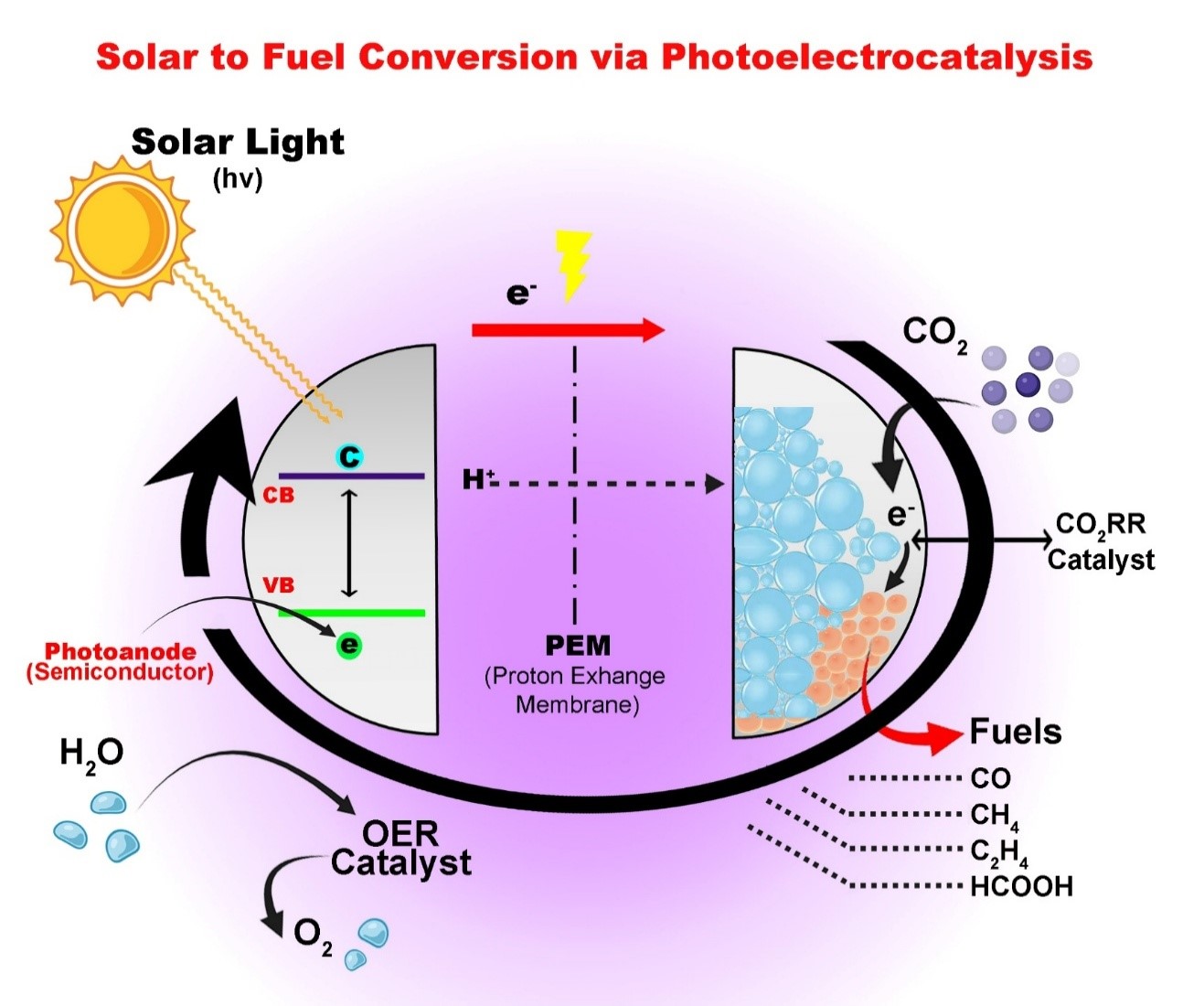
Patients with respiratory diseases are primarily treated for their symptoms, with oxygen therapy as support.During the Coronavirus Disease 2019 (COVID-19) pandemic, oxygen concentrators were in high demand, and even afterward, many patients died due to a shortage of oxygen cylinders. This crisis prompted many entrepreneurs to establish oxygen plants, which required a large-scale setup. The articles included in this review were searched using Google Scholar, Scopus, and Web of Science using appropriate keywords. Here,we summarize the need for oxygen and how this need can be met through artificial photosynthesis. Using solar energy in the presence of a catalyst, water can be split into hydrogen and various organic products,resulting in oxygen production. The produced oxygen can be stored in oxygen cylinders and supplied to hospitals for patients in need. The difference between oxygen concentrators and artificial photosynthesis is that in the former, atmospheric oxygen is concentrated, and no new oxygen is produced, whereas in the latter,oxygen is produced from water, which is more useful. This mini review discusses artificial photosynthesis, the process, and the role of nanotechnology in enabling it.
Downloads
References
Suzuki YJ, Gychka SG. SARS-CoV-2 spike protein elicits cell signaling in human host cells: implications for possible consequences of COVID-19 vaccines. Vaccines (Basel) 2021;9:36.
https://doi.org/10.3390/vaccines9010036
Paul S, Bravo Vázquez LA, Reyes-Pérez PR, Estrada-Meza C, Aponte Alburquerque RA Pathak S, et al. The role of microRNAs in solving COVID-19 puzzle from infection to therapeutics: A mini-review. Virus Res 2022;308:198631.
https://doi.org/10.1016/j.virusres.2021.198631
Moll M, Silverman EK. Precision approaches to chronic obstructive pulmonary disease management. Annu Rev Med 2024;75:247-62.
https://doi.org/10.1146/annurev-med-060622-101239
Prasanth G, Anbumaran PM, Swetha S, Krishnarajasekhar OR, Gangadharan V. Medical thoracoscopy-Diagnostics of pleural effusion with indefinite etiology. Biomedicine 2023;43:507-13.
https://doi.org/10.51248/.v43i01.2057
Devadarshini, Shazia Neelam N, Senthil P, Subramanian S. Effectiveness of upper limb endurance and resistance exercises on reducing dyspnoea and improving activities of daily living (ADL) in patients with COPD. Biomedicine 2022;42:367-70.
https://doi.org/10.51248/.v42i2.897
Graham HR, Bagayana SM, Bakare AA, Olayo BO, Peterson SS, Duke T, et al. Improving hospital oxygen systems for COVID-19 in low-resource settings: lessons from the field. Glob Health Sci Pract 2020;8:858-62.
https://doi.org/10.9745/GHSP-D-20-00224
Ross M, Wendel SK. Oxygen inequity in the COVID-19 pandemic and beyond. Glob Health Sci Prac 2023;11:e2200360.
https://doi.org/10.9745/GHSP-D-22-00360
Ackley MW. Medical oxygen concentrators: a review of progress in air separation technology. Adsorption 2019;25:1437-74.
https://doi.org/10.1007/s10450-019-00155-w
Najafpour MM, Shen JR, Allakhverdiev SI. Natural and artificial photosynthesis: fundamentals, progress, and challenges. Photosynth Res 2022;154:229-31.
https://doi.org/10.1007/s11120-022-00982-z
Campagna S, Nastasi F, La Ganga G, Serroni S, Santoro A, Arrigo A, et al. Self-assembled systems for artificial photosynthesis. Phys Chem Chem Phys 2023;25:1504-12.
https://doi.org/10.1039/D2CP03655J
Nocera DG. Realizing ciamician's energy future. La Chimica e l'Industria 2024;3:58-62.
Fujishima A, Honda K. Electrochemical photolysis of water at a semiconductor electrode. nature 1972;238:37-8.
https://doi.org/10.1038/238037a0
Nocera DG. The artificial leaf. Acc Chem Res 2012;45:767-76.
https://doi.org/10.1021/ar2003013
Shah R, Das M. Latest advances in Artificial Photosynthesis: a hidden gem in the realm of alternative energy technologies .United Kingdom: PIN; 2022
Faunce T. Global artificial photosynthesis and renewable energy storage and policy for the sustainocene. Adv Sustainable Syst 2018;2:1800035.
https://doi.org/10.1002/adsu.201800035
Xie Y, Khoo KS, Chew KW, Devadas VV, Phang SJ, Lim HR, et al. Advancement of renewable energy technologies via artificial and microalgae photosynthesis. Bioresour Technol 2022;363:127830.
https://doi.org/10.1016/j.biortech.2022.127830
Li S, Liu Y, Lin L, Pudukudy M, Zhang C, Zhao W, et al. Synergistic effects of multiple functionalities in a modified triazine-based organic polymer for enhanced CO2 cycloaddition with epoxides. Fuel 2025;385:134057.
https://doi.org/10.1016/j.fuel.2024.134057
Liu Y, Li S, Pudukudy M, Lin L, Yang H, Li M, et al. Melamine-based nitrogen-heterocyclic polymer networks as efficient platforms for CO2 adsorption and conversion. Sep Purif Technol 2024;331:125645.
https://doi.org/10.1016/j.seppur.2023.125645
Machín A, Cotto M, Ducongé J, Márquez F. Artificial photosynthesis: current advancements and future prospects. Biomimetics (Basel) 2023;8:298.
https://doi.org/10.3390/biomimetics8030298
Whang DR. Immobilization of molecular catalysts for artificial photosynthesis. Nano Converg 2020;7:37.
https://doi.org/10.1186/s40580-020-00248-1
Zhu Q, Xu Q, Du M, Zeng X, Zhong G, Qiu B, et al. Recent progress of metal sulfide photocatalysts for solar energy conversion. Adv Mater 2022;34:2202929.
https://doi.org/10.1002/adma.202202929
Smith PT, Nichols EM, Cao Z, Chang CJ. Hybrid catalysts for artificial photosynthesis: merging approaches from molecular, materials, and biological catalysis. Acc Chem Res 2020;53:575-87.
https://doi.org/10.1021/acs.accounts.9b00619
Hong YH, Lee YM, Nam W, Fukuzumi S. Reaction intermediates in artificial photosynthesis with molecular catalysts. ACS Catal 2023;13:308-41.
https://doi.org/10.1021/acscatal.2c05033
Wang L, Shao M, Xie ZL, Mulfort KL. Recent advances in immobilizing and benchmarking molecular catalysts for artificial photosynthesis. Langmuir 2024;40:24195-215.
https://doi.org/10.1021/acs.langmuir.4c03249
Zhang Z, Zhang D, Abanades S, Lu H. High-temperature semiconductor CuO/SiC-Based catalyst for artificial photosynthesis. ChemistrySelect 2024;9:e202400724.
https://doi.org/10.1002/slct.202400724
Li Y, Meng F, Wu Q, Yuan D, Wang H, Liu B, et al. A Ni-O-Ag photothermal catalyst enables 103-m2 artificial photosynthesis with >17% solar-to-chemical energy conversion efficiency. Sci Adv 2024;10:eadn5098.
https://doi.org/10.1126/sciadv.adn5098
Wu HL, Li XB, Tung CH, Wu LZ. Bioinspired metal complexes for energy-related photocatalytic small molecule transformation. Chem Commun (Camb) 2020;56:15496-512.
https://doi.org/10.1039/D0CC05870J
Baheti AD, Nayak P. Covid-19 in India: Oxygen shortages and a real world trolley problem. BMJ 2022;376:o369.
https://doi.org/10.1136/bmj.o369
Dogutan DK, Nocera DG. Artificial photosynthesis at efficiencies greatly exceeding that of natural photosynthesis. Acc Chem Res 2019;52:3143-8.
https://doi.org/10.1021/acs.accounts.9b00380
Wang L. Recent advances in metal-based molecular photosensitizers for artificial photosynthesis. Catalysts 2022;12:919.
https://doi.org/10.3390/catal12080919
García-Serna J, Piñero-Hernanz R, Durán-Martín D. Inspirational perspectives and principles on the use of catalysts to create sustainability. Catal Today 2022;387:237-43.
https://doi.org/10.1016/j.cattod.2021.11.021
Lv J, Xie J, Mohamed AGA, Zhang X, Feng Y, Jiao L, et al. Solar utilization beyond photosynthesis. Nat Rev Chem 2023;7:91-105.
https://doi.org/10.1038/s41570-022-00448-9
Pan X, Li D, Fang Y, Liang Z, Zhang H, Zhang JZ, et al. Enhanced photogenerated electron transfer in a semiartificial photosynthesis system based on highly dispersed titanium oxide nanoparticles. J Phys Chem Lett 2020;11:1822-7.
https://doi.org/10.1021/acs.jpclett.9b03740
Yang Y, Zhu B, Wang L, Cheng B, Zhang L, Yu J. In-situ grown N, S co-doped graphene on TiO2 fiber for artificial photosynthesis of H2O2 and mechanism study. Appl Catal B: Environ 2022;317:121788.
https://doi.org/10.1016/j.apcatb.2022.121788
Oyibo G, Barrett T, Jois S, Blackburn JL, Lee JU. All-Carbon Nanotube Solar Cell Devices Mimic Photosynthesis. Nano Lett 2022;22:9100-6.
https://doi.org/10.1021/acs.nanolett.2c03544
Khosravi M, Mohammadi MR. Trends and progress in application of cobalt-based materials in catalytic, electrocatalytic, photocatalytic, and photoelectrocatalytic water splitting. Photosynth Res 2022;154:329-52.
https://doi.org/10.1007/s11120-022-00965-0
Sun P, Zhou S, Yang Y, Liu S, Cao Q, Wang Y, et al. Artificial chloroplast-like phosphotungstic acid - iron oxide microbox heterojunctions penetrated by carbon nanotubes for solar photocatalytic degradation of tetracycline antibiotics in wastewater. Adv Compos Hybrid Mater 2022;5:3158-75.
https://doi.org/10.1007/s42114-022-00462-x
Hodges BC, Cates EL, Kim JH. Challenges and prospects of advanced oxidation water treatment processes using catalytic nanomaterials. Nat Nanotechnol 2018;13:642-50.
https://doi.org/10.1038/s41565-018-0216-x
Sawal MH, Jalil AA, Khusnun NF, Hassan NS, Bahari MB. A review of recent modification strategies of TiO2-based photoanodes for efficient photoelectrochemical water splitting performance. Electrochim Acta 2023;467:143142.
https://doi.org/10.1016/j.electacta.2023.143142
Louis J, Padmanabhan NT, Jayaraj MK, John H. Exploring enhanced interfacial charge separation in ZnO/reduced graphene oxide hybrids on alkaline photoelectrochemical water splitting and photocatalytic pollutant degradation. Mater Res Bull 2024;169:112542.
https://doi.org/10.1016/j.materresbull.2023.112542
Zindrou A, Belles L, Deligiannakis Y. Cu-Based materials as photocatalysts for solar light Artificial Photosynthesis: Aspects of engineering performance, stability, selectivity. Solar 2023;3:87-112.
https://doi.org/10.3390/solar3010008
Mohd Raub AA, Bahru R, Mohamed MA, Latif R, Mohammad Haniff MAS, Simarani K, et al. Photocatalytic activity enhancement of nanostructured metal-oxides photocatalyst: a review. Nanotechnology 2024;35:242004.
https://doi.org/10.1088/1361-6528/ad33e8
Zhang F, Wang Y, Zhao Q, Zhao H, Dong X, Gu X-K, et al. Designed synthesis of mesoporous sp2 carbon-conjugated benzothiadiazole covalent organic frameworks for artificial photosynthesis of hydrogen peroxide. ACS Appl Mater Interfaces 2025;17:1097-109.
https://doi.org/10.1021/acsami.4c16707
Raza W, Ahmad K. Chapter 29 - Artificial photosynthesis system for the reduction of carbon dioxide to value-added fuels. In: Kharisov B, Kharissova O, editors. Handbook of greener synthesis of nanomaterials and compounds. Volume 1: Fundamental principles and methods. Boston: Elsevier; 2021. p. 917-38.
https://doi.org/10.1016/B978-0-12-821938-6.00029-3
Li W, Chen J, Guo J, Chan KT, Liang Y, Chen M, et al. Exploring the multifaceted roles of metal-organic frameworks in ecosystem regulation. J Mater Chem B 2025;13:2272-94.
https://doi.org/10.1039/D4TB01882F
Zhao S, Wang H, He J, Dong L, Xie T, Luo Y, et al. Developing dual-state ultra-efficient emissive carbon dots as internal and external artificial antenna of chloroplasts to enhance plant-photosynthesis. Aggregate 2024;5:e625.
https://doi.org/10.1002/agt2.625
Lan G, Fan Y, Shi W, You E, Veroneau SS, Lin W. Biomimetic active sites on monolayered metal-organic frameworks for artificial photosynthesis. Nat Catal 2022;5:1006-18.
https://doi.org/10.1038/s41929-022-00865-5
Nair P, Das B, Kuriakose T. Artificial photosynthesis using nanotechnology. In: Malik JA, Sadiq Mohamed MJ, editors. Modern nanotechnology. Volume 1: Environmental sustainability and remediation. Cham: Springer; 2023. p. 639-67.
https://doi.org/10.1007/978-3-031-31111-6_25
Sharma RK, Yadav S, Dutta S, Kale HB, Warkad IR, Zbořil R, et al. Silver nanomaterials: synthesis and (electro/photo) catalytic applications. Chem Soc Rev 2021;50:11293-380.
https://doi.org/10.1039/D0CS00912A
Nugnes R, De Negri Atanasio G, Perata E, Lertora E, Dondero L, Robino F, et al. Comprehensive methodology for standardized ecotoxicological assessment of TiO2-based sunscreen leachates in aquatic environment. Front Toxicol 2025;7:1686954.
https://doi.org/10.3389/ftox.2025.1686954
Facin F, Staub de Melo JV, Costa Puerari R, Matias WG. Toxicological effects of leachates extracted from photocatalytic concrete blocks with nano-TiO2 on daphnia magna. Nanomaterials (Basel) 2024;14:1447.
https://doi.org/10.3390/nano14171447
Ziani A, Al-Shankiti I, Khan MA, Idriss H. Integrated photo-electrocatalytic (PEC) systems for water splitting to hydrogen and oxygen under concentrated sunlight: Effect of internal parameters on performance. Energy Fuels 2020;34:13179-85.
https://doi.org/10.1021/acs.energyfuels.0c02481
Wang Z, Gou X, Zhang H. Explosion limit of hydrogen/oxygen mixture with water vapor addition. Int J Hydrogen Energy 2024;50:772-81.
Downloads
Published
How to Cite
Issue
Section
License
Copyright (c) 2026 Chulalongkorn Medical Journal

This work is licensed under a Creative Commons Attribution-NonCommercial-NoDerivatives 4.0 International License.