Association of microRNAs as biomarkers for severe liver dysfunction in severe dengue infection
Keywords:
microRNA, non-severe liver dysfunction, severe dengue infection, severe liver dysfunction, ThailandAbstract
Background: The identification of early biomarkers to predict liver dysfunction in patients with severe dengue is essential. Currently, there is no available data on circulating microRNAs to predict this important complication.
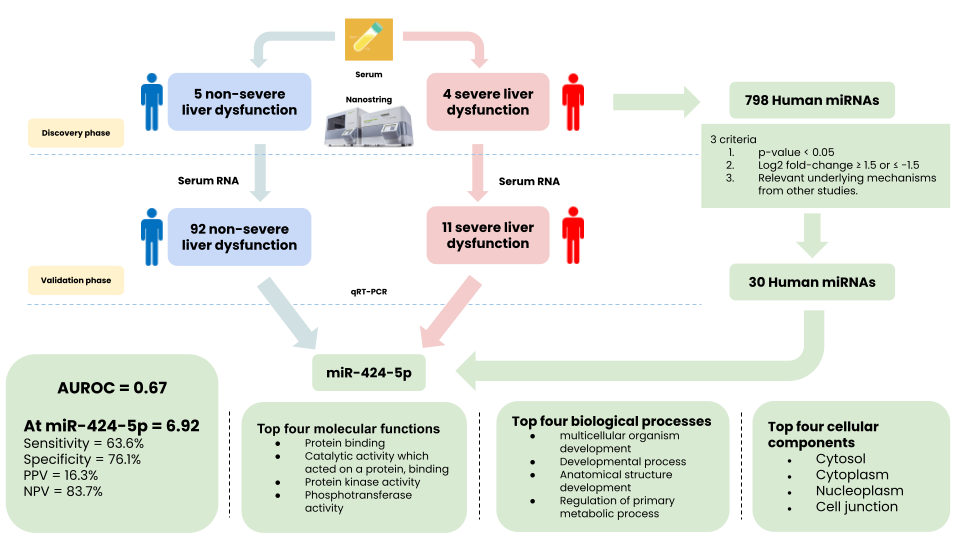
Objectives: This study aimed to explore the role of circulating microRNAs in predicting severe liver dysfunction in dengue infection by identifying and validating predictive microRNAs via NanoString and quantitative reverse transcription-polymerase chain reaction (qRT-PCR).
Methods: On the initial day of admission, serum samples were gathered from patients with dengue infection. These patients were monitored for 14 days post-admission to ascertain their final diagnosis. Following the WHO 2009 criteria, participants were categorized into severe and non-severe liver dysfunction groups. To perform transcriptomic analysis of the circulating microRNAs, we used the NanoString nCounter 1 Human v3 microRNA Expression Assays. Subsequently, we validated the levels of the selected microRNAs using qRTPCR.
Results: In the discovery phase, 5 non-severe cases and 4 severe cases were tested, and elevated liver enzymes were found in the severe cases. In the validation phase, 11 severe cases demonstrated substantially longer durations of fever before admission; higher white blood cell counts, total bilirubin, direct bilirubin, and liver enzyme levels; and lower platelet counts and abdominal pain, compared with those of the 92 non-severe cases. Analysis revealed that only 2 of 798 microRNAs, microRNA-424-5p and microRNA-30d-5p, were upregulated in the non-severe group compared to the severe group, and only microRNA-424-5p was significantly higher. microRNA-424-5p had an area under the receiver operating characteristic curve of 0.67 (95% confidence interval: 0.52–0.86, P = 0.04) and exhibited sensitivity, specificity, positive predictive value, and negative predictive value of 63.6%, 76.1%, 16.3%, and 83.7%, respectively. Functional enrichment and gene-targeting analyses indicated that microRNA-424-5p may influence important signaling pathways, including mitogen-activated protein kinase, PI3K-Akt, and mTOR, which are involved in cellular development and metabolic regulation.
Conclusion: Notably, microRNA-424-5p exhibited modest diagnostic performance in distinguishing severe from non-severe liver dysfunction. Our research highlighted the potential of circulating microRNAs, particularly microRNA-424-5p, as biomarkers for predicting severe liver dysfunction in patients with dengue.
Downloads
References
Cogan JE. Dengue and severe dengue. Geneva: World Health Organization; 2020 [cited 2021 Mar 1].
Leowattana W, Leowattana T. Dengue hemorrhagic fever and the liver. World J Hepatol 2021;13:1968-76.
https://doi.org/10.4254/wjh.v13.i12.1968
Fernando S, Wijewickrama A, Gomes L, Punchihewa CT, Madusanka SD, Dissanayake H, et al. Patterns and causes of liver involvement in acute dengue infection. BMC Infect Dis 2016;16:319.
https://doi.org/10.1186/s12879-016-1656-2
Kye Mon K, Nontprasert A, Kittitrakul C, Tangkijvanich P, Leowattana W, Poovorawan K. Incidence and clinical outcome of acute liver failure caused by dengue in a hospital for tropical diseases, Thailand. Am J Trop Med Hyg 2016;95:1338-44.
https://doi.org/10.4269/ajtmh.16-0374
Ruiz-Tagle C, Naves R, Balcells ME. Unraveling the Role of MicroRNAs in Mycobacterium tuberculosis Infection and Disease: Advances and Pitfalls. Infect Immun 2020;88:e00649-19.
https://doi.org/10.1128/IAI.00649-19
Gupta H, Wassmer SC. Harnessing the Potential of miRNAs in Malaria Diagnostic and Prevention. Front Cell Infect Microbiol 2021;11:793954.
https://doi.org/10.3389/fcimb.2021.793954
Fabian MR, Sonenberg N. The mechanics of miRNA-mediated gene silencing: a look under the hood of miRISC. Nat Struct Mol Biol 2012;19:586-93.
https://doi.org/10.1038/nsmb.2296
Tambyah PA, Ching CS, Sepramaniam S, Ali JM, Armugam A, Jeyaseelan K. microRNA expression in blood of dengue patients. Ann Clin Biochem 2016;53 Pt 4:466-76.
https://doi.org/10.1177/0004563215604001
Hanley JA, McNeil BJ. A method of comparing the areas under receiver operating characteristic curves derived from the same cases. Radiology 1983;148:839-43.
https://doi.org/10.1148/radiology.148.3.6878708
Obuchowski NA, McClish DK. Sample size determination for diagnostic accuracy studies involving binormal ROC curve indices. Stat Med 1997;16:1529-42.
https://doi.org/10.1002/(SICI)1097-0258(19970715)16:13<1529::AID-SIM565>3.0.CO;2-H
Negida A, Fahim NK, Negida Y. sample size calculation guide - part 4: how to calculate the sample size for a diagnostic test accuracy study based on sensitivity, specificity, and the area under the ROC curve. Adv J Emerg Med 2019;3:e33.
World Health Organization. Dengue: Guidelines for Diagnosis, Treatment, Prevention and Control. Geneva: World Health Organization; 2009.
Donati S, Ciuffi S, Brandi ML. Human Circulating miRNAs Real-time qRT-PCR-based Analysis: An Overview of Endogenous Reference Genes Used for Data Normalization. Int J Mol Sci 2019;20:4353.
https://doi.org/10.3390/ijms20184353
Wang L, Liu Y, Du L, Li J, Jiang X, Zheng G, et al. Identification and validation of reference genes for the detection of serum microRNAs by reverse transcription-quantitative polymerase chain reaction in patients with bladder cancer. Mol Med Rep 2015;12:615-22.
https://doi.org/10.3892/mmr.2015.3428
Peng HY, Jiang SS, Hsiao JR, Hsiao M, Hsu YM, Wu GH, et al. IL-8 induces miR-424-5p expression and modulates SOCS2/STAT5 signaling pathway in oral squamous cell carcinoma. Mol Oncol 2016;10:895-909.
https://doi.org/10.1016/j.molonc.2016.03.001
Monti-Rocha R, Cramer A, Gaio Leite P, Antunes MM, Pereira RVS, Barroso A, et al. SOCS2 is critical for the balancing of immune response and oxidate stress protecting against acetaminophen-induced acute liver injury. Front Immunol 2019;9:3134.
https://doi.org/10.3389/fimmu.2018.03134
Saini J, Bandyopadhyay B, Pandey AD, Ramachandran VG, Das S, Sood V, et al. High-Throughput RNA sequencing analysis of plasma samples reveals circulating microrna signatures with biomarker potential in dengue disease progression. mSystems 2020;5:e00724-20.
https://doi.org/10.1128/mSystems.00724-20
Dissanayake HA, Seneviratne SL. Liver involvement in dengue viral infections. Rev Med Virol 2018;28: e1971.
Downloads
Published
How to Cite
Issue
Section
License
Copyright (c) 2026 Chulalongkorn Medical Journal

This work is licensed under a Creative Commons Attribution-NonCommercial-NoDerivatives 4.0 International License.