Effectiveness and implementation of the SHIELD integrated multi-level model to reduce adolescent depression and internet addiction: A cluster randomized waitlist-controlled trial in Wang Chin district, Phrae province
Keywords:
Adolescent depression, cluster-randomized trial, implementation science, internet addiction, mental health interventionAbstract
Background: Adolescent depression and internet addiction are substantial comorbid mental health challenges in rural Thailand, where access to evidence-based interventions remains limited. Traditional single-modality approaches often fail to address the complex interplay among individual, family, and systemic factors that contribute to these conditions.
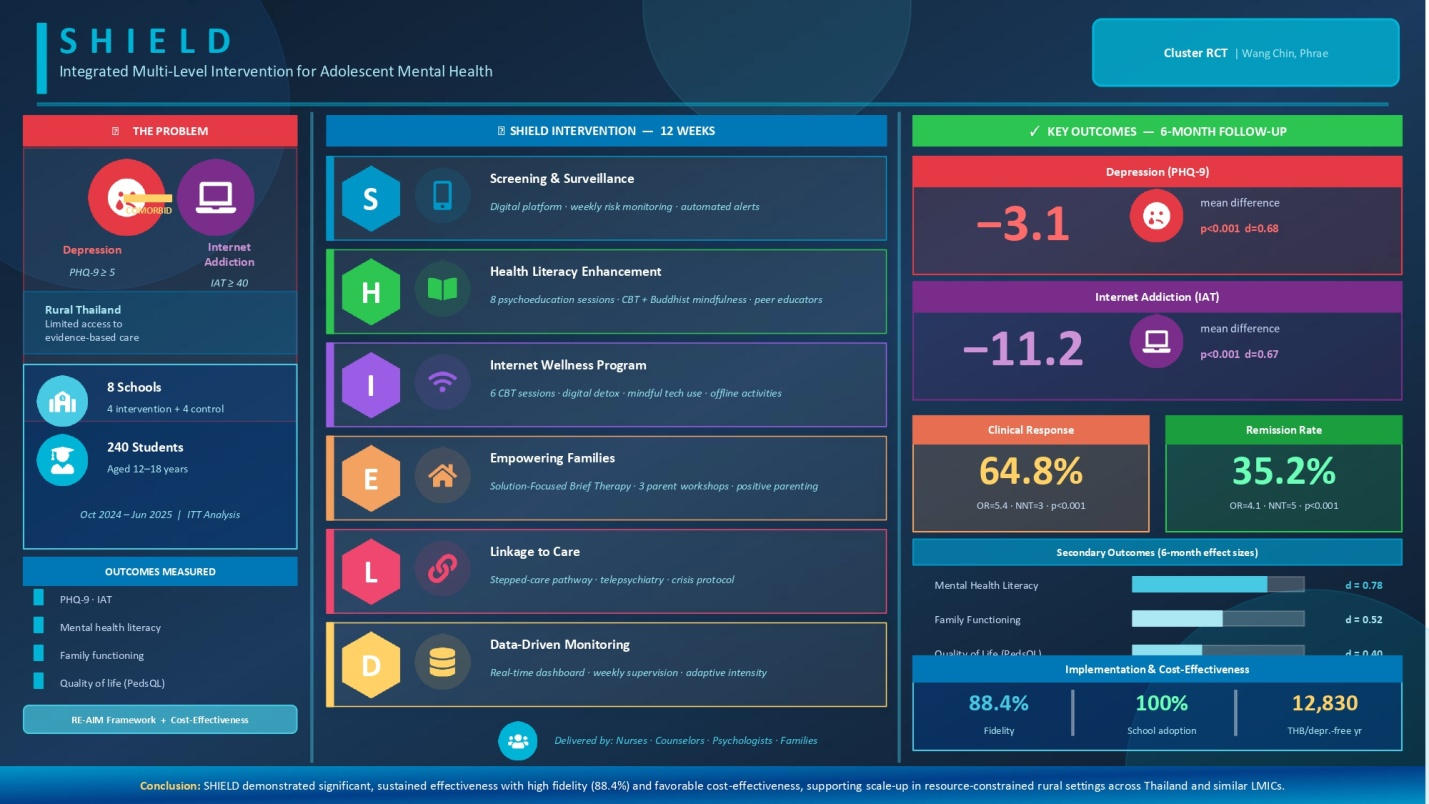
Objectives: This study aimed to evaluate the effectiveness and implementation outcomes of the SHIELD (Screening & surveillance, Health literacy enhancement, Internet wellness program, Empowering families, Linkage to care, Data-driven monitoring) integrated multi-level intervention for reducing depression and internet addiction among at-risk adolescents in rural Thailand.
Methods: A cluster-randomized waitlist-controlled trial was conducted across eight secondary schools in the Wang Chin district, Phrae province, between October 2024 and June 2025. The schools were randomized to immediate intervention (n = 4) or waitlist (n = 4) control groups. Participants included 240 at-risk students aged 12–18 years with Patient Health Questionnaire-9 (PHQ-9) ≥ 5 and Internet Addiction Test (IAT) ≥ 40. The 12-week SHIELD intervention integrated digital screening, psychoeducation, family therapy, internet wellness training, care coordination, and real-time monitoring, which was delivered by trained registered nurses, school counselors, and clinical psychologists. Primary outcomes included depression severity (PHQ- 9) and internet addiction levels (IAT). The secondary outcomes included mental health literacy, family functioning, quality of life, and implementation metrics using the RE-AIM framework. The observed intracluster correlation coefficient was 0.048. Data were analyzed using intention-to-treat mixed-effects models accounting for clustering, with economic evaluation performed from a societal perspective.
Results: At 6-month follow-up, the intervention group demonstrated significantly greater improvements in PHQ-9 scores (mean difference: −3.1, 95% CI: −4.0 to −2.2,P < 0.001, Cohen’s d = 0.68) and IAT scores (mean difference: −11.2, 95% CI: −14.8 to −7.6,P < 0.001, d = 0.67) compared to controls. Moreover, the clinical response rates (≥ 50% PHQ-9 reduction) were 64.8% vs. 25.5% (OR = 5.4, 95% CI: 3.2–9.2, NNT = 3) and the remission rates (PHQ-9 < 5) were 35.2% vs. 11.8% (OR = 4.1, 95% CI: 2.1–8.0, NNT = 5) differed between the intervention and control groups, respectively. Subgroup analyses demonstrated consistent intervention benefits across sex and age groups, with greater effects observed among students with moderate-to-severe baseline depression (d = 0.81) than mild depression (d = 0.54). Furthermore, the secondary outcomes revealed significant improvements in mental health literacy (d = 0.78), family functioning (d = 0.52), and quality of life (d = 0.40). The implementation outcomes demonstrated high fidelity (88.4%), excellent adoption (100.0% school participation), and favorable cost-effectiveness (ICER = 12,830 THB per depression-free year, below the WHO threshold of 34,400 THB).
Conclusion: The SHIELD integrated multi-level intervention exhibited substantial and sustained effectiveness in reducing adolescent depression and internet addiction with excellent implementation outcomes and favorable cost-effectiveness. Despite real-world implementation challenges, including initial barriers to parental engagement and technology access in rural settings, high fidelity was maintained throughout the trial. These findings support the potential for scaling evidence-based, culturally adapted interventions within Thailand’s educational and mental health systems to address the growing adolescent mental health needs in resourceconstrained settings.
Downloads
References
Boucher EM, Ward H, Miles CJ, Henry RD, Stoeckl SE. Effects of a digital mental health intervention on perceived stress, rumination, and loneliness in adolescents: randomized controlled trial. J Med Internet Res 2024;26:e54282.
Peake E, Miller I, Flannery J, Chen L, Lake J, Padmanabhan A. Preliminary efficacy of a digital intervention for adolescent depression: randomized clinical trial. J Med Internet Res 2024;26:e48467.
Pisani AR, Wyman PA, Cero I, Kelberman C, Gurditta K, Judd E, et al. Text messaging to extend school-based suicide prevention: pilot randomized controlled trial. JMIR Ment Health 2024;11:e56407.
Marino C, Gini G, Vieno A, Spada MM. A comprehensive meta-analysis on problematic social media use among adolescents and its associations with mental health. JMIR Ment Health 2023;10:e33450.
Chen Q, Lo CKM, Yip PSF, Chan KL. Global prevalence of cyberbullying in adolescents and its association with mental health: systematic review and meta-analysis. Eur Child Adolesc Psychiatry 2023;32:1107-23.
Walsh C, McMahon EM, Herring MP. The effects of school-based suicide prevention programs on suicidal ideation and behaviors in adolescents: systematic review and meta-analysis. J Child Psychol Psychiatry 2022;63:1197-207.
https://doi.org/10.1111/jcpp.13598
Goodkind S, Bybee D, Hess J, Newbery J, Brown K. Multilevel community-based mental health intervention for adolescents: randomized trial. PLoS One 2024;19:e0298369.
https://doi.org/10.1371/journal.pone.0298369
Schäfer SK, von Boros L, Schaubruch LM, Kunzler AM, Lindner S, Koehler F, et al. Digital interventions to promote psychological resilience: a systematic review and meta-analysis. NPJ Digit Med 2024;7:30.
https://doi.org/10.1038/s41746-024-01017-8
Yi-Frazier JP, Hilliard ME, O'Donnell MB, Zhou C, Ellisor BM, Garcia Perez S, et al. Promoting resilience in stress management for adolescents with type 1 diabetes: a randomized clinical trial. JAMA Netw Open 2024;7:e2428287.
https://doi.org/10.1001/jamanetworkopen.2024.28287
Mei Z, Jiang W, Zhang Y, Luo S, Luo S. Mind-body therapies for resilience in adolescents: a systematic review of randomized controlled trials. Gen Hosp Psychiatry 2024;91:43-51.
https://doi.org/10.1016/j.genhosppsych.2024.08.014
Llistosella M, Ramos-Sánchez N, Conte-Berruga B, et al. A school-based multicomponent program to strengthen resilience in at-risk adolescents: randomized controlled trial. Front Psychol 2024;15:1478424.
https://doi.org/10.3389/fpsyg.2024.1478424
Danpho K, Umesh P, Jones S, Chaisricharoen R, Watts P. Digital behavior and mental health among Thai adolescents in Bangkok: cross-sectional study. BMJ Paediatr Open 2025;9:e003238.
https://doi.org/10.1136/bmjpo-2024-003238
Hosiri T, Rattarittamrong R, Charoensook R, Tovar A, Sirilert P. Adverse childhood experiences, behavior problems, and resilience among adolescents in Southern Thailand. Siriraj Med J 2024;76:282-92.
https://doi.org/10.33192/smj.v76i5.267232
Kulikov VN, Crosthwaite PC, Hall SA, Flannery JE, Strauss GS, Vierra EM, et al. A CBT-based mobile intervention as an adjunct treatment for adolescents with symptoms of depression: a virtual randomized controlled feasibility trial. Front Digit Health 2023;5:1062471.
https://doi.org/10.3389/fdgth.2023.1062471
Wani C, McCann L, Lennon M, Radu C. Digital mental health interventions for adolescents in low- and middle-income countries: systematic review. J Med Internet Res 2024;26:e51376.
Hjetland GJ, Finserås TR, Sivertsen B, Colman I, Hella RT, Andersen AIO, et al. Digital self-presentation and adolescent mental health: a longitudinal study. BMC Public Health 2024;24:2635.
https://doi.org/10.1186/s12889-024-20052-4
Uhlhaas PJ, Torous J, Carpenter WT Jr. Digital psychiatry and youth mental health: opportunities and challenges. Mol Psychiatry 2023;28:1280-92.
Nochaiwong S, Ruengorn C, Awiphan R, Phosuya C, Ruanta Y, Kanjanarat P, et al. Transcultural adaptation and psychometric validation of the Thai Brief Resilient Coping Scale (BRCS) among general population and college students. Sci Rep. 2022;12:21521.
https://doi.org/10.1038/s41598-022-26063-8
Organisation for Economic Co-operation and Development. OECD Digital education outlook 2021: Pushing the frontiers with artificial intelligence, blockchain and robots. Paris: OECD Publishing; 2021.
Sun H, Yuan C, Qian Q, He S, Luo Q. Digital resilience among individuals in school education settings: a concept analysis based on a scoping review. Front Psychiatry 2022;13:858515.
Downloads
Published
How to Cite
Issue
Section
License
Copyright (c) 2026 Chulalongkorn Medical Journal

This work is licensed under a Creative Commons Attribution-NonCommercial-NoDerivatives 4.0 International License.