Association between underpants fit and semen quality: A hospital-based cross-sectional study
Keywords:
DNA fragmentation, lifestyle factors, semen analysis, underpants fitAbstract
Background: The effect of the underpants type on semen parameters remains controversial. Therefore, conducting such a study in Thai male partners may provide valuable region-specific data.
Objectives: This cross-sectional study aimed to examine the association between underpants fit and semen parameters, including semen volume, sperm count, motility, morphology, and DNA fragmentation, among Thai male partners in Bangkok, Thailand.
Methods: Thai male partners aged 20–55 years who sought infertility treatment from the Reproductive Biology Unit, King Chulalongkorn Memorial Hospital, Bangkok, were recruited from March to June 2024. All participants completed a questionnaire on their sociodemographic, medical history, and underpants type and provided one semen sample, which was analyzed in accordance with the 6thedition of the World Health Organization laboratory manual (2021).
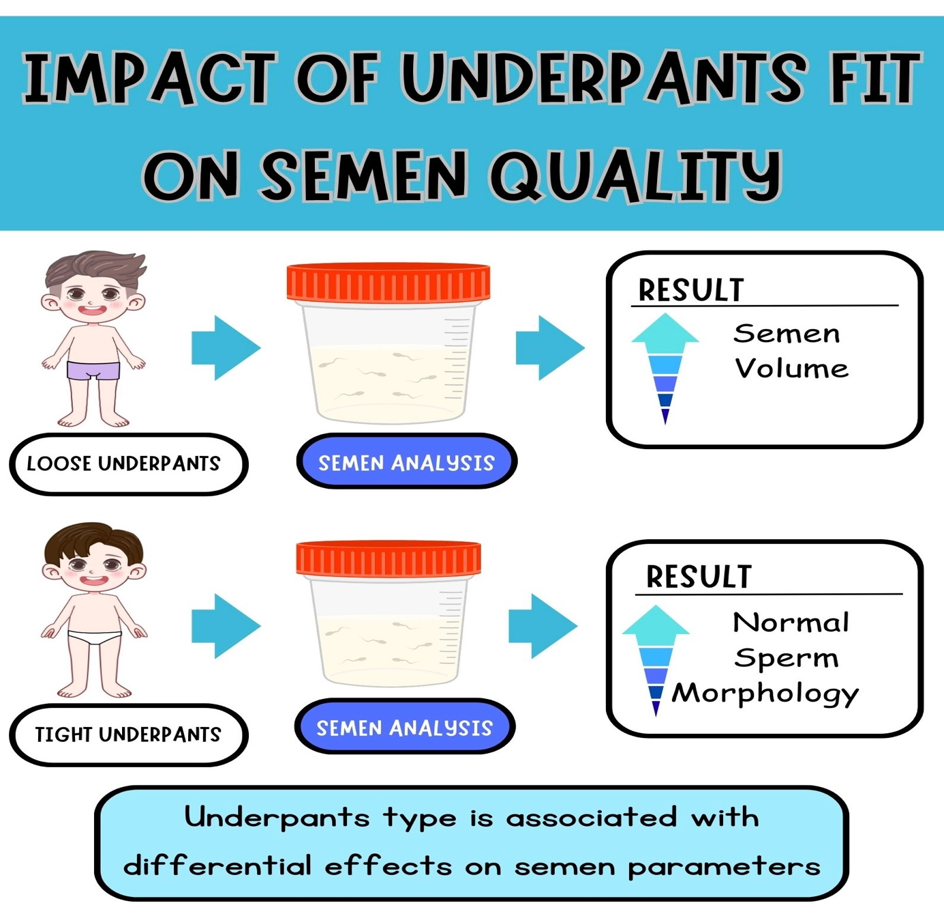
Results: Among the 116 eligible participants, 93.1% preferred wearing tight-fitting underpants during the day, whereas 74.1% opted for boxers or none at night. An increased semen volume was observed in men wearing loose-fitting underwear during the day and at night by 1.2 mL with P = 0.004 (95% CI: 0.41–2.06), whereas higher normal sperm morphology was found in men wearing tight-fitting underpants during that day and night by 0.5 with P = 0.031 (95% CI: 0.04–0.94). The other semen parameters were not significantly affected by the fit of the underpants.
Conclusion: A straightforward lifestyle choice, such as selecting a specific type of underpants, may influence semen volume and sperm morphology.
Downloads
References
Zegers-Hochschild F, Adamson GD, Dyer S, Racowsky C, de Mouzon J, Sokol R, et al. The International Glossary on Infertility and Fertility Care, 2017. Hum Reprod 2017;32:1786-801.
https://doi.org/10.1093/humrep/dex234
Cox CM, Thoma ME, Tchangalova N, Mburu G, Bornstein MJ, Johnson CL, et al. Infertility prevalence and the methods of estimation from 1990 to 2021: A systematic review and meta-analysis. Hum Reprod Open 2022;2022:hoac051.
https://doi.org/10.1093/hropen/hoac051
Huang B, Wang Z, Kong Y, Jin M, Ma L. Global, regional and national burden of male infertility in 204 countries and territories between 1990 and 2019: An analysis of global burden of disease study. BMC Public Health 2023;23:2195.
https://doi.org/10.1186/s12889-023-16793-3
Vander Borght M, Wyns C. Fertility and infertility: Definition and epidemiology. Clin Biochem 2018;62:2-10.
https://doi.org/10.1016/j.clinbiochem.2018.03.012
Sharma A, Minhas S, Dhillo WS, Jayasena CN. Male infertility due to testicular disorders. J Clin Endocrinol Metab 2021;106:e442-59.
https://doi.org/10.1210/clinem/dgaa781
Tang Q, Pan F, Wu X, Nichols CE, Wang X, Xia Y, et al. Semen quality and cigarette smoking in a cohort of healthy fertile men. Environ Epidemiol 2019;3:e055.
https://doi.org/10.1097/EE9.0000000000000055
Finelli R, Mottola F, Agarwal A. Impact of alcohol consumption on male fertility potential: A narrative review. Int J Environ Res Public Health 2021;19:328.
https://doi.org/10.3390/ijerph19010328
Amor H, Hammadeh ME, Mohd I, Jankowski PM. Impact of heavy alcohol consumption and cigarette smoking on sperm DNA integrity. Andrologia 2022;54:e14434.
https://doi.org/10.1111/and.14434
Bu FL, Feng X, Yang XY, Ren J, Cao HJ. Relationship between caffeine intake and infertility: A systematic review of controlled clinical studies. BMC Womens Health 2020;20:125.
https://doi.org/10.1186/s12905-020-00973-z
Alghobary M, Mostafa T. Addiction and human male fertility: A systematic review and a critical appraisal. Andrology 2022;10:1073-95.
https://doi.org/10.1111/andr.13196
Pinto-Pinho P, Matos J, Arantes-Rodrigues R, Gomes Z, Brito M, Moutinho O, et al. Association of lifestyle factors with semen quality: A pilot study conducted in men from the Portuguese Trás-os-Montes and Alto Douro region followed in fertility support consultations. Andrologia 2020;52:e13549.
https://doi.org/10.1111/and.13549
Mann U, Shiff B, Patel P. Reasons for worldwide decline in male fertility. Curr Opin Urol 2020;30:296-301.
https://doi.org/10.1097/MOU.0000000000000745
Leisegang K, Dutta S. Do lifestyle practices impede male fertility? Andrologia 2021;53:e13595.
Nordkap L, Jensen TK, Hansen ÅM, Lassen TH, Bang AK, Joensen UN, et al. Psychological stress and testicular function: a cross-sectional study of 1,215 Danish men. Fertil Steril 2016;105:174-87.
https://doi.org/10.1016/j.fertnstert.2015.09.016
Tiemessen CH, Evers JL, Bots RS. Tight-fitting underwear and sperm quality. Lancet 1996;347:1844-5.
https://doi.org/10.1016/S0140-6736(96)91670-0
Povey AC, Clyma JA, McNamee R, Moore HD, Baillie H, Pacey AA, et al. Modifiable and non-modifiable risk factors for poor semen quality: a case-referent study. Hum Reprod 2012;27:2799-806.
https://doi.org/10.1093/humrep/des183
Mínguez-Alarcón L, Gaskins AJ, Chiu YH, Messerlian C, Williams PL, Ford JB, et al. Type of underwear worn and markers of testicular function among men attending a fertility center. Hum Reprod 2018;33:1749-56.
https://doi.org/10.1093/humrep/dey259
Mieusset R, Bengoudifa B, Bujan L. Effect of posture and clothing on scrotal temperature in fertile men. J Androl 2007;28:170-5.
https://doi.org/10.2164/jandrol.106.000646
Jung A, Leonhardt F, Schill WB, Schuppe HC. Influence of the type of undertrousers and physical activity on scrotal temperature. Hum Reprod 2005;20:1022-7.
https://doi.org/10.1093/humrep/deh697
Kefer JC, Agarwal A, Sabanegh E. Role of antioxidants in the treatment of male infertility. Int J Urol 2009;16:449-57.
https://doi.org/10.1111/j.1442-2042.2009.02280.x
Esteves SC, Zini A, Coward RM, Evenson DP, Gosálvez J, Lewis SEM, et al. Sperm DNA fragmentation testing: Summary evidence and clinical practice recommendations. Andrologia 2021;53:e13874.
https://doi.org/10.1111/and.13874
Sapra KJ, Eisenberg ML, Kim S, Chen Z, Buck Louis GM. Choice of underwear and male fecundity in a preconception cohort of couples. Andrology 2016;4:500-8.
https://doi.org/10.1111/andr.12163
Green SB. How Many Subjects Does It Take To Do A Regression Analysis. Multivar Behav Res 1991;26:499-510.
https://doi.org/10.1207/s15327906mbr2603_7
Chung E, Atmoko W, Saleh R, Shah R, Agarwal A. Sixth edition of the World Health Organization laboratory manual of semen analysis: Updates and essential take away for busy clinicians. Arab J Urol 2023;22:71-4.
https://doi.org/10.1080/20905998.2023.2298048
Sanger WG, Friman PC. Fit of underwear and male spermatogenesis: a pilot investigation. Reprod Toxicol 1990;4:229-32.
https://doi.org/10.1016/0890-6238(90)90063-2
Parazzini F, Marchini M, Luchini L, Tozzi L, Mezzopane R, Fedele L. Tight underpants and trousers and risk of dyspermia. Int J Androl 1995;18:137-40.
https://doi.org/10.1111/j.1365-2605.1995.tb00400.x
Munkelwitz R, Gilbert BR. Are boxer shorts really better? A critical analysis of the role of underwear type in male subfertility. J Urol 1998;160:1329-33.
https://doi.org/10.1016/S0022-5347(01)62528-X
Jurewicz J, Radwan M, Sobala W, Ligocka D, Radwan P, Bochenek M, et al. Lifestyle and semen quality: role of modifiable risk factors. Syst Biol Reprod Med 2014;60:43-51.
https://doi.org/10.3109/19396368.2013.840687
Ameen EM, Najim K Sabir F, Mohammed SI. Relationships between semen quality and fertility in a population of infertile men in Erbil city: Semen quality and fertility in infertile men. Cell Mol Biol (Noisy-le-grand) 2022;68:63-8.
https://doi.org/10.14715/cmb/2022.68.10.9
Kasman AM, Li S, Zhao Q, Behr B, Eisenberg, ML. Relationship between male age, semen parameters and assisted reproductive technology outcomes. Andrology 2021;9:245-52.
https://doi.org/10.1111/andr.12908
Zhou J, Chen L, Li J, Li H, Hong Z, Xie M, et al. The Semen pH affects sperm motility and capacitation. PLoS One 2015;10:e0132974.
Dcunha R, Hussein RS, Ananda H, Kumari S, Adiga SK, Kannan N, et al. Current insights and latest updates in sperm motility and associated applications in assisted reproduction. Reprod Sci 2022;29:7-25.
https://doi.org/10.1007/s43032-020-00408-y
Maldonado-Cárceles AB, Mínguez-Alarcón L, Mendiola J, Vioque J, Jørgensen N, Árense-Gonzalo JJ, et al. Meat intake in relation to semen quality and reproductive hormone levels among young men in Spain. Br J Nutr 2019;121:451-60.
https://doi.org/10.1017/S0007114518003458
Oldereid NB, Rui H, Purvis K. Lifestyles of men in barren couples and their relationships to sperm quality. Eur J Obstet Gynecol Reprod Biol 1992;43:51-7.
https://doi.org/10.1016/0028-2243(92)90243-R
Pacey AA, Povey AC, Clyma JA, McNamee R, Moore HD, Baillie H, et al. Modifiable and non-modifiable risk factors for poor sperm morphology. Hum Reprod 2014;29:1629-36.
https://doi.org/10.1093/humrep/deu116
Gatimel N, Moreau J, Parinaud J, Léandri RD. Sperm morphology: assessment, pathophysiology, clinical relevance, and state of the art in 2017. Andrology 2017;5:845-62.
https://doi.org/10.1111/andr.12389
Sapra KJ, Kim S, Eisenberg M, Chen Z, Buck Louis GM. Male underwear and semen quality in a population-based preconception cohort. Fertil Sterilt 2015;104:e45.
Chao HH, Zhang Y, Dong PY, Gurunathan S, Zhang XF. Comprehensive review on the positive and negative effects of various important regulators on male spermatogenesis and fertility. Front Nutr 2023;9:1063510.
Downloads
Published
How to Cite
Issue
Section
License
Copyright (c) 2026 Chulalongkorn Medical Journal

This work is licensed under a Creative Commons Attribution-NonCommercial-NoDerivatives 4.0 International License.