Machine learning-based gene signature detection highlights CXCL12 as a key marker for acute myeloid leukemia prediction
Keywords:
AML, biomarker detection, gene signature, machine learning, transcriptomicsAbstract
Background: Acute myeloid leukemia (AML) is a severe hematologic malignancy that is marked by the uncontrolled proliferation and impaired differentiation of myeloid cells, which disrupts normal hematopoiesis and results in poor clinical outcomes. Conventional diagnostic approaches often lack the precision needed to accurately classify AML subtypes; therefore, integrating advanced computational methods is required to improve diagnostic and therapeutic strategies.
Objectives: This study aimed to apply machine learning (ML) techniques to transcriptomic data to identify a concise, informative gene signature that can distinguish AML cases from normal samples. In addition, the study sought to evaluate the performance of predictive models in supporting AML prediction and facilitating biomarker discovery.
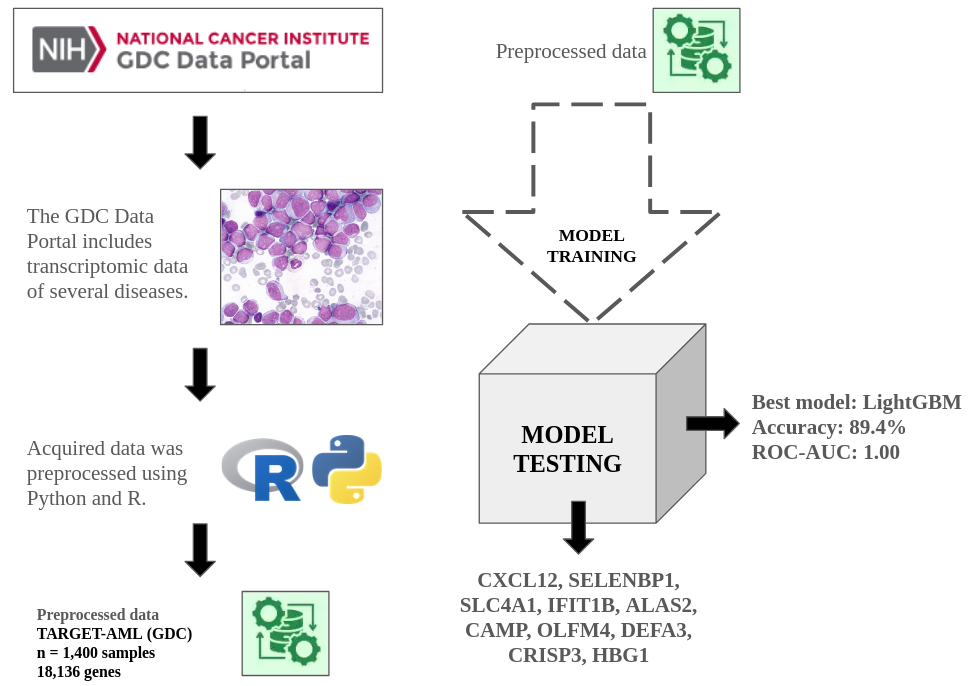
Methods: Gene expression data were obtained from the TARGET-AML project via the Genomic Data Commons portal. Feature selection was performed using SelectKBest with chi-square scoring to identify the top 10 AML-associated genes. To address class imbalance, SMOTE was employed. Several ML models, including Random Forest, XGBoost, LightGBM, and a Stacking ensemble, were trained and optimized via hyperparameter tuning to classify AML vs. normal samples.
Results: The selected gene panel included CXCL12, SELENBP1, SLC4A1, IFIT1B, ALAS2, CAMP, OLFM4, DEFA3, CRISP3, and HBG1, which are functionally associated with immune response, inflammation, and hematopoietic processes. All models demonstrated robust classification performance: Random Forest (88.6%), XGBoost (88.8%), LightGBM (89.4%), and Stacking (89.4%). SMOTE effectively enhanced the model performance, particularly for underrepresented classes, thereby improving precision and recall.
Conclusion: This study identified a small, yet informative gene set that accurately differentiates AML from normal samples, with LightGBM revealing the highest predictive accuracy. The involvement of immune and inflammatory genes aligns with AML’s biological foundations. These findings suggest the clinical potential of ML-based tools for AML diagnostics. Future validation on independent cohorts and the integration of multi-omic data could further improve the model’s robustness and facilitate broader applications in precision medicine for hematologic malignancies.
Downloads
References
Courville EL, Wu Y, Kourda J, Roth CG, Brockmann J, Muzikansky A, et al. Clinicopathologic analysis of acute myeloid leukemia arising from chronic myelomonocytic leukemia. Mod Pathol 2013;26:751-61.
https://doi.org/10.1038/modpathol.2012.218
Portwood S, Lal D, Hsu YC, Vargas R, Johnson MK, Wetzler M, et al. Activity of the hypoxia-activated prodrug, TH-302, in preclinical human acute myeloid leukemia models. Clin Cancer Res 2013;19:6506-19.
https://doi.org/10.1158/1078-0432.CCR-13-0674
El-Jawahri A, Nelson-Lowe M, VanDusen H, Traeger L, Abel GA, Greer JA, et al. Patient-Clinician Discordance in Perceptions of Treatment Risks and Benefits in Older Patients with Acute Myeloid Leukemia. Oncologist 2019;24:247-54.
https://doi.org/10.1634/theoncologist.2018-0317
Han HJ, Choi K, Suh HS. Impact of aging on acute myeloid leukemia epidemiology and survival outcomes: A real-world, population-based longitudinal cohort study. PLoS One 2024;19:e0300637.
https://doi.org/10.1371/journal.pone.0300637
Nakada D. Venetolax with azacitidine drains fuel from aml stem cells. Cell Stem Cell 2019;24:7-8.
https://doi.org/10.1016/j.stem.2018.12.005
Wang W, Xu J, Khoury JD, Pemmaraju N, Fang H, Miranda RN, et al. Immunophenotypic and molecular features of acute myeloid leukemia with plasmacytoid dendritic cell differentiation are distinct from blastic plasmacytoid dendritic cell neoplasm. Cancers (Basel) 2022;14:3375.
https://doi.org/10.3390/cancers14143375
Qi H, Zhang H, Zhao X, Qin Y, Liang G, He X, et al. Integrated analysis of mRNA and protein expression profiling in tubal endometriosis. Reproduction 2020;159:601-14.
https://doi.org/10.1530/REP-19-0587
Akshay A, Besic M, Kuhn A, Burkhard FC, Bigger-Allen A, Adam RM, et al. Machine learning-based classification of transcriptome signatures of non-ulcerative bladder pain syndrome. Int J Mol Sci 2024;25:1568.
https://doi.org/10.3390/ijms25031568
Zhu X, Wang CL, Yu JF, Weng J, Han B, Liu Y, et al. Identification of immune-related biomarkers in peripheral blood of schizophrenia using bioinformatic methods and machine learning algorithms. Front Cell Neurosci 2023;17:1256184.
https://doi.org/10.3389/fncel.2023.1256184
Staples TL. Expansion and evolution of the R programming language. R Soc Open Sci 2023;10:221550.
https://doi.org/10.1098/rsos.221550
Mounir M, Lucchetta M, Silva CT, Olsen C, Bontempi G, Chen X, et al. New functionalities in the TCGAbiolinks package for the study and integration of cancer data from GDC and GTEx. PLoS Comput Biol 2019;15:e1006701.
https://doi.org/10.1371/journal.pcbi.1006701
Wickham H, Averick M, Bryan J, Chang W, McGowan LD, François R, et al. Welcome to the tidyverse. J Open Source Softw 2019 ;4:1686.
https://doi.org/10.21105/joss.01686
Morgan M, Obenchain V, Hester J, Pagès H. SummarizedExperiment: A container (S4 class) for matrix-like assays [Internet]. Version 1.38.1. 2025 [cited 2026 May 19]. Available from: https://bioconductor.org/packages/SummarizedExperiment
Abdennur N, Fudenberg G, Flyamer IM, Galitsyna AA, Goloborodko A, Imakaev M, et al. Bioframe: operations on genomic intervals in Pandas dataframes. Bioinformatics 2024;40:btae088.
Durinck S, Spellman PT, Birney E, Huber W. Mapping identifiers for the integration of genomic datasets with the R/Bioconductor package biomaRt. Nat Protoc 2009;4:1184-91.
https://doi.org/10.1038/nprot.2009.97
Pedregosa F, Varoquaux G, Gramfort A, Michel V, Thirion B, Grisel O, et al. Scikit-learn: Machine learning in Python. J Mach Learn Res 2011;12:2825-30.
Xu S, Hu E, Cai Y, Xie Z, Luo X, Zhan L, et al. Using clusterProfiler to characterize multiomics data. Nat Protoc 2024;19:3292-320.
https://doi.org/10.1038/s41596-024-01020-z
ENCODE Project Consortium. An integrated encyclopedia of DNA elements in the human genome. Nature 2012;489:57-74.
https://doi.org/10.1038/nature11247
Qi WY, Zheng SH, Li SZ, Wang W, Wang QY, Liu QY, et al. Immune cells in metabolic associated fatty liver disease: Global trends and hotspots (2004-2024). World J Hepatol 2025;17:103327.
https://doi.org/10.4254/wjh.v17.i3.103327
Tu S, Zhang H, Qu X. Screening of key methylation-driven genes CDO1 in breast cancer based on WGCNA. Cancer Biomark 2022;34:571-82.
https://doi.org/10.3233/CBM-210485
Sherman BT, Hao M, Qiu J, Jiao X, Baseler MW, Lane HC, et al. DAVID: a web server for functional enrichment analysis and functional annotation of gene lists (2021 update). Nucleic Acids Res 2022;50 W1:W216-W21.
https://doi.org/10.1093/nar/gkac194
Shen T, Wang H, Hu R, Lv Y. Developing neural network diagnostic models and potential drugs based on novel identified immune-related biomarkers for celiac disease. Hum Genomics 2023;17:76.
https://doi.org/10.1186/s40246-023-00526-z
Karamti H, Alharthi R, Anizi AA, Alhebshi RM, Eshmawi AA, Alsubai S, et al. Improving prediction of cervical cancer using KNN imputed SMOTE features and multi-model ensemble learning approach. Cancers (Basel). 2023;15:4412.
https://doi.org/10.3390/cancers15174412
Panwar B, Arora A, Raghava GP. Prediction and classification of ncRNAs using structural information. BMC Genomics 2014;15:127.
https://doi.org/10.1186/1471-2164-15-127
Patel K, Remlinger KS, Walker TG, Leitner P, Lucas JE, Gardner SD, et al. Multiplex protein analysis to determine fibrosis stage and progression in patients with chronic hepatitis C. Clin Gastroenterol Hepatol 2014;12:2113-20.e3.
https://doi.org/10.1016/j.cgh.2014.04.037
Zou Z, Wang L, Chen J, Long T, Wu Q, Zhou M. Research on peanut variety classification based on hyperspectral image. Food Sci Technol 2022;42:e18522.
https://doi.org/10.1590/fst.18522
Yan J, Xu Y, Cheng Q, Jiang S, Wang Q, Xiao Y, et al. Light GBM: accelerated genomically designed crop breeding through ensemble learning. Genome Biol 2021;22:271.
https://doi.org/10.1186/s13059-021-02492-y
Kim J, Mun S, Lee S, Jeong K, Baek Y. Prediction of metabolic and pre-metabolic syndromes using machine learning models with anthropometric, lifestyle, and biochemical factors from a middle-aged population in Korea. BMC Public Health 2022;22:664.
https://doi.org/10.1186/s12889-022-13131-x
Alghamdi M, Al-Mallah M, Keteyian S, Brawner C, Ehrman J, Sakr S. Predicting diabetes mellitus using SMOTE and ensemble machine learning approach: The Henry Ford ExercIse Testing (FIT) project. PLoS One 2017;12:e0179805.
https://doi.org/10.1371/journal.pone.0179805
Hadianfard Z, Lotfnezhad Afshar H, Nazarbaghi S, Rahimi B, Timpka T. Predicting mortality in patients with stroke using data mining techniques. Acta Inform Prag 2022;11:36-47.
https://doi.org/10.18267/j.aip.163
Zhao Y, Wong ZS, Tsui KL. A framework of rebalancing imbalanced healthcare data for rare events' classification: A case of look-alike sound-alike mix-up incident detection. J Healthc Eng 2018;2018:6275435.
https://doi.org/10.1155/2018/6275435
Anuntakarun S, Khamjerm J, Tangkijvanich P, Chuaypen N. Classification of long non-coding RNAs s between early and late stage of liver cancers from non-coding RNA profiles using machine-learning approach. Bioinform Biol Insights. 2024;18:11779322241258586.
https://doi.org/10.1177/11779322241258586
Aswal S, Ahuja NJ, and Mehra R. Feature Selection Method Based on Honeybee-SMOTE for Medical Data Classification. Informatica 2023:46.
https://doi.org/10.31449/inf.v46i9.4098
Sugiyama T, Kohara H, Noda M, Nagasawa T. Maintenance of the hematopoietic stem cell pool by CXCL12-CXCR4 chemokine signaling in bone marrow stromal cell niches. Immunity 2006;25:977-88.
https://doi.org/10.1016/j.immuni.2006.10.016
Fricker SP, Sprott K, Spyra M, Uhlig P, Lange N, David K, Wang Y. Characterization and validation of antibodies for immunohistochemical staining of the chemokine CXCL12. J Histochem Cytochem 2019;67:257-66.
https://doi.org/10.1369/0022155418818788
Abe-Suzuki S, Kurata M, Abe S, Onishi I, Kirimura S, Nashimoto M, et al. CXCL12+ stromal cells as bone marrow niche for CD34+ hematopoietic cells and their association with disease progression in myelodysplastic syndromes. Lab Invest 2014;94:1212-23.
https://doi.org/10.1038/labinvest.2014.110
Yao JC, Oetjen KA, Wang T, Xu H, Abou-Ezzi G, Krambs JR, et al. TGF-β signaling in myeloproliferative neoplasms contributes to myelofibrosis without disrupting the hematopoietic niche. J Clin Invest 2022;132:e154092.
https://doi.org/10.1172/JCI154092
Smith MA, Choudhary GS, Pellagatti A, Choi K, Bolanos LC, Bhagat TD, et al. U2AF1 mutations induce oncogenic IRAK4 isoforms and activate innate immune pathways in myeloid malignancies. Nat Cell Biol 2019;21:640-50.
https://doi.org/10.1038/s41556-019-0314-5
Barreyro L, Sampson AM, Ishikawa C, Hueneman KM, Choi K, Pujato MA, et al. Blocking UBE2N abrogates oncogenic immune signaling in acute myeloid leukemia. Sci Transl Med 2022;14:eabb7695.
https://doi.org/10.1126/scitranslmed.abb7695
Toufiq M, Rinchai D, Bettacchioli E, Kabeer BSA, Khan T, Subba B, et al. Harnessing large language models (LLMs) for candidate gene prioritization and selection. J Transl Med 2023;21:728.
https://doi.org/10.1186/s12967-023-04576-8
Pashoutan Sarvar D, Karimi MH, Movassaghpour A, Akbarzadehlaleh P, Aqmasheh S, Timari H, Shamsasenjan K. The effect of mesenchymal stem cell-derived microvesicles on erythroid differentiation of umbilical cord blood-derived CD34+ Cells. Adv Pharm Bull 2018;8:291-6.
https://doi.org/10.15171/apb.2018.034
Kohara H, Kohara H, Ogura H, Aoki T, Sakamoto C, Ogawa Y, Miyamoto S, et al. Generation and functional analysis of congenital dyserythropoietic anemia (CDA) patient-specific induced pluripotent stem cells. Blood 2016;128;2426.
Downloads
Published
How to Cite
Issue
Section
License
Copyright (c) 2026 Chulalongkorn Medical Journal

This work is licensed under a Creative Commons Attribution-NonCommercial-NoDerivatives 4.0 International License.