Beyond idiopathic ventricular fibrillation: Vasospastic angina uncovered after ICD implantation
Keywords:
CAG with provocative test, vasospastic angina, ventricular fibrillationAbstract
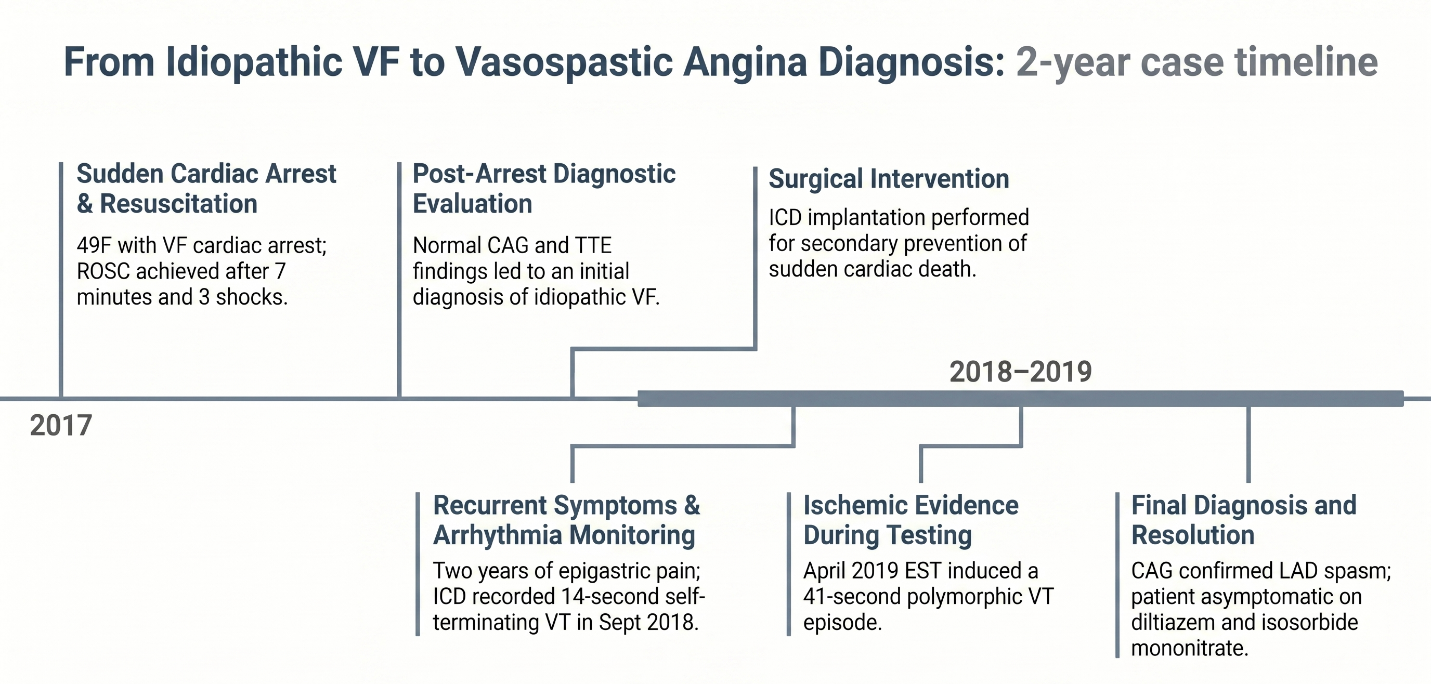
A woman in her 40s presented with epigastric pain and subsequently developed ventricular fibrillation (VF) cardiac arrest requiring resuscitation. The initial coronary angiography (CAG) revealed no significant stenosis. Due to limited resources and the unavailability of a provocation test, the patient was diagnosed with idiopathic VF, and an implantable cardioverter-defibrillator (ICD) was placed. Despite experiencing epigastric pain for two years with no significant endoscopic findings, an exercise stress test (EST) later identified ventricular arrhythmia, which suggested an ischemia-related mechanism despite normal coronary anatomy. During followup, she developed ST-elevation myocardial infarction, and a subsequent CAG revealed coronary spasm. She was diagnosed with vasospastic angina (VSA) and treated with nitrates and diltiazem. The patient is now free of epigastric pain and arrhythmic episodes. This case highlights the diagnostic challenges of VSA because of its atypical presentation and the limitations of resource-constrained settings, which can result in delayed diagnosis. Clinicians should consider VSA in patients with angina, sudden cardiac death, and abnormal EST results, especially in the absence of significant stenosis. While CAG with provocative testing is the standard diagnostic approach, alternative diagnostic pathways should be applied in resource-limited settings. Treatment options include medications and ICD placement, which should be considered for patients with high-risk VSA and recurrent ventricular arrhythmias.
Downloads
References
Prinzmetal M, Kennamer R, Merliss R, Wada T, Bor N. Angina pectoris. I. A variant form of angina pectoris; preliminary report. Am J Med 1959;27:375-88.
https://doi.org/10.1016/0002-9343(59)90003-8
Beltrame JF, Crea F, Kaski JC, Ogawa H, Ong P, Sechtem U, et al. International standardization of diagnostic criteria for vasospastic angina. Eur Heart J 2015;38:ehv351.
https://doi.org/10.1093/eurheartj/ehv351
Rodríguez-Mañero M, Oloriz T, le Polain de Waroux JB, Burri H, Kreidieh B, de Asmundis C, et al. Long-term prognosis of patients with life-threatening ventricular arrhythmias induced by coronary artery spasm. Europace 2017;20:851-8.
https://doi.org/10.1093/europace/eux052
Picard F, Sayah N, Spagnoli V, Adjedj J, Varenne O. Vasospastic angina: A literature review of current evidence. Arch Cardiovasc Dis 2019;112:44-55.
https://doi.org/10.1016/j.acvd.2018.08.002
Myerburg RJ, Kessler KM, Mallon SM, Cox MM, deMarchena E, Interian A Jr, Castellanos A. Life-threatening ventricular arrhythmias in patients with silent myocardial ischemia due to coronary-artery spasm. N Engl J Med 1992;326:1451-5.
https://doi.org/10.1056/NEJM199205283262202
Baig MA, Elmogy A, Hegazy Y, Ghallab M, Ahmed MS. Unleashing an underlying serious cardiac arrhythmia: a case of coronary vasospasm with atypical presentation. Cureus 2024;16:e54971.
https://doi.org/10.7759/cureus.54971
Chevalier P, Dacosta A, Defaye P, Chalvidan T, Bonnefoy E, Kirkorian G, et al. Arrhythmic cardiac arrest due to isolated coronary artery spasm: long-term outcome of seven resuscitated patients. J Am Coll Cardiol 1998;31:57-61.
https://doi.org/10.1016/S0735-1097(97)00442-7
Ahn JM, Lee KH, Yoo SY, Cho YR, Suh J, Shin ES, et al. Prognosis of variant angina manifesting as aborted sudden cardiac death. J Am Coll Cardiol 2016;68:137-45.
https://doi.org/10.1016/j.jacc.2016.04.050
Yasue H, Nakagawa H, Itoh T, Harada E, Mizuno Y. Coronary artery spasm--clinical features, diagnosis, pathogenesis, and treatment. J Cardiol 2008;51:2-17.
https://doi.org/10.1016/j.jjcc.2008.01.001
Zaya M, Mehta PK, Merz CN. Provocative testing for coronary reactivity and spasm. J Am Coll Cardiol 2014;63:103-9.
https://doi.org/10.1016/j.jacc.2013.10.038
Picard F, Adjedj J, Collet JP, Van Belle E, Monsegu J, Karsenty B, Pharmacological coronary spasm provocative testing in clinical practice: A French Coronary Atheroma and Interventional Cardiology Group (GACI) position paper. Arch Cardiovasc Dis 2023;116:590-6.
Downloads
Published
How to Cite
Issue
Section
License
Copyright (c) 2026 Chulalongkorn Medical Journal

This work is licensed under a Creative Commons Attribution-NonCommercial-NoDerivatives 4.0 International License.