Integrated analysis of bioinformatic databases to identify thyroid cancer drug target candidates
Keywords:
Bioinformatics, drug repurposing, GWAS, PheWAS, thyroid cancerAbstract
Background: Thyroid cancer (TC) is an endocrine malignancy whose global incidence continues to rise. Although it generally has a favourable prognosis, aggressive subtypes, such as anaplastic thyroid cancer, remain a therapeutic challenge. Drug repurposing strategies offer the opportunity to accelerate the development of therapies by utilising available drugs with an established safety profile.
Objectives: This study aimed to identify candidate thyroid cancer risk-associated genes by analyzing GWAS and PheWAS data and to evaluate their potential therapeutic relevance through drug recycling.
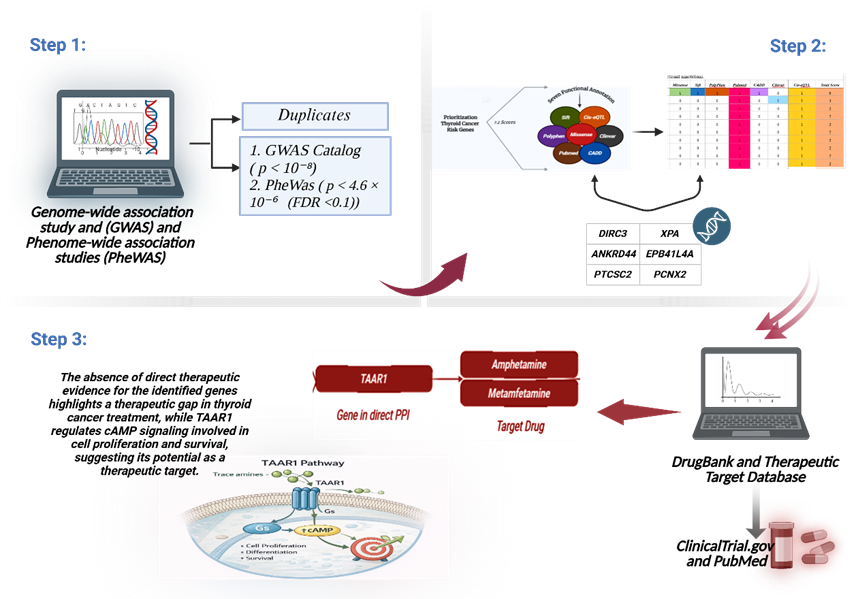
Methods: Significant gene variants were obtained from these databases and functionally annotated using HaploReg, ClinVar, SIFT, PolyPhen, CADD, cis-eQTL, and a review of PubMed literature. Candidate genes from seven functional annotations with scores ≥ 2 were designated as risk-associated and further analyzed using the STRING database. Drug candidates were searched for in DrugBank and ClinicalTrials.gov.
Results: Ten risk-associated genes may be involved in thyroid cancer pathogenesis, with DIRC3 having the highest score. However, no drugs that could directly interact with these genes were recognized. These findings highlight the therapeutic gap between thyroid cancer risk-associated genes and available drugs.
Conclusion: This study identified ten risk genes involved in thyroid cancer pathogenesis, with DIRC3 as the topmost candidate. Although no approved drugs directly targeted these genes, the findings highlight their potential as biomarkers and novel therapeutic targets. Integrative genomics and drug repurposing approaches remain promising strategies for advancing precision therapy in thyroid cancer.
Downloads
References
Qu N, Hui Z, Shen Z, Kan C, Hou N, Sun X, et al. Thyroid cancer and COVID-19 : prospects for therapeutic approaches and drug development. Front Endocrinol (Lausanne) 2022;13:873027.
https://doi.org/10.3389/fendo.2022.873027
Laha D, Nilubol N, Boufraqech M. New therapies for advanced thyroid cancer. Front Endocrinol (Lausanne) 2020;11:82.
https://doi.org/10.3389/fendo.2020.00082
Greco A, Coperchini F, Croce L, Magri F, Teliti M, Rotondi M. Drug repositioning in thyroid cancer treatment : the intriguing case of anti-diabetic drugs. 2023;14:1303844.
https://doi.org/10.3389/fphar.2023.1303844
World Health Organization. Global health estimates: Leading causes of death. Geneva: WHO; 2022.
Sung H, Ferlay J, Siegel RL, Laversanne M, Soerjomataram I, Jemal A, et al. Global cancer statistics 2020 : GLOBOCAN estimates of incidence and mortality worldwide for 36 cancers in 185 countries. CA Cancer J Clin 2021;71:209-49.
https://doi.org/10.3322/caac.21660
Prete A, Borges de Souza P, Censi S, Muzza M, Nucci N, Sponziello M. Update on fundamental mechanisms of thyroid cancer. Front Endocrinol (Lausanne) 2020;11:102.
https://doi.org/10.3389/fendo.2020.00102
Cao J, He X, Li X, Sun Y, Zhang W, Li Y, et al. The potential association of peripheral inflammatory biomarkers in patients with papillary thyroid cancer before radioiodine therapy to clinical outcomes. Front Endocrinol (Lausanne) 2023;14:1253394
https://doi.org/10.3389/fendo.2023.1253394
Maurea S, Stanzione A, Klain M. Thyroid cancer radiomics: Navigating challenges in a developing landscape. Cancers (Basel) 2023;15:5884.
https://doi.org/10.3390/cancers15245884
Irham LM, Adikusuma W, Perwitasari DA, Dania H, Maliza R, Faridah IN, et al. The use of genomic variants to drive drug repurposing for chronic hepatitis B. Biochem Biophys Rep 2022;31:101307.
https://doi.org/10.1016/j.bbrep.2022.101307
Tufail M, Jiang CH, Li N. Tumor dormancy and relapse : understanding the molecular mechanisms of cancer recurrence. Mil Med Res 2025;12:7.
https://doi.org/10.1186/s40779-025-00595-2
Irham LM, Adikusuma W, Lolita L, Puspitaningrum AN, Afief AR, Sarasmita MA, et al. Investigation of susceptibility genes for chickenpox disease across multiple continents. Biochem Biophys Rep 2023;33:101419.
https://doi.org/10.1016/j.bbrep.2022.101419
He J, Baxter SL, Xu J, Xu J, Zhou X, Jolla L, et al. The practical implementation of artificial intelligence technologies in medicine. Nat Med 2020;25:30-6.
https://doi.org/10.1038/s41591-018-0307-0
Hu G, Niu W, Ge J, Xuan J, Liu Y, Li M, et al. Identification of thyroid cancer biomarkers using WGCNA and machine learning. Eur J Med Res 2025;30:244.
https://doi.org/10.1186/s40001-025-02466-x
Kamani T, Charkhchi P, Zahedi A, Akbari MR. Genetic susceptibility to hereditary non- medullary thyroid cancer. Hered Cancer Clin Pract 2022;20:9.
https://doi.org/10.1186/s13053-022-00215-3
Drenner K, Basu GD, Goodman LJ, Ozols AA, Lobello JR, Royce T, et al. The value of comprehensive genomic sequencing to maximize the identification of clinically actionable alterations in advanced cancer patients : a case series. Oncotarget 2021;12:1836-47.
https://doi.org/10.18632/oncotarget.28046
Walker VM, Davey Smith G, Davies NM, Martin RM. Mendelian randomization : a novel approach for the prediction of adverse drug events and drug repurposing opportunities. Int J Epidemiol 2017;46:2078-89.
https://doi.org/10.1093/ije/dyx207
Oprea TI, Mestres J. Drug repurposing: far beyond new targets for old drugs. AAPS J 2012;14:759-63.
https://doi.org/10.1208/s12248-012-9390-1
Xia Y, Sun M, Huang H, Jin WL. Drug repurposing for cancer therapy. Signal Transduct Target Ther 2024:9:92.
https://doi.org/10.1038/s41392-024-01808-1
Irham LM, Adikusuma W, La'ah AS, Chong R, Septama AW, Angelina M. Leveraging genomic and bioinformatic analysis to enhance drug repositioning for dermatomyositis. Bioengineering (Basel) 2023;10:890.
https://doi.org/10.3390/bioengineering10080890
GTEx Consortium. The GTEx Consortium atlas of genetic regulatory effects across human tissues. Science 2020;369(6509):1318-30.
https://doi.org/10.1126/science.aaz1776
Kosarek N, Ho ES. IDICAP : A novel tool for integrating drug intervention based on cancer panel. J Pers Med 2016;64:19.
https://doi.org/10.3390/jpm6040019
Lee K, Anastasopoulou C, Chandran C, Cassaro S. Thyroid cancer. In: StatPearls [Internet]. Treasure Island (FL): StatPearls Publishing; 2026 [cited 2026 May 22]. Available from: https://www.ncbi.nlm.nih.gov/books/NBK459299/.
Yu SI, Chang YK, Sheu ML, Tseng YH. Thyroiditis and thyroid cancer : Bioinformatics analysis of gene expression data. In Vivo 2024;38:2205-13.
https://doi.org/10.21873/invivo.13684
Muhammad L, Adikusuma W, Khairi S, Mufidah S, Muhammad L, Adikusuma W, et al. A global bibliometric analysis of the scientific landscape and collaborative networks in prostate cancer and bioinformatics research. Siberian J Oncol 2026;25:155-69.
https://doi.org/10.21294/1814-4861-2026-25-1-155-169
Guo H, Liu R, Wu J, Li S, Yao W, Xu J, et al. SRPX2 promotes cancer cell proliferation and migration of papillary thyroid cancer. Clin Exp Med 2023;23:4825-34.
https://doi.org/10.1007/s10238-023-01113-1
Semmes EC, Vijayakrishnan J, Zhang C, Hurst JH, Houlston RS, Walsh KM. Leveraging genome and phenome-wide association studies to investigate genetic risk of acute lymphoblastic leukemia. Cancer Epidemiol Biomarkers Prev 2020;29:1606-14.
https://doi.org/10.1158/1055-9965.EPI-20-0113
Rahmawati D, Isrovanigoro I, Kurniawan A, Amukti DP, Salamah N, Adikusuma W, et al. Advances in genetic research in systemic lupus erythematosus : Trend Analysis , global collaborations and bibliometric perspectives. Scr Med 2025;56:1049-58.
https://doi.org/10.5937/scriptamed56-56329
Tan J, Qian X, Song BIN, An X, Cai T, Zuo Z, et al. Integrated bioinformatics analysis reveals that the expression of cathepsin S is associated with lymph node metastasis and poor prognosis in papillary thyroid cancer. Oncol Rep. 2018;40:111-22.
https://doi.org/10.3892/or.2018.6428
Gillberg C, Melander H, von Knorring AL, Janols LO, Thernlund G, Hägglöf B, et al. Long-term stimulant treatment of children with attention-deficit hyperactivity disorder symptoms. A randomized, double-blind, placebo-controlled trial. Arch Gen Psychiatry 1997;54:857-64.
https://doi.org/10.1001/archpsyc.1997.01830210105014
Kulkarni VS, Alagarsamy V, Solomon VR, Jose PA, Murugesan S. Drug repurposing : an effective tool in modern drug discovery. Russ J Bioorg Chem 2023;49:157-66.
https://doi.org/10.1134/S1068162023020139
García-Sáenz M, Lobaton-Ginsberg M, Ferreira-Hermosillo A. Metformin in differentiated thyroid cancer : Molecular Pathways and its clinical implications. Biomolecules 2022;12:574.
https://doi.org/10.3390/biom12040574
Eilbeck K, Quinlan A, Yandell M. Settling the score: variant prioritization and Mendelian disease. Nat Rev Genet 2017;18:599-612.
https://doi.org/10.1038/nrg.2017.52
Landrum MJ, Lee JM, Benson M, Brown G, Chao C, Chitipiralla S, et al. ClinVar : public archive of interpretations of clinically relevant variants Nucleic Acids Res 2016;44:862-8.
https://doi.org/10.1093/nar/gkv1222
Punja S, Shamseer L, Hartling L, Urichuk L, Vandermeer B, Nikles J, et al. Amphetamines for attention deficit hyperactivity disorder (ADHD) in children and adolescents. Cochrane Database Syst Rev 2016;2:CD009996.
https://doi.org/10.1002/14651858.CD009996.pub2
Afief AR, Irham LM, Adikusuma W, Perwitasari DA, Brahmadhi A, Chong R. Integration of genomic variants and bioinformatic-based approach to drive drug repurposing for multiple sclerosis. Biochem Biophys Rep 2022;32:101337.
https://doi.org/10.1016/j.bbrep.2022.101337
Liu TT, Yin DT, Wang N, Li N, Dong G, Peng MF. Identifying and analyzing the key genes shared by papillary thyroid carcinoma and Hashimoto' s thyroiditis using bioinformatics methods. Front Endocrinol (Lausanne) 2023;14: 1140094.
Downloads
Published
How to Cite
Issue
Section
License
Copyright (c) 2026 Chulalongkorn Medical Journal

This work is licensed under a Creative Commons Attribution-NonCommercial-NoDerivatives 4.0 International License.