Assessing the responses of miRNA-200b and miRNA-429 in cyanide poisoning cases
Keywords:
Cyanide, miRNA, sudden deathAbstract
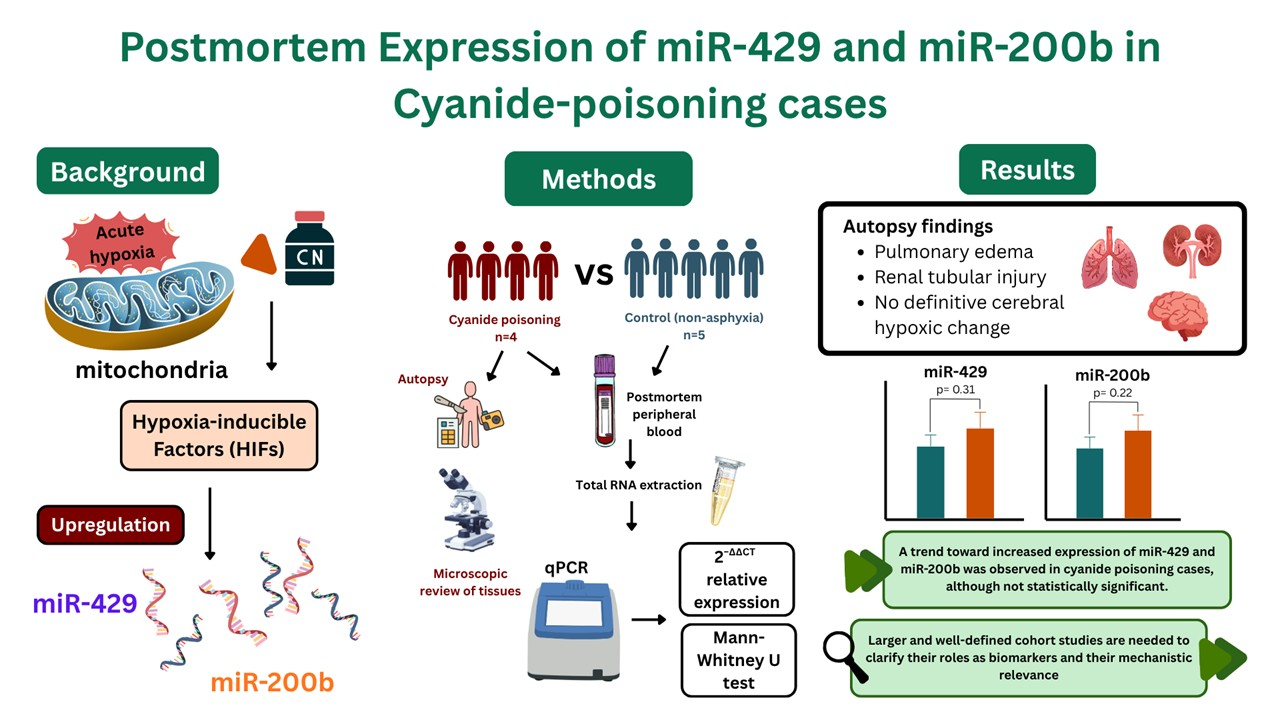
Background: Cyanide toxicity disrupts cellular respiration by inhibiting mitochondrial cytochrome oxidase a3, resulting in cellular hypoxia. The cell’s response to hypoxia is mediated by hypoxia-inducible factors (HIFs) and associated microRNAs (hypoxamiRs). Among these, miR-429 and miR-200b have been implicated in the regulation of HIFs and were found to be upregulated during acute hypoxic conditions. However, their specific roles in cyanide-induced hypoxia remain poorly understood.
Objective: The aim of this study was to evaluate the expression of miR-429 and miR-200b in postmortem peripheral blood collected from cyanide poisoning fatalities.
Methods: Postmortem blood was obtained from five cyanide poisoning cases and five nonasphyxial controls; for all cases, the postmortem interval was < 24 hours. After total RNA was extracted from the blood, 10 ng of RNA was reverse-transcribed into complementary DNA using MultiScribe™ Reverse Transcriptase. The expression of miR-429 and miR-200b was quantified using the QuantStudio™ 5 system and TaqMan™ MicroRNA assays. Relative miRNA expression was calculated using the 2 ΔΔCTmethod and compared using the Mann–Whitney U test. One cyanide case was excluded because of low RNA quality.
Results: Toxicological screening confirmed lethal cyanide concentrations consistent with oral ingestion. Common autopsy findings included pulmonary edema and renal tubular injury, with no definitive cerebral hypoxic changes. The comparative analysis revealed that miR-429 and miR-200b tended to be higher in the cyanide group (n = 4) than in the controls (n = 5), but the differences were not statistically significant (miR- 429: P = 0.31; miR-200b: P= 0.22).
Conclusion: This study identified higher expressions of miR-429 and miR-200b in cyanide poisoning cases compared with controls, which was consistent with previous evidence linking these microRNAs to hypoxic responses. Although the increase in expression did not meet statistical thresholds, the observed patterns indicate that these microRNAs may be involved in cyanide-induced hypoxia. These preliminary findings underscore the need for further investigation of larger, well-defined cohorts to fully elucidate the diagnostic and mechanistic roles of miR-429 and miR-200b in cyanide toxicity.
Downloads
References
Abdollahi M, Hosseini A. Cyanogen chloride. In: Wexler P, editor. Encyclopedia of toxicology. 3rd ed. Oxford: Academic Press; 2014. p. 1096-9.
https://doi.org/10.1016/B978-0-12-386454-3.00484-X
Saxena K, Jolly MK. Acute vs. chronic vs. cyclic hypoxia: their differential dynamics, molecular mechanisms, and effects on tumor progression. Biomolecules 2019;9:339.
https://doi.org/10.3390/biom9080339
Bertero T, Rezzonico R, Pottier N, Mari B. Impact of microRNAs in the cellular response to hypoxia. Int Rev Cell Mol Biol 2017;333:91-158.
https://doi.org/10.1016/bs.ircmb.2017.03.006
Ying SY, Chang DC, Lin SL. The microRNA (miRNA): overview of the RNA genes that modulate gene function. Mol Biotechnol 2008;38:257-68.
https://doi.org/10.1007/s12033-007-9013-8
Silina MV, Dzhalilova DS, Makarova OV. Role of microRNAs in regulation of cellular response to hypoxia. Biochemistry (Mosc) 2023;88:741-57.
https://doi.org/10.1134/S0006297923060032
Serocki M, Bartoszewska S, Janaszak-Jasiecka A, Ochocka RJ, Collawn JF, Bartoszewski R. miRNAs regulate the HIF switch during hypoxia: a novel therapeutic target. Angiogenesis 2018;21:183-202.
https://doi.org/10.1007/s10456-018-9600-2
Bartoszewska S, Kochan K, Piotrowski A, Kamysz W, Ochocka RJ, Collawn JF, et al. The hypoxia-inducible miR-429 regulates hypoxia-inducible factor-1α expression in human endothelial cells through a negative feedback loop. FASEB J 2015;29:1467-79.
https://doi.org/10.1096/fj.14-267054
Jaskiewicz M, Moszynska A, Serocki M, Króliczewski J, Bartoszewska S, Collawn JF, et al. Hypoxia-inducible factor (HIF)-3a2 serves as an endothelial cell fate executor during chronic hypoxia EXCLI J 2022;21:454-69.
Chan YC, Khanna S, Roy S, Sen CK. miR-200b targets Ets-1 and is down-regulated by hypoxia to induce angiogenic response of endothelial cells. J Biol Chem 2011;286:2047-56.
https://doi.org/10.1074/jbc.M110.158790
Janaszak-Jasiecka A, Siekierzycka A, Bartoszewska S, Serocki M, Dobrucki LW, Collawn JF, et al. eNOS expression and NO release during hypoxia is inhibited by miR-200b in human endothelial cells. Angiogenesis 2018;21:711-24.
https://doi.org/10.1007/s10456-018-9620-y
Livak KJ, Schmittgen TD. Analysis of relative gene expression data using real-time quantitative PCR and the 2(-Delta Delta C(T)) Method. Methods 2001;25:402-8.
https://doi.org/10.1006/meth.2001.1262
Jadav D, Saraf A, Shekhawat R, Kanchan T, Nalwa A. Accidental deaths due to toxic industrial cyanide inhalation: an autopsy case report. Cureus 2022;14:e25376.
https://doi.org/10.7759/cureus.25376
Rhee J, Jung J, Yeom H. Distribution of cyanide in heart blood, peripheral blood and gastric contents in 21 cyanide-related fatalities. Forensic Sci Int 2011;210:e12-5.
Downloads
Published
How to Cite
Issue
Section
License
Copyright (c) 2026 Chulalongkorn Medical Journal

This work is licensed under a Creative Commons Attribution-NonCommercial-NoDerivatives 4.0 International License.