
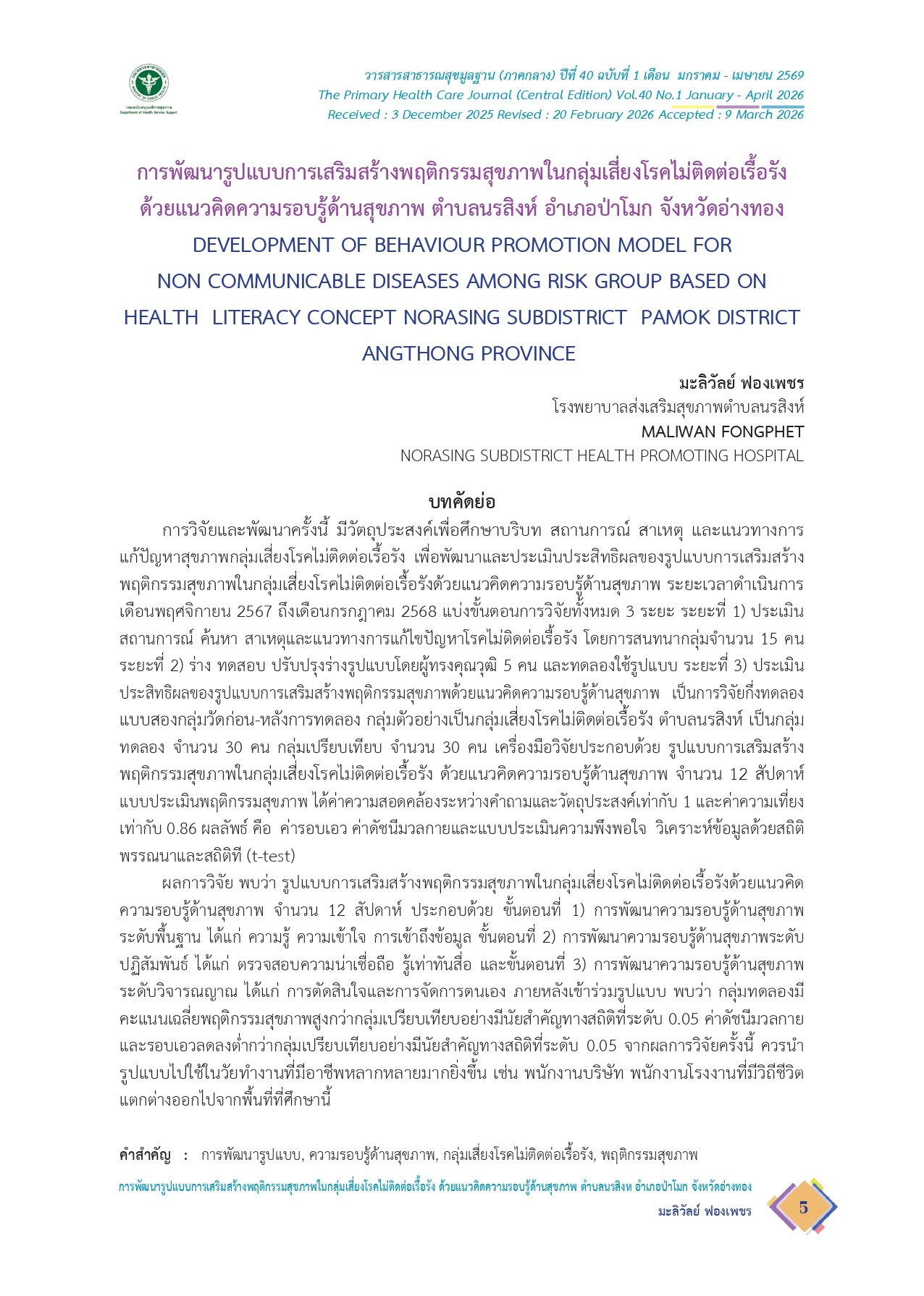
DEVELOPMENT OF BEHAVIOUR PROMOTION MODEL FOR NON COMMUNICABLE DISEASES AMONG RISK GROUP BASED ON HEALTH LITERACY CONCEPT NORASING SUBDISTRICT PAMOK DISTRICT ANGTHONG PROVINCE
Keywords:
Model development, Health literacy, Non-communicable disease risk groups, Health behaviorAbstract
Non-communicable diseases (NCDs) constitute a predominant public health challenge requiring comprehensive intervention strategies. This research and development endeavor aimed to investigate contextual frameworks, situational dynamics, etiological factors, and remedial approaches for health promotion among populations at risk for chronic non-communicable diseases. The study sought to develop a health behavior enhancement model utilizing health literacy processes and evaluate its efficacy in mitigating NCD risk factors.
This quasi-experimental study employed a three-phase methodological approach conducted from November 2024 to July 2025 in Norasingh Sub-district, Pa Mok District, Ang Thong Province. Phase I encompassed qualitative assessment of NCD prevention behaviors and focus group discussions (n=15) to identify causative factors and solution pathways. Phase II involved model development, prototype testing, and refinement through expert validation (n=5). Phase III evaluated model implemented a two-group pre-post quasi-experimental design with intervention (n=30) and control groups (n=30) comprising individuals at risk for NCDs. The 12-week health literacy intervention concept is IOC =1 and reliability =0.86 incorporated three sequential components: fundamental health literacy development, interactive health literacy enhancement, and critical health literacy cultivation satisfaction. Data were analyzed by t-test statistics.
The comprehensive health behavior enhancement model demonstrated significant efficacy in improving health outcomes. Post-intervention analysis revealed that the experimental group exhibited significantly higher mean health behavior scores compared to the control group (p<0.05). Furthermore, the intervention group demonstrated statistically significant reductions in body mass index (p<0.05) and waist circumference measurements (p<0.05) relative to the comparison group. Data analysis utilized descriptive statistics and t-test procedures for outcome evaluation.
The health literacy-based intervention model proved effective in enhancing health behaviors and reducing physiological risk markers among individuals susceptible to non-communicable diseases. The model has been implemented as a prototype for developing health-literate communities aimed at reducing NCD risk populations. Future applications should extend to diverse occupational groups, including corporate employees and factory workers with varying lifestyle patterns, to enhance generalizability and population-level impact.
Downloads
References
กรมควบคุมโรค กระทรวงสาธารณสุข. (2566). รายงานประจำปี 2565. สืบค้น 20 ตุลาคม 2567,
จาก https://ddc.moph.go.th/dncd/journal_detail.php?publish=16681/สถิติโรค
กองสุขศึกษา กรมสนับสนุนบริการสุขภาพ. (2564).กลยุทธ์การเสริมสร้างความรอบรู้ด้านสุขภาพและ
พฤติกรรม. สืบค้น 20 ตุลาคม 2567,https://hed.hss.moph.go.th/tool-hlhb/ความรอบรู้
ณัฐสิทธิ์ สินโท และคณะ. (2565). ความรอบรู้ด้านสุขภาพและพฤติกรรมสุขภาพของกลุ่มเสี่ยงโรค
ความดันโลหิตสูงจังหวัดมหาสารคาม. วารสารวิชาการมหาวิทยาลัยปทุมธานี, 6(3), 171-178.
บุญใจ ศรีสถิตย์นรากูล.(2562). การพัฒนาและตรวจสอบคุณภาพเครื่องมือวิจัย:คุณสมบัติการวัด
เชิงจิตวิทยา. กรุงเทพฯ: โรงพิมพ์จุฬาลงกรณ์มหาวิทยาลัย.
ปาณิสรา ส่งวัฒนายุทธ, ภคพร กลิ่นหอม, จินต์ทิพา ศิริกุลวิวัฒน์. (2566). การพัฒนารูปแบบความรอบรู้
ด้านสุขภาพและแรงสนับสนุนของครอบครัว เพื่อส่งเสริมพฤติิกรรมการป้องกันโรคความดันโลหิตสูง
และควบคุมระดับความดันโลหิตของกลุ่มเสี่ยงความดันโลหิตสูงจังหวัดเพชรบุรี. วารสารคณะ
พยาบาลศาสตร์ มหาวิทยาลัยบูรพา, 31(4), 91-106.
พวงผกา สุริวรรณ. (2564). รูปแบบการเสริมสร้างพฤติกรรมสุขภาพในกลุ่มเสี่ยงโรคเบาหวาน และโรค
ความดันโลหิตสูง ด้วยกระบวนการจัดการความรู้ จังหวัดลำพูน. วารสารกรมสนับสนุนบริการ
สุขภาพ, 17(2), 41-50.
มนัสนันท์ สุขใส, วิราพร ใจดี, และ สุภาวดี เจริญดี. (2565). ประสิทธิผลของโปรแกรมส่งเสริมการดูแลตนเอง
ตามแนวทาง 3อ2ส ในผู้ป่วยความดันโลหิตสูง. วารสารโรคหัวใจและหลอดเลือด, 31(2), 78-91.
โรงพยาบาลส่งเสริมสุขภาพตำบลนรสิงห์. (2567). ฐานข้อมูลสุขภาพ.รายงานสรุปผลการดำเนินงาน
ประจำปี งบประมาณ พ.ศ.2567. รพ.สต.นรสิงห์.
รุ่งนภา อาระหัง, สุธีรา ฮุ่นตระกูล, และศศิิธร รุจิรเวช. (2562). ผลของโปรแกรมการส่งเสริมความรอบรู้้
ด้านสุขภาพต่อพฤติกรรมการป้องกันโรคความดันโลหิตสูงสำหรับกลุ่มเสี่ยงความดันโลหิตสูงที่
แห่งหนึ่งในจังหวัดนครปฐม. วารสารแพทย์นาวี, 45(3), 509-26.
ศิริเนตร สุขดี. (2562). การพัฒนารูปแบบการปรับเปลี่ยนพฤติกรรมสุขภาพของกลุ่มเสี่ยงโรคไม่ติดต่อเรื้อรังด้วยการมีส่วนร่วมของชุมชน (วิทยานิพนธ์ปริญญาดุษฎีบัณฑิต). มหาวิทยาลัยศรีนครินทร์วิโรฒ, กรุงเทพฯ.
สุภาพร สุขเกษม, วิชญ์ มั่นคง, และรัตนา ใจแสง. (2566). ปัญหาและความท้าทายในการดูแลผู้ป่วยโรคไม่
ติดต่อเรื้อรังในชุมชน: การศึกษาเชิงคุณภาพ. วารสารสุขภาพชุมชน, 29(1), 34-47.
สำนักสาธารณสุขจังหวัดอ่างทอง. (2567). ระบบคลังข้อมูลด้านสุขภาพและการแพทย์.
. สืบค้น 21 ตุลาคม 2567, จาก https://atgh.moph.go.th/HDC
อรนุช ชูศรี และคณะ. (2564). ผลของโปรแกรมการปรับเปลี่ยนพฤติกรรมการป้องกันโรคหลอดเลือด
หัวใจในผู้สูงอายุที่ป่วยด้วยโรคเรื้อรังในชุมชนเมือง กรุงเทพมหานคร. วารสารวิจัยสุขภาพและการ
พยาบาล, 34(3), 20-36.
Faul, F., Erdfelder, E., Lang, A-G., & Buchner, A. (2007). “G*power 3: A flexible statistical power
analysis program for the social, behavioral, and biomedical sciences”. Behavior Research
Methods, 39(2), 175-191. doi: 10.3758/BF03193146.
Lemeshow, S., Hosmer, D.W., Klar, J., & Lwanga, S.K. (1990). Adequacy of sample size in health
studies. USA: John Wiley & Sons
Nutbeam, D. (2008). The evolving concept of health literacy. Social Science &Medicine,
(12), 2071-2078.
Polit, D. F., & Hungler, B. P. (1999). Nursing Research Principles and Methods. Philadelphia:
Lippincott
World Health Organization [WHO]. (2023). World Health Day 2023. Retrieved from
https://www.who.int/campaigns/world-health-day/2013/campaign_essentials.pdf?ua=1
Downloads
Published
How to Cite
Issue
Section
License
Copyright (c) 2026 The Primary Health Care Journal (Central Edition)

This work is licensed under a Creative Commons Attribution-NonCommercial-NoDerivatives 4.0 International License.
บทความที่ได้รับการตีพิมพ์เป็นลิขสิทธิ์ของศูนย์สนับสนุนบริการสุขภาพที่ 6
ข้อความที่ปรากฏในบทความแต่ละเรื่องในวารสารวิชาการเล่มนี้เป็นความคิดเห็นส่วนตัวของผู้เขียนแต่ละท่านไม่เกี่ยวข้องกับศูนย์สนับสนุนบริการสุขภาพที่ 6 และบุคลากรท่านอื่น ในศูนย์ฯ แต่อย่างใด ความรับผิดชอบองค์ประกอบทั้งหมดของบทความแต่ละเรื่องเป็นของผู้เขียนแต่ละท่าน หากมีความผิดพลาดใด ๆ ผู้เขียนแต่ละท่านจะรับผิดชอบบทความของตนเองแต่ผู้เดียว


