
FACTORS ASSOCIATED WITH DOOR-TO-BALLOON TIME AND CLINICAL OUTCOMES IN PATIENTS WITH ST-ELEVATION MYOCARDIAL INFARCTION UNDERGOING PRIMARY PCI AT HUA HIN HOSPITAL
Abstract
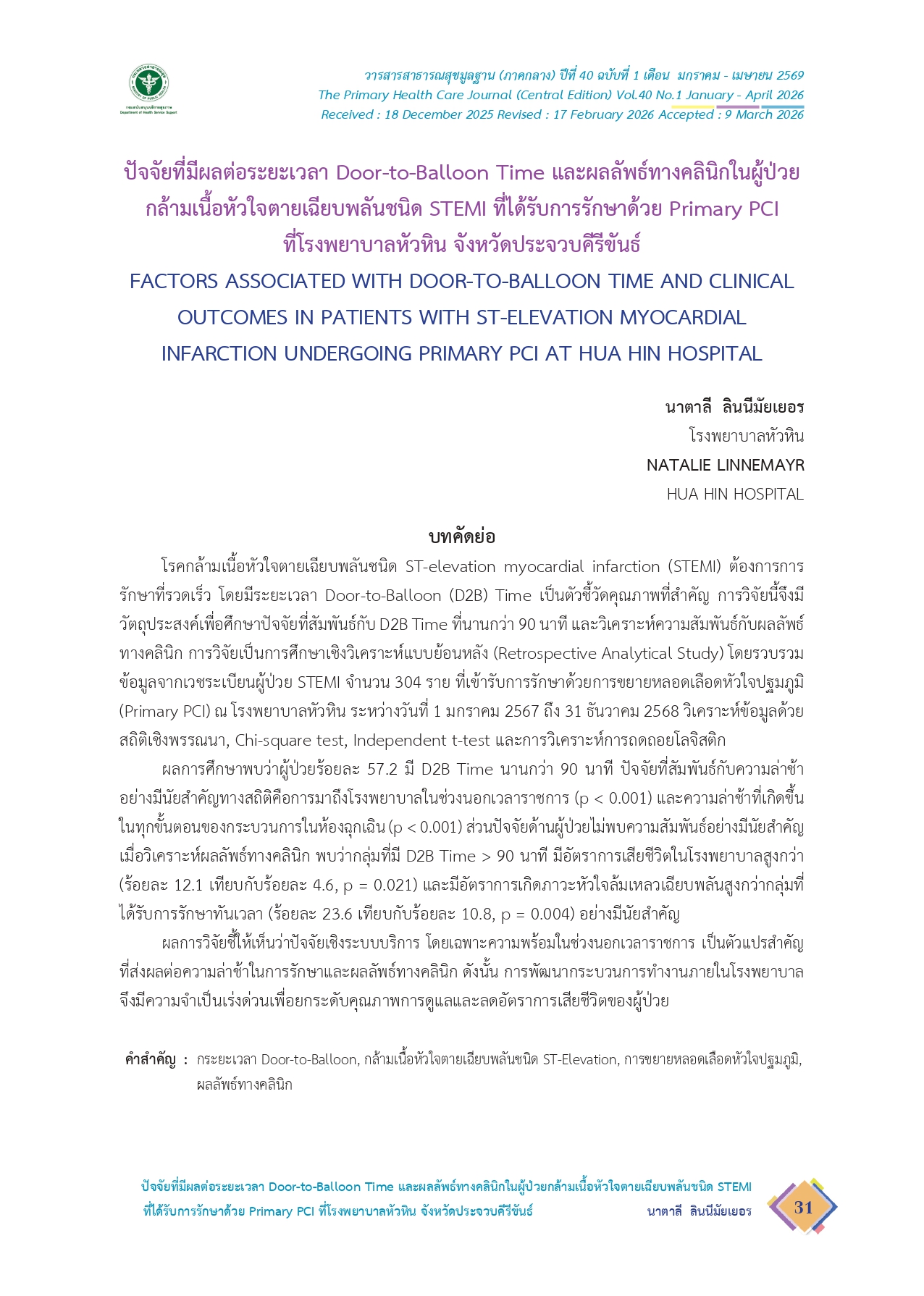
ST-elevation myocardial infarction (STEMI) is a time-sensitive condition where prompt treatment is crucial, with Door-to-Balloon (D2B) time serving as a critical quality indicator. This study aimed to investigate factors associated with a D2B time exceeding 90 minutes and to analyze its association with clinical outcomes. A retrospective analytical study was conducted using medical records from 304 STEMI patients who underwent Primary Percutaneous Coronary Intervention (Primary PCI) at Hua Hin Hospital between January 1, 2024, and December 31, 2025. Data were analyzed using descriptive statistics, Chi-square test, independent t-test, and binary logistic regression.
The results indicated that 57.2% of patients experienced a D2B time exceeding 90 minutes. Factors significantly associated with treatment delay included arrival during off-hours (p < 0.001) and prolonged times at each step of the emergency department process (p < 0.001). Patient-related factors did not show a significant association. The group with a D2B time > 90 minutes had significantly higher in-hospital mortality (12.1% vs. 4.6%, p = 0.021) and a higher incidence of acute heart failure (23.6% vs. 10.8%, p = 0.004) compared to the on-time group.
The study concludes that service system factors, particularly off-hour readiness, are critical determinants of treatment delays and adverse clinical outcomes. Therefore, improving internal hospital workflows is imperative to enhance the quality of care and reduce patient mortality.
Downloads
References
Champasri, U., Krittayaphong, R., Kiatchoosakun, S., et al. (2024). Door-to-device time and mortality in patients with ST-elevation myocardial infarction treated with primary percutaneous coronary intervention: Insight from real world data of Thai PCI Registry. Cardiovascular Diagnosis and Therapy, 14(2), 200–211.
Chimluang, J., Apiratwarakul, K., Ienghong, K., Phothisri, K., & Kotruchin, P. (2023). The impact of emergency department arrival time on door-to-balloon time in patients with ST-segment elevation myocardial infarction receiving primary percutaneous coronary intervention. Journal of Clinical Medicine, 12(6), 2392.
De Luca, G., Suryapranata, H., Ottervanger, J. P., & Antman, E. M. (2004). Time delay to treatment and mortality in primary angioplasty for acute myocardial infarction. Circulation, 109(10), 1223–1225. https://doi.org/10.1161/01.CIR.0000121424.76486.20
Donabedian, A. (1988). The quality of care: How can it be assessed? JAMA, 260(12), 1743–1748. https://doi.org/10.1001/jama.1988.03410120089033
Foo, C. Y., Bonsu, K. O., Nallamothu, B. K., et al. (2018). Coronary intervention door-to-balloon time and outcomes in ST-elevation myocardial infarction: A meta-analysis. Heart, 104(16), 1362–1369. https://doi.org/10.1136/heartjnl-2017-312517
Ibanez, B., James, S., Agewall, S., Antunes, M. J., Bucciarelli-Ducci, C., Bueno, H., … Widimský, P. (2018). 2017 ESC guidelines for the management of acute myocardial infarction in patients presenting with ST-segment elevation. European Heart Journal, 39(2), 119–177. https://doi.org/10.1093/eurheartj/ehx393
Menees, D. S., Peterson, E. D., Wang, Y., Curtis, J. P., Messenger, J. C., Rumsfeld, J. S., … Gurm, H. S. (2013). Door-to-balloon time and mortality among patients undergoing primary PCI. New England Journal of Medicine, 369(10), 901–909. https://doi.org/10.1056/NEJMoa1208200
Nallamothu, B. K., Normand, S. L. T., Wang, Y., Hofer, T. P., Brush, J. E., Messenger, J. C., … Krumholz, H. M. (2015). Relation between door-to-balloon times and mortality after primary percutaneous coronary intervention over time: A retrospective study. The Lancet, 385(9973), 1114–1122. https://doi.org/10.1016/S0140-6736(14)61932-2
Narindrarangkura, P., Srisawat, C., Siribumrungwong, B., & Borwornboon, S. (2019). Door-to-balloon time and factors associated with delayed door-to-balloon time in ST-segment elevation myocardial infarction at Thailand’s largest tertiary referral centre. Emergency Medicine Australasia, 31(4), 624–630.
Sritara, P., et al. (2008). Registry of Acute Coronary Syndrome in Thailand (Thai ACS Registry): Patient characteristics, management, and clinical outcomes. Journal of the Medical Association of Thailand, 91(Suppl 3), S1-S10.
The World Medical Association. (2013). World Medical Association Declaration of Helsinki: Ethical principles for medical research involving human subjects. JAMA, 310(20), 2191–2194. https://doi.org/10.1001/jama.2013.281053
Downloads
Published
How to Cite
Issue
Section
License
Copyright (c) 2026 The Primary Health Care Journal (Central Edition)

This work is licensed under a Creative Commons Attribution-NonCommercial-NoDerivatives 4.0 International License.
บทความที่ได้รับการตีพิมพ์เป็นลิขสิทธิ์ของศูนย์สนับสนุนบริการสุขภาพที่ 6
ข้อความที่ปรากฏในบทความแต่ละเรื่องในวารสารวิชาการเล่มนี้เป็นความคิดเห็นส่วนตัวของผู้เขียนแต่ละท่านไม่เกี่ยวข้องกับศูนย์สนับสนุนบริการสุขภาพที่ 6 และบุคลากรท่านอื่น ในศูนย์ฯ แต่อย่างใด ความรับผิดชอบองค์ประกอบทั้งหมดของบทความแต่ละเรื่องเป็นของผู้เขียนแต่ละท่าน หากมีความผิดพลาดใด ๆ ผู้เขียนแต่ละท่านจะรับผิดชอบบทความของตนเองแต่ผู้เดียว


