Effectiveness of Self–Management Program Combined with Pharmacist Care on Antiretroviral Medication Among HIV/AIDS Patients at Ban Na San Hospital, Surat Thani Province
Keywords:
Antiretroviral Medication Use, Adherence, HIV/AIDS Patients, Self-Management ProgramAbstract
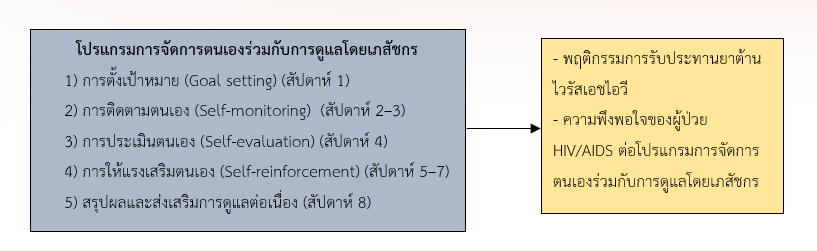
This quasi-experimental study employed a one-group pretest-posttest design. The objective was to examine the effectiveness of a self-management program combined with pharmacist care on antiretroviral medication adherence among HIV/AIDS patients. The sample consisted of 35 HIV/AIDS patients aged 18 years and older who received antiretroviral medications at the Rakjit Clinic, Ban Na San Hospital, Surat Thani Province. Participants were selected through purposive sampling based on predetermined eligibility criteria. The research instruments included: a self-management program combined with pharmacist care implemented over an 8-week period, a personal data questionnaire, an antiretroviral medication-taking behavior assessment, and a satisfaction evaluation form. All instruments were validated for content validity by experts. The reliability of the antiretroviral medication-taking behavior assessment was α = .89, and the satisfaction evaluation form was α = .90. Data were analyzed using descriptive statistics, including frequency, percentage, mean, and standard deviation, as well as the paired t-test.
1. The findings revealed the following: The mean score of antiretroviral medication-taking behavior after participating in the program (M = 4.23, SD = 0.30) was significantly higher than before participation (M = 3.42, SD = 0.45), with statistical significance (t = 9.10, p-value < .001). Mean scores increased across all dimensions, with the most significant improvements in timeliness of medication intake, consistency of medication intake, and avoidance of self-discontinuation or skipping doses.
2. Overall patient satisfaction with the self-management program combined with pharmacist care was at the highest level (M = 4.31, SD = 0.47).
The results of this study demonstrate that the program can effectively promote antiretroviral medication adherence among HIV/AIDS patients.
References
กรมควบคุมโรค. (2565). แนวทางการดูแลรักษาผู้ติดเชื้อเอชไอวีประเทศไทย พ.ศ. 2565. กระทรวงสาธารณสุข. https://hivhub.ddc.moph.go.th
กองโรคเอดส์และโรคติดต่อทางเพศสัมพันธ์ กรมควบคุมโรค. (2566). สถานการณ์เอชไอวี/เอดส์ ประเทศไทย ปี 2565. กระทรวงสาธารณสุข. https://ddc.moph.go.th
กัญญา พฤฒิสืบ. (2564). ปัจจัยที่สัมพันธ์กับการขาดนัดการรักษาของผู้ติดเชื้อเอชไอวี/เอดส์ที่เข้ารับการรักษา ในโรงพยาบาลวชิระภูเก็ต. วารสารโรคเอดส์, 33(3), 139-150.
ชัยกฤติ ดีวะลา. (2566). การเสริมพลังผู้ป่วยเอชไอวีเพื่อเพิ่มพฤติกรรมการดูแลตนเอง. วารสารการพยาบาลและสุขภาพ, 17(2), 45–58.
มัตติกา คุลี, หทัยกาญจน์ เชาวนพูนผล, และชิดชนก เรือนก้อน. (2565). ผลของโปรแกรมการส่งเสริมสมรรถนะแห่งตนและการสนับสนุนทางสังคมโดยเภสัชกรผ่านแอปพลิเคชันไลน์ต่อความร่วมมือในการใช้ยาต้านไวรัสในผู้ป่วยติดเชื้อเอชไอวี/เอดส์ โรงพยาบาลหัวหิน. วารสารเภสัชกรรมไทย, 15(2), 1–15.
พชรพร ยิ่งยง, อัครวัฒน์ กรจิระเกษมศานต์, และโสภณ แพงไตร. (2568). การพัฒนาระบบบริการเภสัชกรรมทางไกลในผู้ป่วยรับยาต้านไวรัสเอชไอวีที่รับยาทางไปรษณีย์ โรงพยาบาลนครพิงค์ จังหวัดเชียงใหม่. Journal of Nakornping Hospital, 16(2), 205–221.
โรงพยาบาลบ้านนาสาร. (2568). รายงานสถานการณ์ผู้ติดเชื้อเอชไอวี/ผู้ป่วยเอดส์ และการให้บริการดูแลรักษา ปีงบประมาณ 2565–2568. สุราษฎร์ธานี: โรงพยาบาลบ้านนาสาร.
ไสว ตันทวุทธ. (2559). ผลของการส่งเสริมการใช้ยาต้านไวรัสอย่างต่อเนื่องต่อความร่วมมือในการรักษาในผู้ป่วยเอชไอวี. วารสารเภสัชกรรม, 33(1), 11–20.
อ้อมทิพย์ พลบุบผา, วันทนา มณีศรีวงศ์กูล, และวรรณา สนองเดช. (2565). ความสัมพันธ์ระหว่างปัจจัยคัดสรรกับความสม่ำเสมอในการรับประทานยาต้านไวรัสของผู้ติดเชื้อเอชไอวี. วารสารพยาบาลทหารบก, 23(3), 314–322.
Best, J. W. (1997). Research in education (7th ed.). Allyn & Bacon. Institute for Health Metrics and Evaluation. (2019). Global HIV/AIDS estimates. https://www.healthdata.org
Kalichman, S. C., Pellowski, J., & Turner, C. (2020). Integrated behavioral and biomedical approaches to improve medication adherence among people living with HIV. Current HIV/AIDS Reports, 17(4), 283–292. https://doi.org/10.1007/s11904-020-00496-5
Kanfer, F. H., & Gaelick-Buys, L. (1991). Self-management methods. In F. H. Kanfer & A. P. Goldstein (Eds.), Helping people change: A textbook of methods (4th ed., pp. 305–360). Pergamon Press.
Lorig, K. R., & Holman, H. R. (2003). Self-management education: History, definition, outcomes, and mechanisms. Annals of Behavioral Medicine, 26(1), 1–7. https://doi.org/10.1207/S15324796ABM2601_01
Mills, E. J., Lester, R., Thorlund, K., et al. (2014). Interventions to promote adherence to antiretroviral therapy: A network meta-analysis. AIDS and Behavior, 18(5), 883–891.
Phuphanich, M., et al. (2016). A qualitative assessment of barriers and facilitators to antiretroviral adherence in Thai patients. Journal of Virus Eradication, 2(1):22–27.
Ruxrungtham, K., Chokephaibulkit, K., Chetchotisakd, P., Chariyalertsak, S., Kiertburanakul, S., Putacharoen, O., et al. (2022). Thailand national guidelines on HIV/AIDS treatment and prevention 2021/2022. Division of AIDS and Sexually Transmitted Diseases, Department of Disease Control, Ministry of Public Health.
Suntharapot, S., & Sribundit, N. (2022).Effectiveness of text messaging via LINE application on adherence to antiretroviral drugs among HIV and AIDS patients in Khaoyoi Hospital, Phetchaburi Province. Thai Bulletin of Pharmaceutical Sciences, 17(2), 83–99.
UNAIDS. (2018). Global HIV & AIDS statistics. https://www.unaids.org/ World Health Organization. (2023). HIV treatment and care. https://www.who.int/teams/global-hiv-hepatitis-and-stis-programmes/hiv
Downloads
Published
How to Cite
Issue
Section
License
Copyright (c) 2025 Nursing Innovation and Health Association Journal

This work is licensed under a Creative Commons Attribution-NonCommercial-NoDerivatives 4.0 International License.


