Development of a Telemedicine System in the Chawang District Health Network, Nakhon Si Thammarat Province
Keywords:
Research and Development, Telemedicine, Healthcare Network, Healthcare Accessibility , Waiting Time, User SatisfactionAbstract
This research and development (R&D) design aimed to (1) analyze the existing problems and needs related to the development of a telemedicine system, (2) develop a telemedicine system tailored to the real-world healthcare service context, and (3) evaluate its effectiveness in improving healthcare accessibility, reducing patient waiting times, and enhancing user satisfaction examining user satisfaction. The study was conducted in three phases. Phase 1 employed a qualitative approach to explore existing problems and user requirements through in-depth interviews among 30 healthcare professionals and 5 patients with chronic diseases. Phase 2 involved the development of a telemedicine system using a user-centered design approach integrated with an iterative development process to ensure continuous refinement based on user feedback of 30 healthcare professionals. Phase 3 evaluated the effectiveness of the developed system through a two-group posttest-only quasi-experimental design. A total of 102 participants were recruited and equally assigned to an experimental group (n = 51) and a control group (n = 51). Data were analyzed using descriptive statistics and the independent t-test. The findings revealed that Phase
1. The participants identified delayed access to healthcare services, prolonged waiting times, and a substantial demand for telemedicine services.
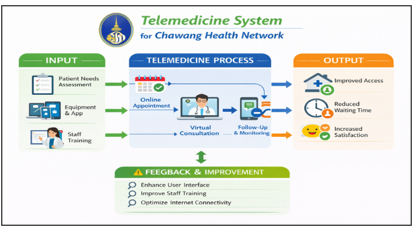
2. A context-appropriate telemedicine system was successfully developed, incorporating three core functions: patient triage, teleconsultation, and remote follow-up. The system was evaluated as appropriate and ready for implementation in routine practice.
3. The participants in the experimental group reported significantly higher healthcare accessibility than those in the control group (M = 4.10, SD = 0.50; t = 7.34, p-value < .001). Furthermore, the experimental group had significantly shorter waiting times than the control group (M = 50.00 minutes, SD = 15.00; t = 11.43, p-value < .001). Overall satisfaction among both patients and healthcare professionals was rated at a high level.
In conclusion, the developed telemedicine system effectively improved healthcare accessibility, reduced waiting times, and achieved high levels of user satisfaction. The system demonstrates strong potential for implementation across healthcare networks to enhance service quality, improve healthcare efficiency, and support sustainable chronic disease management.
References
กระทรวงสาธารณสุข. (2564). ยุทธศาสตร์สุขภาพดิจิทัล กระทรวงสาธารณสุข พ.ศ. 2564–2568. นนทบุรี: ผู้แต่ง.
กระทรวงสาธารณสุข. (2568). ระบบคลังข้อมูลด้านการแพทย์และสุขภาพ (Health Data Center): รายงานสถิติสุขภาพอำเภอฉวาง จังหวัดนครศรีธรรมราช. สืบค้นจาก https://hdcservice.moph.go.th
นาถฤดี ศิรินาม, จารุวรรณ วิโรจน์, และณัชชลิดา ยุคะลัง. (2567). รูปแบบการให้บริการด้วยระบบการแพทย์ทางไกลในคลินิกผู้สูงอายุที่มีภาวะสมองเสื่อม โรงพยาบาลหนองหาน จังหวัดอุดรธานี. วารสารศูนย์อนามัยที่ 7 ขอนแก่น, 16(3), 276–294.
นัฐยา พานิชย์ดี. (2566). การพัฒนาระบบบริการแพทย์ทางไกลคลินิกเฉพาะโรค (Telemedicine) โรงพยาบาลกาฬสินธุ์. วารสารวิชาการทางการพยาบาลและวิทยาศาสตร์สุขภาพ, 3(2), 127–142.
นิตยา คล่องขยัน. (2567). การพัฒนารูปแบบบริการผู้ป่วยนอกโรงพยาบาลพรเจริญด้วยระบบ Telemedicine. วารสารสำนักงานสาธารณสุขจังหวัดนครพนม, 2(1), e267809.
ประเสริฐ บินตะคุ. (2566). การจัดบริการดูแลผู้ป่วยเบาหวานที่ควบคุมระดับน้ำตาลในเลือดได้ไม่ดีผ่านระบบการแพทย์ทางไกลของโรงพยาบาลส่งเสริมสุขภาพตำบล (Telemedicine NCDs on Cloud). วารสารวิจัยและพัฒนาระบบสุขภาพ, 16(3), 127–140.
รัฐศาสตร์ สุดหนองบัว. (2567). การเปรียบเทียบประสิทธิผลของการตรวจผ่านระบบการแพทย์ทางไกล (Telemedicine) และการตรวจแบบดั้งเดิมในผู้ป่วยเบาหวานเพื่อควบคุมระดับน้ำตาลในเลือด โรงพยาบาลมหาชนะชัย จังหวัดยโสธร. วารสารวิชาการสาธารณสุขชุมชน, 10(2), 200–210.
วีระชณ ทวีศักดิ์. (2566). การพัฒนารูปแบบการรับและส่งต่อผู้ป่วยโรคเรื้อรังโดยใช้เครือข่ายสุขภาพร่วมกับระบบการแพทย์ทางไกล อำเภอพิบูลมังสาหาร จังหวัดอุบลราชธานี. วารสารวิชาการสาธารณสุขชุมชน, 9(1), 148–159.
วรานลินรัตน์ โพธิพัฒน์. (2568). การยอมรับเทคโนโลยีที่ส่งผลต่อการตัดสินใจใช้บริการระบบแพทย์ทางไกลของผู้ป่วยโรคความดันโลหิตสูง: กรณีศึกษาโรงพยาบาลมะขาม จังหวัดจันทบุรี. วารสารวิจัยรำไพพรรณี, 19(1), 65–78.
สังวาลย์ วงศ์สมศักดิ์, พัฒน์สรณ์ บุราณรักษ์, และชญาภา เยยโพธิ์. (2567). การพัฒนารูปแบบบริการการแพทย์ทางไกล (Telemedicine) ในผู้ป่วยโรคเรื้อรัง อำเภอพยัคฆภูมิพิสัย จังหวัดมหาสารคาม. วารสารวิจัยและพัฒนานวัตกรรมทางสุขภาพ, 5(2), 268–281.
Davis, F. D. (1989). Perceived usefulness, perceived ease of use, and user acceptance of information technology. MIS Quarterly, 13(3), 319–340. doi:10.2307/249008
Donabedian, A. (1988). The quality of care: How can it be assessed? JAMA, 260(12), 1743–1748. doi:10.1001/jama.1988.03410120089033
Kruse, C. S., Krowski, N., Rodriguez, B., Tran, L., Vela, J., & Brooks, M. (2017). Telehealth and patient satisfaction: A systematic review and narrative analysis. BMJ Open, 7(8), e016242. doi:10.1136/bmjopen-2017-016242
Omboni, S., Ballatore, T., Rizzi, F., Tomassini, F., Panzeri, E., & Campolo, L. (2021). Telehealth at scale can improve chronic disease management in the community during a pandemic: An experience at the time of COVID-19. PLOS ONE, 16(9), e0258015. doi:10.1371/journal.pone.0258015
World Health Organization. (2021). Global strategy on digital health 2020–2025. Geneva, Switzerland: Author.
Downloads
Published
How to Cite
Issue
Section
License
Copyright (c) 2026 Nursing Innovation and Health Association Journal

This work is licensed under a Creative Commons Attribution-NonCommercial-NoDerivatives 4.0 International License.


