The Effects of Emergency and Disaster Preparedness Drills on The Knowledge, Understanding, and Confidence in Performing Duties of Personnel at Surat Thani Hospital
Keywords:
Emergency and Disaster Preparedness Drills, Knowledge, Understanding of Roles and Responsibilities, Confidence in Performing Duties, Hospital PersonnelAbstract
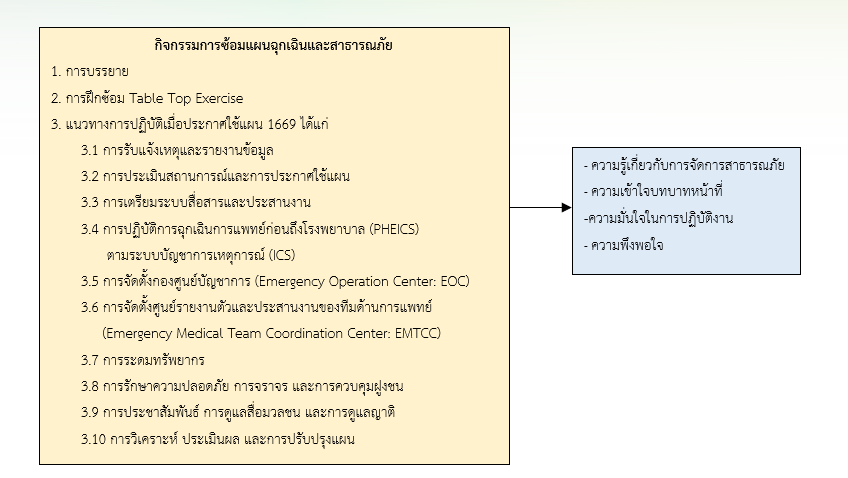
This quasi-experimental study employed a one-group pretest–posttest design. The objective was to examine the effects of an emergency and disaster preparedness exercise on the knowledge, understanding of roles and responsibilities, and confidence in performing duties among 70 personnel at Surat Thani Hospital, selected through purposive sampling. The research instruments consisted of a general information questionnaire, a knowledge assessment on emergency and disaster management, an assessment of understanding of roles and responsibilities and confidence in performing duties, and a satisfaction assessment of the emergency and disaster preparedness exercise. The instruments were validated for content validity, with an S-CVI/Ave of 1.00, and were tested for reliability using Cronbach's alpha coefficient. The assessment of understanding of roles and responsibilities and confidence in performing duties yielded a value of 0.84, and the satisfaction assessment yielded a value of 0.88. Data were analyzed using descriptive statistics, including frequency, percentage, mean, median and standard deviation, and inferential statistics using the Wilcoxon signed-rank test, with the level of statistical significance set at .05. The results showed that
1. After participating in the emergency and disaster preparedness exercise, the personnel at Surat Thani Hospital had significantly higher scores for knowledge of emergency and disaster management, perceived understanding of roles and responsibilities, and confidence in performing duties than before the exercise (p-value < .001). Knowledge scores increased from median of 6.00 (Q1–Q3 = 5.00–7.00) to 9.00 (Q1–Q3 = 8.00–10.00). Scores for understanding of roles and responsibilities scores increased from a median of 2.60 (Q1–Q3 = 2.40–2.80) to 3.60 (Q1–Q3 = 3.40–3.80) ; and confidence in performing duties scores increased from a median of 2.50 (Q1–Q3 = 2.33–2.67) to 3.50 (Q1–Q3 = 3.33–3.67).
2. The participants’ overall satisfaction with the emergency and disaster preparedness exercise was at a high level (M= 3.76, SD = 0.42)
To enhance personnel knowledge, understanding, and operational confidence, the continuous organization of drills should be promoted—focusing on reviewing roles and responsibilities, decision-making, incident reporting, and coordination under the Incident Command System (ICS) to further build operational confidence.
References
กระทรวงสาธารณสุข. (2565). แนวทางการจัดทำแผนและการฝึกซ้อมแผนรองรับภาวะฉุกเฉินและสาธารณภัยด้านการแพทย์และสาธารณสุข สำหรับสถานพยาบาล. นนทบุรี: กระทรวงสาธารณสุข.
จังหวัดสุราษฎร์ธานี. (2567). รักษาการผู้ว่าราชการจังหวัดสุราษฎร์ธานี ในฐานะผู้บัญชาการเหตุการณ์อุทกภัยวาตภัย และดินถล่ม จังหวัดสุราษฎร์ธานี เรียกประชุมคณะทำงานด่วน. เว็บไซต์จังหวัดสุราษฎร์ธานี. สืบค้นเมื่อ 16 ธันวาคม 2568. https://suratthani.go.th/home/news-announcement/executive-news/2024-12-20-08-55-55.html?utm_source
จังหวัดสุราษฎร์ธานี. (2568). ผู้ว่าฯ สุราษฎร์ธานี เยี่ยมให้กำลังใจและอำนวยความสะดวกผู้ประสบเหตุรถบัสพลิกคว่ำ พร้อมประสานส่งกลับภูมิลำเนา. เว็บไซต์จังหวัดสุราษฎร์ธานี. สืบค้นเมื่อวันที่ 2 มกราคม 2569. https://www.suratthani.go.th/home/17-news-announcement/executive-news.html?start=2128&utm_source
พัทยา งามหอม. (2566). การพัฒนารูปแบบการพยาบาลผู้ป่วยบาดเจ็บรุนแรง แผนกอุบัติเหตุและฉุกเฉิน โรงพยาบาลยโสธร. ยโสธรเวชสาร, 25(2), 17-34.
สุทธิชัย สายเย็น และชัชนันท์ ลีระเติมพงษ์. (2565). ความรู้ความเข้าใจและทัศนคติของพนักงานศูนย์การค้าเซ็นทรัลเวิลด์ต่อการฝึกซ้อมดับเพลิงขั้นต้น 40 เปอร์เซ็นต์. วารสารวิจยวิชาการ, 5(1), 173–202.
อภิชิต เหมือยไธสง. (2560). ความพึงพอใจของประชาชนต่อการให้บริการด้านการป้องกันและบรรเทา สาธารณภัย เทศบาลเมืองหนองบัวลำภู อำเภอเมืองหนองบัวลำภู จังหวัดหนองบัวลำภู. วารสารวิชาการแสงอีสาน, 14(2), 81–88.
Best, J. W. (1977). Research in Education. Englewood Cliffs, New Jersy: Pretice Hall.
Federal Emergency Management Agency. (2018). National Incident Management System. U.S. Department of Homeland Security.
Jung, Y. (2022). Virtual reality simulation for disaster preparedness training in hospitals: Integrated review. Journal of Medical Internet Research, 24(1), e30600.
Ledbury, K., Glasgow, S., & Tallach, R. (2023). Learning from simulating mass casualty events: A systematic search and a comprehensive qualitative review. Disaster Medicine and Public Health Preparedness, 17, e242.
Mahdi, S. S., Jafri, H. A., Allana, R., Battineni, G., Khawaja, M., Sakina, S., Agha, D., Rehman, K., & Amenta, F. (2023). Systematic review on the current state of disaster preparation simulation exercises (SimEx). BMC Emergency Medicine, 23, Article 52.
World Health Organization Regional Office for Europe. (2011). Hospital emergency response checklist: An all-hazards tool for hospital administrators and emergency managers. World Health Organization.
World Health Organization. (2017). WHO simulation exercise manual. WHO.
World Health Organization. (2019). Health emergency and disaster risk management framework. World Health Organization.
Downloads
Published
How to Cite
Issue
Section
License
Copyright (c) 2026 Nursing Innovation and Health Association Journal

This work is licensed under a Creative Commons Attribution-NonCommercial-NoDerivatives 4.0 International License.


