
การเปลี่ยนแปลงการรู้คิดในผู้ป่วยโรคสมองเสื่อมหลังการรักษาแบบไม่ใช้ยาอย่างต่อเนื่อง 44 สัปดาห์ ด้วยกิจกรรมบำบัดปักผ้าบูรณาการ: การศึกษาย้อนหลัง ณ โรงพยาบาลสิรินธร จังหวัดขอนแก่น
คำสำคัญ:
ภาวะสมองเสื่อม, การรักษาแบบไม่ใช้ยา, การปักผ้า, การทำหน้าที่ของสมอง, การทบทวนเวชระเบียนย้อนหลังบทคัดย่อ
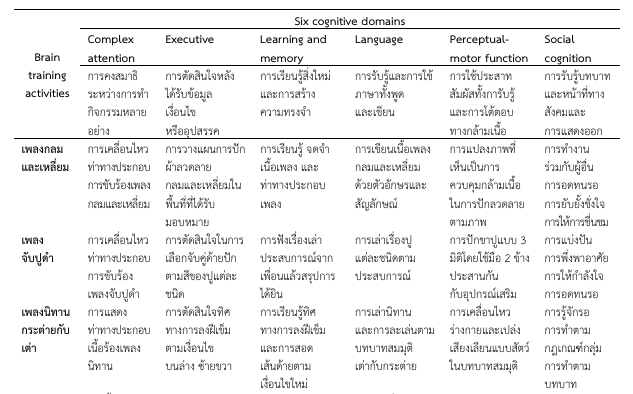
ที่มาของปัญหา: ภาวะสมองเสื่อมเป็นปัญหาสาธารณสุขที่เพิ่มขึ้นในสังคมสูงอายุ โรงพยาบาลสิรินธร จังหวัดขอนแก่น ได้ใช้กระบวนการรักษาแบบไม่ใช้ยา (non-pharmacological Intervention; NPI) ออกแบบผ่าน Six cognitive domains โดยมีกิจกรรมบำบัดปักผ้าบูรณาการ ศิลปะ ดนตรีและการเคลื่อนไหวร่างกายทุกสัปดาห์ต่อเนื่อง 44 สัปดาห์ มีติดตามการเปลี่ยนแปลงด้านพฤติกรรม อารมณ์ สังคมและผลการทำหน้าที่ของสมองในเวชระเบียนอย่างเป็นระบบ แต่ยังไม่มีการวิเคราะห์อย่างครอบคลุม
วัตถุประสงค์: เพื่อศึกษาการเปลี่ยนแปลงของการรู้คิดของผู้ป่วยสมองเสื่อมที่รับการรักษาแบบไม่ใช้ยาตามหลักการ Six cognitive domains อย่างต่อเนื่อง 44 สัปดาห์และประเมินคุณภาพชีวิตหลังการรักษา จากข้อมูลเวชระเบียนย้อนหลัง ณ โรงพยาบาลสิรินธร จังหวัดขอนแก่น
วิธีการศึกษา: การศึกษาย้อนหลังเชิงพรรณนา ทบทวนเวชระเบียนผู้ป่วยสมองเสื่อม (ICD-10: F00-F03) ปีงบประมาณ พ.ศ.2567-2568 จากผู้ป่วย 46 ราย คัดเลือกแบบเจาะจง (purposive sampling) ได้กลุ่มที่มีข้อมูลจากเวชระเบียนที่ครบถ้วนและเข้าร่วมกิจกรรมบำบัดปักผ้าบูรณาการต่อเนื่องทั้งหมด 13 ราย เครื่องมือประเมิน ได้แก่ MoCA, MMSE และ Bender gestalt test วิเคราะห์ด้วย Paired t-test/Wilcoxon signed-rank test และ Cohen's d
ผลการศึกษา: กลุ่มตัวอย่าง 13 ราย อายุเฉลี่ย 71.2±4.6 ปี คะแนน MoCA เพิ่มขึ้นจาก 17.38±2.33 เป็น 20.85±2.54 (p<0.01, d=1.27; ขนาดผลใหญ่) คะแนน MMSE เพิ่มจาก 20.08±3.04 เป็น 21.92±2.64 (p<0.05, d=0.73; ขนาดผลปานกลาง) Bender gestalt test ข้อผิดพลาดลดลงอย่างมีนัยสำคัญ (p<0.05, d=0.66) ด้าน Visuospatial/Executive เพิ่มขึ้น (Δ=+1.23, p=0.004) คุณภาพชีวิตดีขึ้นทุกมิติ โดยร้อยละ 100 มีความสุขและอารมณ์ดีขึ้น
สรุป: NPI ออกแบบผ่าน Six cognitive domains โดยมีกิจกรรมบำบัดปักผ้าบูรณาการ ศิลปะ ดนตรีและการเคลื่อนไหวร่างกาย ทุกสัปดาห์ต่อเนื่อง 44 สัปดาห์ มีประสิทธิผลในการพัฒนาการทำหน้าที่สมองและคุณภาพชีวิตผู้ป่วยสมองเสื่อม สนับสนุนการขยายโปรแกรมสู่ชุมชนและพัฒนาแนวทางเวชปฏิบัติระดับประเทศ
เอกสารอ้างอิง
World Health Organization. Global status report on the public health response to dementia. Geneva: WHO; 2021.
Alzheimer's Disease International. World Alzheimer report 2022: life after diagnosis. London: ADI; 2022.
กรมกิจการผู้สูงอายุ กระทรวงพัฒนาสังคมและความมั่นคงของมนุษย์. รายงานสถานการณ์ผู้สูงอายุไทย พ.ศ.2566. กรุงเทพฯ: กรมกิจการผู้สูงอายุ; 2567.
Finkel SI, Costa de Silva J, Cohen G, Miller S, Sartorius N. Behavioral and psychological signs and symptoms of dementia: a consensus statement on current knowledge and implications for research and treatment. Int Psychogeriatrics. 1996;8(Suppl 3):497-500. doi: 10.1017/s1041610297003943.
Ballard CG, O'Brien JT. Pharmacological treatment of behavioral and psychological signs in Alzheimer's disease: how good is the evidence for current pharmacological treatments? BMJ. 1999;319(7203):138-9.
Margallo-Lana M, Swann A, O'Brien J, Fairbairn A, Reichelt K, Potkins D, et al. Prevalence and pharmacological management of behavioural and psychological symptoms amongst dementia sufferers living in care environments. Int J Geriatr Psychiatry.2001;16(1):39-44. doi: 10.1002/1099-1166(200101)16:1<39::aid-gps269>3.0.co;2-f.
Ballard CG, O'Brien J, James I, Swann A. Dementia: management of behavioral and psychological symptoms. Oxford: Oxford University Press; 2001.
McShane R, Keene J, Gedling K, Fairburn C, Jacoby R, Hope T. Do neuroleptic drugs hasten cognitive decline in dementia? prospective study with necropsy follow up. BMJ. 1997;314(7076):266-70. doi: 10.1136/bmj.314.7076.266.
Berg-Weger M, Stewart DB. Non-pharmacologic interventions for people with dementia. Mo Med. 2017;114(2):116-9.
Wang G, Albayrak A, van der Cammen TJM. A systematic review of non-pharmacological interventions for BPSD in nursing home residents with dementia: from a perspective of ergonomics. Int Psychogeriatr. 2019;31(8):1137-49. doi: 10.1017/S1041610218001679.
Vu HT, Nguyen HT, Nguyen AT. Effectiveness of non-pharmacological interventions for dementia among the elderly: a randomized controlled trial. Geriatrics (Basel). 2024;9(2):52. doi:10.3390/geriatrics9020052.
Maneemai O, Cujilan Alvarado MC, Calderon Intriago LG, Donoso Triviño AJ, Franco Coffré JA, Pratico D, et al. Sensory integration: a novel approach for healthy ageing and dementia management. Brain Sci. 2024;14(3):285. doi: 10.3390/brainsci14030285.
Zhao Y, Li T, Wang H, Li C. Visual art therapy for cognitive and emotional enhancement in aging and dementia: a structured narrative review. J Alzheimer’s Dis Rep. 2025;9:25424823251383728. doi:10.1177/25424823251383728.
Zhuo X, Yan Y, Lin R, Lin S, Zheng X, Shao T, et al. Effects of an art-based intervention in older adults with dementia: a randomized controlled trial. Sci Rep. 2025;15(1):10406. doi: 10.1038/s41598-025-95051-5.
Jornkokgoud K, Makmee P, Wongupparaj P, Grecucci A. Tablet- and group-based multicomponent cognitive stimulation for older adults with mild cognitive impairment: single-group pilot study and protocol for randomized controlled trial. JMIR Res Protoc. 2025;14:e64465. doi:10.2196/64465.
ดาวน์โหลด
เผยแพร่แล้ว
รูปแบบการอ้างอิง
ฉบับ
ประเภทบทความ
สัญญาอนุญาต
ลิขสิทธิ์ (c) 2026 ราชภิวัฒน์เวชสาร

อนุญาตภายใต้เงื่อนไข Creative Commons Attribution-NonCommercial-NoDerivatives 4.0 International License.
Articles in this journal are copyrighted by the x may be read and used for academic purposes, such as teaching, research, or citation, with proper credit given to the author and the journal.use or modification of the articles is prohibited without permission.
statements expressed in the articles are solely the opinions of the authors.
authors are fully responsible for the content and accuracy of their articles.
other reuse or republication requires permission from the journal."


