
Cognitive Changes in Dementia Patients Following 44-Week Continuous Non-Pharmacological Treatment with Integrative Embroidery-Based Occupational Therapy: A Retrospective Study at Sirindhorn Hospital, Khon Kaen
Keywords:
Dementia, Non-pharmacological intervention, Embroidery, Cognitive function, Retrospective medical record reviewAbstract
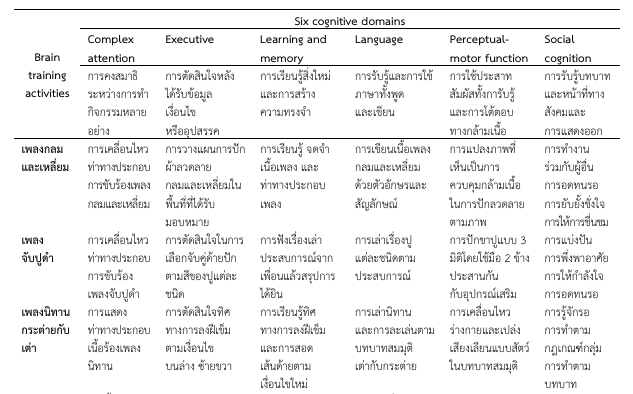
Background: Dementia represents a significant public health challenge in aging populations. Sirindhorn Hospital, Khon Kaen, has initiated a 44-week Non-Pharmacological Intervention (NPI) targeting Six Cognitive Domains, utilizing embroidery, art, music, and physical activity as therapeutic modalities. Progression and psychological evaluations are systematically documented in medical records. Nonetheless, a comprehensive assessment of the program's effectiveness has yet to be undertaken.
Objective: This study aimed to examine cognitive changes in dementia patients receiving continuous non-pharmacological treatment based on the Six Cognitive Domains framework over a 44-week period, and to assess their quality of life following treatment, using retrospective medical record data from Sirindhorn Hospital, Khon Kaen.
Methods: This retrospective observational study reviewed medical records of patients diagnosed with dementia (ICD-10: F00-F03) at Sirindhorn Hospital during fiscal years 2024–2025 (B.E. 2567–2568). Of the 46 eligible records, 13 patients who had complete pre- and post-assessment data and participated in 44 weeks of occupational therapy were selected using purposive sampling. The assessment instruments included the MoCA, MMSE, and Bender Gestalt Test. Data analysis was performed utilizing the Paired t-test or Wilcoxon Signed-Rank Test, and effect sizes were calculated using Cohen's d.
Results: The study included thirteen participants with a mean age of 71.2 ± 4.6 years. MoCA scores showed a statistically significant increase from 17.38 ± 2.33 to 20.85 ± 2.54 (p < 0.01, Cohen's d = 1.27; indicating a large effect size). MMSE scores rose from 20.08 ± 3.04 to 21.92 ± 2.64 (p < 0.05, d = 0.73; medium effect size). Bender Gestalt error scores demonstrated a significant decrease (p < 0.05, d = 0.66). The Visuospatial/Executive and Attention domains of the MoCA improved by +1.23 points (p = 0.004) and +0.77 points (p = 0.033), respectively. Quality of life measures increased across all assessed dimensions, with every participant reporting greater happiness, improved mood, and enhanced relaxation.
Conclusion: A 44-week non-pharmacological intervention (NPI) targeting six cognitive domains through embroidery, art, music, and physical movement demonstrated significant improvements in cognitive function and quality of life among individuals with dementia. These results provide evidence to support broader community adoption and inform the development of national clinical practice guidelines.
References
World Health Organization. Global status report on the public health response to dementia. Geneva: WHO; 2021.
Alzheimer's Disease International. World Alzheimer report 2022: life after diagnosis. London: ADI; 2022.
กรมกิจการผู้สูงอายุ กระทรวงพัฒนาสังคมและความมั่นคงของมนุษย์. รายงานสถานการณ์ผู้สูงอายุไทย พ.ศ.2566. กรุงเทพฯ: กรมกิจการผู้สูงอายุ; 2567.
Finkel SI, Costa de Silva J, Cohen G, Miller S, Sartorius N. Behavioral and psychological signs and symptoms of dementia: a consensus statement on current knowledge and implications for research and treatment. Int Psychogeriatrics. 1996;8(Suppl 3):497-500. doi: 10.1017/s1041610297003943.
Ballard CG, O'Brien JT. Pharmacological treatment of behavioral and psychological signs in Alzheimer's disease: how good is the evidence for current pharmacological treatments? BMJ. 1999;319(7203):138-9.
Margallo-Lana M, Swann A, O'Brien J, Fairbairn A, Reichelt K, Potkins D, et al. Prevalence and pharmacological management of behavioural and psychological symptoms amongst dementia sufferers living in care environments. Int J Geriatr Psychiatry.2001;16(1):39-44. doi: 10.1002/1099-1166(200101)16:1<39::aid-gps269>3.0.co;2-f.
Ballard CG, O'Brien J, James I, Swann A. Dementia: management of behavioral and psychological symptoms. Oxford: Oxford University Press; 2001.
McShane R, Keene J, Gedling K, Fairburn C, Jacoby R, Hope T. Do neuroleptic drugs hasten cognitive decline in dementia? prospective study with necropsy follow up. BMJ. 1997;314(7076):266-70. doi: 10.1136/bmj.314.7076.266.
Berg-Weger M, Stewart DB. Non-pharmacologic interventions for people with dementia. Mo Med. 2017;114(2):116-9.
Wang G, Albayrak A, van der Cammen TJM. A systematic review of non-pharmacological interventions for BPSD in nursing home residents with dementia: from a perspective of ergonomics. Int Psychogeriatr. 2019;31(8):1137-49. doi: 10.1017/S1041610218001679.
Vu HT, Nguyen HT, Nguyen AT. Effectiveness of non-pharmacological interventions for dementia among the elderly: a randomized controlled trial. Geriatrics (Basel). 2024;9(2):52. doi:10.3390/geriatrics9020052.
Maneemai O, Cujilan Alvarado MC, Calderon Intriago LG, Donoso Triviño AJ, Franco Coffré JA, Pratico D, et al. Sensory integration: a novel approach for healthy ageing and dementia management. Brain Sci. 2024;14(3):285. doi: 10.3390/brainsci14030285.
Zhao Y, Li T, Wang H, Li C. Visual art therapy for cognitive and emotional enhancement in aging and dementia: a structured narrative review. J Alzheimer’s Dis Rep. 2025;9:25424823251383728. doi:10.1177/25424823251383728.
Zhuo X, Yan Y, Lin R, Lin S, Zheng X, Shao T, et al. Effects of an art-based intervention in older adults with dementia: a randomized controlled trial. Sci Rep. 2025;15(1):10406. doi: 10.1038/s41598-025-95051-5.
Jornkokgoud K, Makmee P, Wongupparaj P, Grecucci A. Tablet- and group-based multicomponent cognitive stimulation for older adults with mild cognitive impairment: single-group pilot study and protocol for randomized controlled trial. JMIR Res Protoc. 2025;14:e64465. doi:10.2196/64465.
Downloads
Published
How to Cite
Issue
Section
License
Copyright (c) 2026 Ratchabhiwat Medical Journal

This work is licensed under a Creative Commons Attribution-NonCommercial-NoDerivatives 4.0 International License.
Articles in this journal are copyrighted by the x may be read and used for academic purposes, such as teaching, research, or citation, with proper credit given to the author and the journal.use or modification of the articles is prohibited without permission.
statements expressed in the articles are solely the opinions of the authors.
authors are fully responsible for the content and accuracy of their articles.
other reuse or republication requires permission from the journal."


