
บทบาทของพยาบาลในการให้คำแนะนำเพื่อเตรียมตัวก่อนกลับบ้านในผู้ป่วยที่ได้รับการสวนหัวใจ: แนวทางเชิงระบบและแนวปฏิบัติสำหรับการพยาบาล
คำสำคัญ:
การสวนหัวใจ, การวางแผนจำหน่าย, บทบาทพยาบาล, การให้คำแนะนำก่อนกลับบ้าน, การดูแลต่อเนื่องบทคัดย่อ
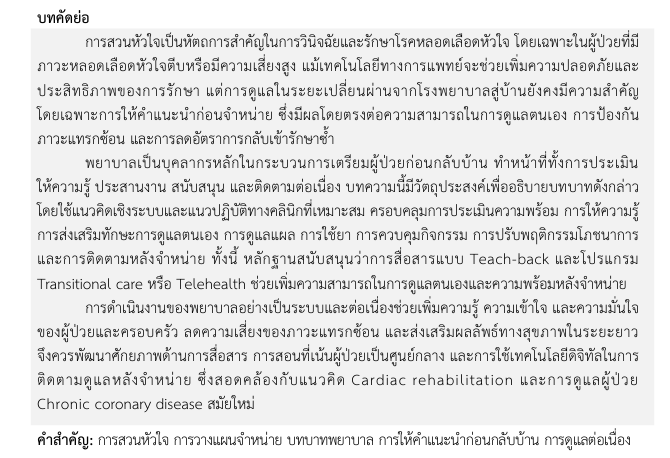
การสวนหัวใจเป็นหัตถการสำคัญในการวินิจฉัยและรักษาโรคหลอดเลือดหัวใจ โดยเฉพาะในผู้ป่วยที่มีภาวะหลอดเลือดหัวใจตีบหรือมีความเสี่ยงสูง แม้เทคโนโลยีทางการแพทย์จะช่วยเพิ่มความปลอดภัยและประสิทธิภาพของการรักษา แต่การดูแลในระยะเปลี่ยนผ่านจากโรงพยาบาลสู่บ้านยังคงมีความสำคัญ โดยเฉพาะการให้คำแนะนำก่อนจำหน่าย ซึ่งมีผลโดยตรงต่อความสามารถในการดูแลตนเอง การป้องกันภาวะแทรกซ้อน และการลดอัตราการกลับเข้ารักษาซ้ำ
พยาบาลเป็นบุคลากรหลักในกระบวนการเตรียมผู้ป่วยก่อนกลับบ้าน ทำหน้าที่ทั้งการประเมินให้ความรู้ ประสานงาน สนับสนุน และติดตามต่อเนื่อง บทความนี้มีวัตถุประสงค์เพื่ออธิบายบทบาทดังกล่าวโดยใช้แนวคิดเชิงระบบและแนวปฏิบัติทางคลินิกที่เหมาะสม ครอบคลุมการประเมินความพร้อม การให้ความรู้ การส่งเสริมทักษะการดูแลตนเอง การดูแลแผล การใช้ยา การควบคุมกิจกรรม การปรับพฤติกรรมโภชนาการ และการติดตามหลังจำหน่าย ทั้งนี้ หลักฐานสนับสนุนว่าการสื่อสารแบบ Teach-back และโปรแกรม Transitional care หรือ Telehealth ช่วยเพิ่มความสามารถในการดูแลตนเองและความพร้อมหลังจำหน่าย
การดำเนินงานของพยาบาลอย่างเป็นระบบและต่อเนื่องช่วยเพิ่มความรู้ ความเข้าใจ และความมั่นใจของผู้ป่วยและครอบครัว ลดความเสี่ยงของภาวะแทรกซ้อน และส่งเสริมผลลัพธ์ทางสุขภาพในระยะยาวจึงควรพัฒนาศักยภาพด้านการสื่อสาร การสอนที่เน้นผู้ป่วยเป็นศูนย์กลาง และการใช้เทคโนโลยีดิจิทัลในการติดตามดูแลหลังจำหน่าย ซึ่งสอดคล้องกับแนวคิด Cardiac rehabilitation และการดูแลผู้ป่วย Chronic coronary disease สมัยใหม่
เอกสารอ้างอิง
Lawton JS, Tamis-Holland JE, Bangalore S, Bates ER, Beckie TM, Bischoff JM, et al. 2021 ACC/AHA/SCAI guideline for coronary artery revascularization: a report of the American College of Cardiology/American Heart Association Joint Committee on Clinical Practice Guidelines. Circulation. 2022;145(3):e18–e114. doi: 10.1161/CIR.0000000000001038.
Dhabi CCA. Discharge instructions: cardiac catheterization & coronary intervention [Internet]. 2026 [cited 2026 Mar 15]. Available from: https://www.clevelandclinicabudhabi.ae/en/health-library/health-resources/treatments-and-procedures/discharge-instructions-cardiac-catheterization-and-coronary-intervention
MedlinePlus. Cardiac catheterization – discharge [Internet]. 2024 [cited 2026 Mar 15]. Available from: https://medlineplus.gov/ency/patientinstructions/000096.htm
Virani SS, Newby LK, Arnold SV, Bittner V, Brewer LC, Demeter SH, et al. 2023 AHA/ACC/ACCP/ASPC/NLA/PCNA guideline for the management of patients with chronic coronary disease: a report of the American Heart Association/American College of Cardiology Joint Committee on Clinical Practice Guidelines. Circulation. 2023;148(9):e9–e119. doi: 10.1161/CIR.0000000000001168.
Keattison K. DevelopingNursing Practice Guideline for Patients with Ischemic Heart Disease, Undergoing Therapeutic Cardiac Catheterization. Nursing, Health, and Public Health Journal. 2022;1(2):28–42.
Homem F, Reveles A, Amaral A, Coutinho V, Gonçalves L. Improving transitional care after acute myocardial infarction: a scoping review. Health Care Sci. 2024;3(5):312-28. doi: 10.1002/hcs2.116.
Prateepmanowong J, Chouyboon S, Nareumanphokin N. Nursing care for patients undergoing transradial cardiac catheterization: case study. Thai Journal of Cardio-Thoracic Nursing. 2019;30(2):2–14.
Howie-Esquivel J, Bidwell JT. A state-of-the-art review of teach-back for patients and families with heart failure: how far have we come? J Cardiovasc Nurs. 2023;38(4): E120–E130. doi: 10.1097/JCN.0000000000000980.
Brown TM, Pack QR, Aberegg E, Brewer LC, Ford YR, Forman DE, et al. Core components of cardiac rehabilitation programs: 2024 update: a scientific statement from the American Heart Association and the American Association of Cardiovascular and Pulmonary Rehabilitation. Circulation. 2024;150(18):e328–e347. doi: 10.1161/CIR.0000000000001289.
Magnani JW, Mujahid MS, Aronow HD, Cené CW, Dickson VV, Havranek E, et al. Health literacy and cardiovascular disease: fundamental relevance to primary and secondary prevention: a scientific statement from the American Heart Association. Circulation. 2018;138(2):e48–e74. doi: 10.1161/CIR.0000000000000579.
Promrod S. Effectiveness of a pre-discharge education programme for patients undergoing cardiac catheterization. The Journal of Faculty of Nursing Burapha University. 2026;34(1):13–25.
Susuthi P, Aoongchittrakul P, Jansrithong P, Chaosangkate N. Effect of a transitional care program for patients with acute coronary syndrome post discharge by telehealth follow-up on self–care agency and rehospitalization*. Nurs Res Inno. 2024;30(2):163-80.
Lindblom S, Ytterberg C, Flink M, Carlsson AC, Stenberg U, Tistad M, et.al. The use of teach back at hospital discharge to support self-management of prescribed medication for secondary prevention after stroke-findings from a feasibility study. Healthcare (Basel). 2023;11(3):391. doi: 10.3390/healthcare11030391.
Yunker C. How to care for yourself after radial access heart catheterization [Internet]. Michigan: Michigan Medicine, University of Michigan; 2026 [cited 2026 Mar 15]. Available from: https://www.uofmhealth.org/sites/default/files/2025-08/HeartCathRadialAccess.pdf
Oh EG, Lee JY, Lee HJ, Oh S. Effects of discharge education using teach-back methods in patients with heart failure: A randomized controlled trial. Int J Nurs Stud. 2023;140:104453. doi: 10.1016/j.ijnurstu.2023.104453.
ดาวน์โหลด
เผยแพร่แล้ว
รูปแบบการอ้างอิง
ฉบับ
ประเภทบทความ
สัญญาอนุญาต
ลิขสิทธิ์ (c) 2026 ราชภิวัฒน์เวชสาร

อนุญาตภายใต้เงื่อนไข Creative Commons Attribution-NonCommercial-NoDerivatives 4.0 International License.
Articles in this journal are copyrighted by the x may be read and used for academic purposes, such as teaching, research, or citation, with proper credit given to the author and the journal.use or modification of the articles is prohibited without permission.
statements expressed in the articles are solely the opinions of the authors.
authors are fully responsible for the content and accuracy of their articles.
other reuse or republication requires permission from the journal."


