
The Role of Nurses in Providing Pre-Discharge Education for Patients Undergoing Cardiac Catheterization: A Systematic Approach and Nursing Practice Guidelines
Keywords:
Cardiac catheterization, Discharge planning, Nursing role, Pre-discharge education, Transitional careAbstract
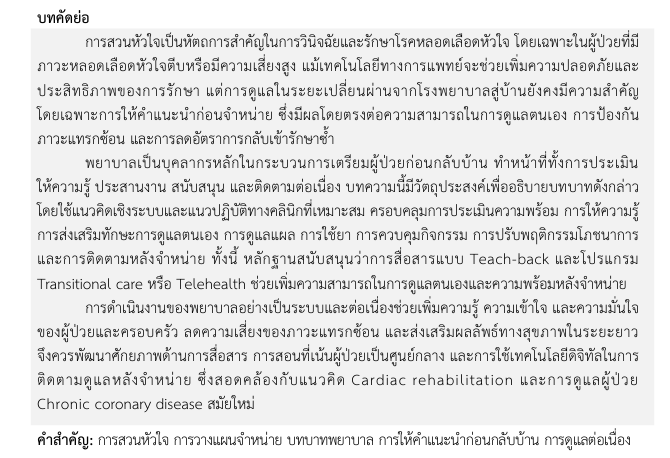
Cardiac catheterization is a critical procedure for the diagnosis and treatment of coronary artery disease, particularly among patients with coronary stenosis or those at high risk of cardiovascular complications. Although advancements in medical technology have enhanced the safety and effectiveness of the procedure, the transition from hospital to home remains a crucial phase that requires systematic discharge planning. In particular, pre-discharge education plays a significant role in improving patients’ self-care abilities, preventing complications, and reducing hospital readmission rates.
Nurses serve as key professionals in the discharge preparation process, undertaking roles as assessors, educators, coordinators, supporters, and follow-up providers. This article aims to describe the nursing roles in providing pre-discharge education for patients undergoing cardiac catheterization, using a systems-based approach in conjunction with appropriate clinical guidelines. The content encompasses readiness assessment, patient education, promotion of self-care skills, wound care, medication management, physical activity regulation, dietary modification, and post-discharge follow-up. Current evidence indicates that the use of teach-back communication and transitional care or telehealth programs enhances self-care capacity and discharge readiness.
A systematic and continuous nursing approach contributes to improved knowledge, understanding, and confidence among patients and their families in managing care at home, reduces the risk of post-procedural complications, and promotes favorable long-term health outcomes. Therefore, it is essential for nurses to strengthen their competencies in communication, patient-centered education techniques, and the integration of digital technologies for ongoing follow-up care after discharge. These approaches are aligned with the core components of cardiac rehabilitation and contemporary guidelines for the management of chronic coronary disease.
References
Lawton JS, Tamis-Holland JE, Bangalore S, Bates ER, Beckie TM, Bischoff JM, et al. 2021 ACC/AHA/SCAI guideline for coronary artery revascularization: a report of the American College of Cardiology/American Heart Association Joint Committee on Clinical Practice Guidelines. Circulation. 2022;145(3):e18–e114. doi: 10.1161/CIR.0000000000001038.
Dhabi CCA. Discharge instructions: cardiac catheterization & coronary intervention [Internet]. 2026 [cited 2026 Mar 15]. Available from: https://www.clevelandclinicabudhabi.ae/en/health-library/health-resources/treatments-and-procedures/discharge-instructions-cardiac-catheterization-and-coronary-intervention
MedlinePlus. Cardiac catheterization – discharge [Internet]. 2024 [cited 2026 Mar 15]. Available from: https://medlineplus.gov/ency/patientinstructions/000096.htm
Virani SS, Newby LK, Arnold SV, Bittner V, Brewer LC, Demeter SH, et al. 2023 AHA/ACC/ACCP/ASPC/NLA/PCNA guideline for the management of patients with chronic coronary disease: a report of the American Heart Association/American College of Cardiology Joint Committee on Clinical Practice Guidelines. Circulation. 2023;148(9):e9–e119. doi: 10.1161/CIR.0000000000001168.
Keattison K. DevelopingNursing Practice Guideline for Patients with Ischemic Heart Disease, Undergoing Therapeutic Cardiac Catheterization. Nursing, Health, and Public Health Journal. 2022;1(2):28–42.
Homem F, Reveles A, Amaral A, Coutinho V, Gonçalves L. Improving transitional care after acute myocardial infarction: a scoping review. Health Care Sci. 2024;3(5):312-28. doi: 10.1002/hcs2.116.
Prateepmanowong J, Chouyboon S, Nareumanphokin N. Nursing care for patients undergoing transradial cardiac catheterization: case study. Thai Journal of Cardio-Thoracic Nursing. 2019;30(2):2–14.
Howie-Esquivel J, Bidwell JT. A state-of-the-art review of teach-back for patients and families with heart failure: how far have we come? J Cardiovasc Nurs. 2023;38(4): E120–E130. doi: 10.1097/JCN.0000000000000980.
Brown TM, Pack QR, Aberegg E, Brewer LC, Ford YR, Forman DE, et al. Core components of cardiac rehabilitation programs: 2024 update: a scientific statement from the American Heart Association and the American Association of Cardiovascular and Pulmonary Rehabilitation. Circulation. 2024;150(18):e328–e347. doi: 10.1161/CIR.0000000000001289.
Magnani JW, Mujahid MS, Aronow HD, Cené CW, Dickson VV, Havranek E, et al. Health literacy and cardiovascular disease: fundamental relevance to primary and secondary prevention: a scientific statement from the American Heart Association. Circulation. 2018;138(2):e48–e74. doi: 10.1161/CIR.0000000000000579.
Promrod S. Effectiveness of a pre-discharge education programme for patients undergoing cardiac catheterization. The Journal of Faculty of Nursing Burapha University. 2026;34(1):13–25.
Susuthi P, Aoongchittrakul P, Jansrithong P, Chaosangkate N. Effect of a transitional care program for patients with acute coronary syndrome post discharge by telehealth follow-up on self–care agency and rehospitalization*. Nurs Res Inno. 2024;30(2):163-80.
Lindblom S, Ytterberg C, Flink M, Carlsson AC, Stenberg U, Tistad M, et.al. The use of teach back at hospital discharge to support self-management of prescribed medication for secondary prevention after stroke-findings from a feasibility study. Healthcare (Basel). 2023;11(3):391. doi: 10.3390/healthcare11030391.
Yunker C. How to care for yourself after radial access heart catheterization [Internet]. Michigan: Michigan Medicine, University of Michigan; 2026 [cited 2026 Mar 15]. Available from: https://www.uofmhealth.org/sites/default/files/2025-08/HeartCathRadialAccess.pdf
Oh EG, Lee JY, Lee HJ, Oh S. Effects of discharge education using teach-back methods in patients with heart failure: A randomized controlled trial. Int J Nurs Stud. 2023;140:104453. doi: 10.1016/j.ijnurstu.2023.104453.
Downloads
Published
How to Cite
Issue
Section
License
Copyright (c) 2026 Ratchabhiwat Medical Journal

This work is licensed under a Creative Commons Attribution-NonCommercial-NoDerivatives 4.0 International License.
Articles in this journal are copyrighted by the x may be read and used for academic purposes, such as teaching, research, or citation, with proper credit given to the author and the journal.use or modification of the articles is prohibited without permission.
statements expressed in the articles are solely the opinions of the authors.
authors are fully responsible for the content and accuracy of their articles.
other reuse or republication requires permission from the journal."


