
อุบัติการณ์การเกิดภาวะภูมิไวเกินจากสูตรยาเคมีบำบัดที่มียาออกซาลิพลาตินเป็นส่วนประกอบ ภายหลังการให้ยาต้านฮีสตามีนและการยืดระยะเวลาบริหารยา : การศึกษาย้อนหลัง
คำสำคัญ:
ยาออกซาลิพลาติน, สูตรยาโฟลฟอกซ์, สูตรยาเคปออกซ์, ปฏิกิริยาการแพ้แบบภูมิไวเกินเกณฑ์อาการไม่พึงประสงค์ที่แบ่งตามระดับความรุนแรงบทคัดย่อ
ที่มาของปัญหา: ยาออกซาลิพลาติน (oxaliplatin) เป็นยาเคมีบำบัดที่ใช้ในผู้ป่วยมะเร็งลำไส้ใหญ่ แต่มีรายงานการเกิดปฏิกิริยาการแพ้แบบภูมิไวเกิน (hypersensitive reaction) จากการใช้ยาออกซาลิพลาตินหลายการศึกษา โดยพบอุบัติการณ์ตั้งแต่ 12-25% โดยข้อมูลการใช้สูตรที่มียาออกซาลิพลาตินในโรงพยาบาลราชบุรีปี 2566 พบการเกิดปฏิกิริยาการแพ้แบบภูมิไวเกินจากการใช้ยาออกซาลิพลาติน 17.7% และโรงพยาบาลราชบุรีได้นำวิธีการให้ยากลุ่ม Antihistamine พร้อมการปรับการบริหารยาให้นานขึ้น ในรอบการที่ 7 ของสูตรโฟลฟอกซ์ และรอบที่ 5 ของสูตรเคปออกซ์ มาใช้ในโรงพยาบาลราชบุรีตั้งแต่มกราคม 2567 ถึงปัจจุบัน โดยยังไม่มีการศึกษาถึงผลการเปลี่ยนแปลงที่เกิดขึ้นจากการปรับเปลี่ยนดังกล่าว
วัตถุประสงค์: เพื่อศึกษาอุบัติการณ์ถึงการเกิดปฏิกิริยาการแพ้แบบภูมิไวเกินจากการใช้ยาออกซาลิพลาติน ในผู้ป่วยที่ไม่เคยได้รับการรักษาด้วยสูตรยาเคมีบำบัดที่มียาออกซาลิพลาติน ในโรงพยาบาลราชบุรี
วิธีการศึกษา: เป็นการศึกษาเชิงพรรณนาแบบย้อนหลัง (retrospective descriptive study) โดยใช้ข้อมูลจากเวชระเบียนโรงพยาบาลราชบุรีของผู้ป่วยนอกและผู้ป่วยในที่ได้รับยาเคมีบำบัดสูตรโฟลฟอกซ์ และเคปออกซ์ ตั้งแต่ 1 มกราคม 2567 ถึง 31 ธันวาคม 2568 ในโรงพยาบาลราชบุรี
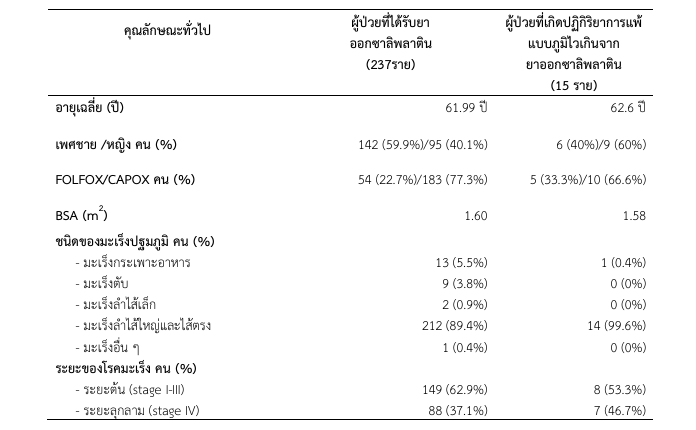
ผลจากการศึกษา: จากการรวบรวมข้อมูลพบว่าจะมีผู้ป่วยที่เข้าเกณฑ์ทั้งหมด 237 ราย และพบอุบัติการณ์การเกิดปฏิกิริยาการแพ้แบบภูมิไวเกินจากการใช้ยาออกซาลิพลาติน ลดลงจากเดิม 17.7% เป็น 6.3 % และลดระดับการแพ้ตาม CTCAE V5.0 จากระดับ 3-4 เหลือเพียงระดับ 1-2 ซึ่งทำให้ลดความเสี่ยงของผู้ป่วยในการเกิดปฏิกิริยาการแพ้ และสามารถรักษาได้ครบรอบการรักษาซึ่งส่งผลต่อการควบคุมโรครวมถึงอัตราการรอดชีวิตของผู้ป่วยอีกด้วย
สรุป: วิธีการให้ยากลุ่ม Antihistamine และการปรับการบริหารยาให้นานขึ้นในรอบการรักษาที่ 7 ของสูตรโฟลฟอกซ์ และรอบการรักษาที่ 5 ของสูตรเคปออกซ์ สามารถลดอุบัติการณ์การเกิดปฏิกิริยาการแพ้แบบภูมิไวเกินจากการใช้ยาออกซาลิพลาติน จาก 17.7% เป็น 6.3 % และลดระดับระดับการแพ้ตาม CTCAE V5.0 จากระดับ 3-4 เหลือเพียงระดับ 1-2
เอกสารอ้างอิง
Andre T, Boni C, Navarro M, Tabernero J, Hickish T, Topham C, et al. Improved overall survival with oxaliplatin, fluorouracil, and leucovorin as adjuvant treatment in stage II or III colon cancer in the MOSAIC trial. J Clin Oncol. 2009;27(19):3109-16. doi: 10.1200/JCO.2008.20.6771.
Yothers G, O'Connell MJ, Allegra CJ, Kuebler JP, Colangelo LH, Petrelli NJ, et al. Oxaliplatin as adjuvant therapy for colon cancer: updated results of NSABP C-07 trial, including survival and subset analyses. J Clin Oncol. 2011;29(28):3768-74. doi: 10.1200/JCO.2011.36.4539.
Kuebler JP, Wieand HS, O'Connell MJ, Smith RE, Colangelo LH, Yothers G, et al. Oxaliplatin combined with weekly bolus fluorouracil and leucovorin as surgical adjuvant chemotherapy for stage II and III colon cancer: results from NSABP C-07. J Clin Oncol. 2007;25(16):2198-204. doi: 10.1200/JCO.2006.08.2974.
Haller DG, Tabernero J, Maroun J, de Braud F, Price T, Van Cutsem E, et al. Capecitabine plus oxaliplatin compared with fluorouracil and folinic acid as adjuvant therapy for stage III colon cancer. J Clin Oncol. 2011;29(11):1465-71. doi: 10.1200/JCO.2010.33.6297.
Schmoll HJ, Tabernero J, Maroun J, de Braud F, Price T, Van Cutsem E, et al. Capecitabine plus oxaliplatin compared with fluorouracil/folinic acid as adjuvant therapy for stage III colon cancer: final results of the NO16968 randomized controlled phase III trial. J Clin Oncol. 2015;33(32):3733-40. doi: 10.1200/JCO.2015.60.9107.
Brandi G, Pantaleo MA, Galli C, Falcone A, Antonuzzo A, Mordenti P, et al. Hypersensitivity reactions related to oxaliplatin (OHP). Br J Cancer. 2003;89(3):477-81. doi: 10.1038/sj.bjc.6601155.
Kim BH, Bradley T, Tai J, Budman DR. Hypersensitivity to oxaliplatin: an investigation of incidence and risk factors, and literature review. Oncology. 2009;76(4):231-8. doi: 10.1159/000205263.
Parel M, Ranchon F, Nosbaum A, You B, Vantard N, Schwiertz V, et al. Hypersensitivity to oxaliplatin: clinical features and risk factors. BMC Pharmacol Toxicol. 2014;15:1. doi: 10.1186/2050-6511-15-1.
Siu SW, Chan RT, Au GK. Hypersensitivity reactions to oxaliplatin: experience in a single institute. Ann Oncol. 2006;17(2):259-61. doi: 10.1093/annonc/mdj042.
Lenz HJ. Management and preparedness for infusion and hypersensitivity reactions. Oncologist. 2007;12(5):601-9. doi: 10.1634/theoncologist.12-5-601.
Polyzos A, Tsavaris N, Gogas H, Souglakos J, Vambakas L, Vardakas N, et al. Clinical features of hypersensitivity reactions to oxaliplatin: a 10-year experience. Oncology. 2009;76(1):36-41. doi: 10.1159/000178163.
Pagani M, Bonadonna P, Senna GE, Antico A. Standardization of skin tests for diagnosis and prevention of hypersensitivity reactions to oxaliplatin. Int Arch Allergy Immunol. 2008;145(1):54-7. doi: 10.1159/000107467.
Pagani M, Bonadonna P. Skin test protocol for the prevention of hypersensitivity reactions to oxaliplatin. Anticancer Res. 2014;34(1):537-40.
Gammon D, Bhargava P, McCormick MJ. Hypersensitivity reactions to oxaliplatin and the application of a desensitization protocol. Oncologist. 2004;9(5):546-9. doi: 10.1634/theoncologist.9-5-546.
Seki K, Tsuduki Y, Ioroi T, Yamane M, Yamauchi H, Shiraishi Y, et al. Serum lactate dehydrogenase levels as a predictive marker of oxaliplatin-induced hypersensitivity reactions in Japanese patients with advanced colorectal cancer. Int J Med Sci. 2014;11(6):641-5. doi: 10.7150/ijms.7643.
Yoshida Y, Hirata K, Matsuoka H, Iwamoto S, Kotaka M, Fujita H, et al. A single-arm Phase II validation study of preventing oxaliplatin-induced hypersensitivity reactions by dexamethasone: the AVOID trial. Drug Des Devel Ther. 2015;9:6067-73. doi: 10.2147/DDDT.S94901.
Lagampan C. An open-label randomized controlled trial to evaluate the efficacy of antihistamine premedication and infusion prolongation in prevention of hypersensitivity reaction to oxaliplatin [thesis]. Bangkok: Chulalongkorn University; 2020.
Kidera Y, Satoh T, Ueda S, Okamoto W, Okamoto I, Fumita S, et al. High-dose dexamethasone plus antihistamine prevents colorectal cancer patients treated with modified FOLFOX6 from hypersensitivity reactions induced by oxaliplatin. Int J Clin Oncol. 2011;16(3):244-9. doi: 10.1007/s10147-010-0170-6.
Yoshino T, Mizunuma N, Yamazaki K, Nishina T, Komatsu Y, Baba H, et al. TAS-102 monotherapy for pretreated metastatic colorectal cancer: a double-blind, randomised, placebo-controlled phase 2 trial. Lancet Oncol. 2012;13(10):993-1001. doi: 10.1016/S1470-2045(12)70345-5.
Sriuranpong V, Areepium N, Chantarawong W, Jinawath A, Numthavaj P, Thakkinstian A. Retrospective analysis of oxaliplatin-related hypersensitivity reactions in colorectal cancer patients. J Oncol Pharm Pract. 2014;20(6):412-8.
Ichikawa Y, Goto A, Hirokawa S, Kijima M, Ishikawa T, Chishima T, et al. Allergic reactions to oxaliplatin in a single institute in Japan. Jpn J Clin Oncol. 2009;39(9):616-20. doi: 10.1093/jjco/hyp070.
Suenaga M, Mizunuma N, Shinozaki E, Matsusaka S, Chin K, Muto T, et al. Management of allergic reactions to oxaliplatin in colorectal cancer patients. J Support Oncol. 2008;6(8):373-8.
Suenaga M, Mizunuma N, Matsusaka S, Shinozaki E, Ueno M, Yamaguchi T. Preventive approach to allergic reaction to oxaliplatin. J Clin Oncol. 2007;25(18 Suppl):14569.
Maindrault-Goebel F, de Gramont A, Louvet C, André T, Carola E, Gilles S, et al. High-grade oxaliplatin-related neurotoxicity and hypersensitivity reactions in patients with colorectal cancer: a prospective study. Ann Oncol. 2005;16(8):1251-7.
Yanai T, Satake H, Mizunuma N, Kataoka M, Yamaguchi T, Yamazaki K, et al. A prospective evaluation of oxaliplatin-related hypersensitivity reactions in Japanese patients with advanced colorectal cancer. Int J Clin Oncol. 2017;22(6):1044-50.
Syrigou EI, Karapanagiotou EM, Alamara CV, Boura PG, Saif MW, Syrigos KN. Hypersensitivity reactions to oxaliplatin: identifying risk factors and judging the efficacy of a desensitization protocol. Clin Ther. 2009;31(4):867-73.
ดาวน์โหลด
เผยแพร่แล้ว
รูปแบบการอ้างอิง
ฉบับ
ประเภทบทความ
สัญญาอนุญาต
ลิขสิทธิ์ (c) 2026 ราชภิวัฒน์เวชสาร

อนุญาตภายใต้เงื่อนไข Creative Commons Attribution-NonCommercial-NoDerivatives 4.0 International License.
Articles in this journal are copyrighted by the x may be read and used for academic purposes, such as teaching, research, or citation, with proper credit given to the author and the journal.use or modification of the articles is prohibited without permission.
statements expressed in the articles are solely the opinions of the authors.
authors are fully responsible for the content and accuracy of their articles.
other reuse or republication requires permission from the journal."


