
Incidence of Hypersensitivity Reactions in Oxaliplatin-Base Regimens Following Prophylactic Antihistamine and Prolonged Infusion : A Retrospective Study
Keywords:
Oxaliplatin, FOLFOX, CAPOX, Hypersensitive reaction, Common terminology criteria for adverse events (CTCAE)Abstract
Background: Oxaliplatin is a standard platinum agent for colorectal cancer, known for improving survival and response rates. Nonetheless, hypersensitivity reactions (HSR) occur in 12–25% of cases, posing risks to patient safety. In 2023, Ratchaburi Hospital recorded a 17.7% HSR incidence rate. To mitigate this, a new protocol using antihistamines and extended infusion times was introduced in January 2024 (commencing at cycle 7th for FOLFOX and cycle 5th for CAPOX). This retrospective study aims to evaluate whether these clinical interventions effectively reduce the incidence of oxaliplatin-induced HSR.
Objective: To investigate the incidence of hypersensitivity reactions (HSRs) induced by oxaliplatin in oxaliplatin-naive patients at Ratchaburi Hospital.
Methods: This study was a retrospective descriptive study. Data were collected from the medical records of Ratchaburi Hospital, encompassing both outpatients and inpatients who received FOLFOX and CAPOX chemotherapy regimens between January 1, 2024, and December 31, 2025, at Ratchaburi Hospital.
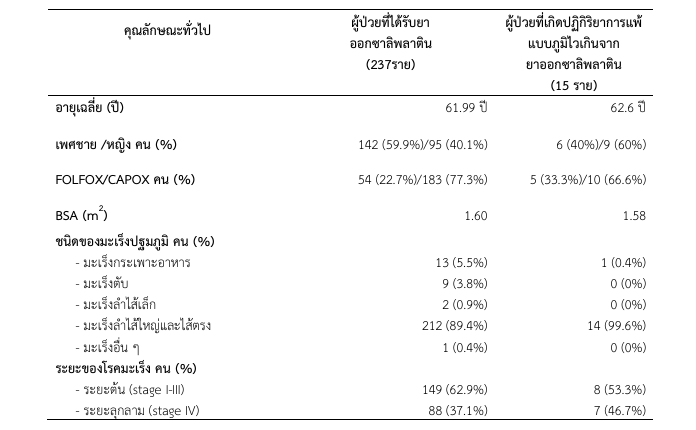
Results: Based on data collected from outpatients and inpatients receiving FOLFOX and CAPEOX chemotherapy regimens between January 1, 2024, and December 31, 2025, at Ratchaburi Hospital, a total of 237 patients met the inclusion criteria and were included in the analysis. The findings revealed that the incidence of oxaliplatin-induced hypersensitivity reactions (HSRs) decreased from the baseline of 17.7% to 6.3%. Furthermore, the severity of the allergic reactions, graded according to CTCAE v5.0, decreased from Grades 3-4 to Grades 1-2. This reduction significantly mitigates patient safety risks associated with allergic reactions and enables patients to complete their planned treatment cycles, which ultimately contributes to better disease control and improves overall patient survival rates.
Conclusion: The administration of antihistamines combined with a prolonged infusion duration initiated at the 7th cycle of the FOLFOX regimen and the 5th cycle of the CAPEOX regimen in oxaliplatin-naive patients effectively reduced the incidence of oxaliplatin-induced hypersensitivity reactions (HSRs) from 17.7% to 6.3%. Furthermore, the severity of these reactions, as graded by CTCAE v5.0, was reduced from Grades 3-4 to Grades 1-2.
References
Andre T, Boni C, Navarro M, Tabernero J, Hickish T, Topham C, et al. Improved overall survival with oxaliplatin, fluorouracil, and leucovorin as adjuvant treatment in stage II or III colon cancer in the MOSAIC trial. J Clin Oncol. 2009;27(19):3109-16. doi: 10.1200/JCO.2008.20.6771.
Yothers G, O'Connell MJ, Allegra CJ, Kuebler JP, Colangelo LH, Petrelli NJ, et al. Oxaliplatin as adjuvant therapy for colon cancer: updated results of NSABP C-07 trial, including survival and subset analyses. J Clin Oncol. 2011;29(28):3768-74. doi: 10.1200/JCO.2011.36.4539.
Kuebler JP, Wieand HS, O'Connell MJ, Smith RE, Colangelo LH, Yothers G, et al. Oxaliplatin combined with weekly bolus fluorouracil and leucovorin as surgical adjuvant chemotherapy for stage II and III colon cancer: results from NSABP C-07. J Clin Oncol. 2007;25(16):2198-204. doi: 10.1200/JCO.2006.08.2974.
Haller DG, Tabernero J, Maroun J, de Braud F, Price T, Van Cutsem E, et al. Capecitabine plus oxaliplatin compared with fluorouracil and folinic acid as adjuvant therapy for stage III colon cancer. J Clin Oncol. 2011;29(11):1465-71. doi: 10.1200/JCO.2010.33.6297.
Schmoll HJ, Tabernero J, Maroun J, de Braud F, Price T, Van Cutsem E, et al. Capecitabine plus oxaliplatin compared with fluorouracil/folinic acid as adjuvant therapy for stage III colon cancer: final results of the NO16968 randomized controlled phase III trial. J Clin Oncol. 2015;33(32):3733-40. doi: 10.1200/JCO.2015.60.9107.
Brandi G, Pantaleo MA, Galli C, Falcone A, Antonuzzo A, Mordenti P, et al. Hypersensitivity reactions related to oxaliplatin (OHP). Br J Cancer. 2003;89(3):477-81. doi: 10.1038/sj.bjc.6601155.
Kim BH, Bradley T, Tai J, Budman DR. Hypersensitivity to oxaliplatin: an investigation of incidence and risk factors, and literature review. Oncology. 2009;76(4):231-8. doi: 10.1159/000205263.
Parel M, Ranchon F, Nosbaum A, You B, Vantard N, Schwiertz V, et al. Hypersensitivity to oxaliplatin: clinical features and risk factors. BMC Pharmacol Toxicol. 2014;15:1. doi: 10.1186/2050-6511-15-1.
Siu SW, Chan RT, Au GK. Hypersensitivity reactions to oxaliplatin: experience in a single institute. Ann Oncol. 2006;17(2):259-61. doi: 10.1093/annonc/mdj042.
Lenz HJ. Management and preparedness for infusion and hypersensitivity reactions. Oncologist. 2007;12(5):601-9. doi: 10.1634/theoncologist.12-5-601.
Polyzos A, Tsavaris N, Gogas H, Souglakos J, Vambakas L, Vardakas N, et al. Clinical features of hypersensitivity reactions to oxaliplatin: a 10-year experience. Oncology. 2009;76(1):36-41. doi: 10.1159/000178163.
Pagani M, Bonadonna P, Senna GE, Antico A. Standardization of skin tests for diagnosis and prevention of hypersensitivity reactions to oxaliplatin. Int Arch Allergy Immunol. 2008;145(1):54-7. doi: 10.1159/000107467.
Pagani M, Bonadonna P. Skin test protocol for the prevention of hypersensitivity reactions to oxaliplatin. Anticancer Res. 2014;34(1):537-40.
Gammon D, Bhargava P, McCormick MJ. Hypersensitivity reactions to oxaliplatin and the application of a desensitization protocol. Oncologist. 2004;9(5):546-9. doi: 10.1634/theoncologist.9-5-546.
Seki K, Tsuduki Y, Ioroi T, Yamane M, Yamauchi H, Shiraishi Y, et al. Serum lactate dehydrogenase levels as a predictive marker of oxaliplatin-induced hypersensitivity reactions in Japanese patients with advanced colorectal cancer. Int J Med Sci. 2014;11(6):641-5. doi: 10.7150/ijms.7643.
Yoshida Y, Hirata K, Matsuoka H, Iwamoto S, Kotaka M, Fujita H, et al. A single-arm Phase II validation study of preventing oxaliplatin-induced hypersensitivity reactions by dexamethasone: the AVOID trial. Drug Des Devel Ther. 2015;9:6067-73. doi: 10.2147/DDDT.S94901.
Lagampan C. An open-label randomized controlled trial to evaluate the efficacy of antihistamine premedication and infusion prolongation in prevention of hypersensitivity reaction to oxaliplatin [thesis]. Bangkok: Chulalongkorn University; 2020.
Kidera Y, Satoh T, Ueda S, Okamoto W, Okamoto I, Fumita S, et al. High-dose dexamethasone plus antihistamine prevents colorectal cancer patients treated with modified FOLFOX6 from hypersensitivity reactions induced by oxaliplatin. Int J Clin Oncol. 2011;16(3):244-9. doi: 10.1007/s10147-010-0170-6.
Yoshino T, Mizunuma N, Yamazaki K, Nishina T, Komatsu Y, Baba H, et al. TAS-102 monotherapy for pretreated metastatic colorectal cancer: a double-blind, randomised, placebo-controlled phase 2 trial. Lancet Oncol. 2012;13(10):993-1001. doi: 10.1016/S1470-2045(12)70345-5.
Sriuranpong V, Areepium N, Chantarawong W, Jinawath A, Numthavaj P, Thakkinstian A. Retrospective analysis of oxaliplatin-related hypersensitivity reactions in colorectal cancer patients. J Oncol Pharm Pract. 2014;20(6):412-8.
Ichikawa Y, Goto A, Hirokawa S, Kijima M, Ishikawa T, Chishima T, et al. Allergic reactions to oxaliplatin in a single institute in Japan. Jpn J Clin Oncol. 2009;39(9):616-20. doi: 10.1093/jjco/hyp070.
Suenaga M, Mizunuma N, Shinozaki E, Matsusaka S, Chin K, Muto T, et al. Management of allergic reactions to oxaliplatin in colorectal cancer patients. J Support Oncol. 2008;6(8):373-8.
Suenaga M, Mizunuma N, Matsusaka S, Shinozaki E, Ueno M, Yamaguchi T. Preventive approach to allergic reaction to oxaliplatin. J Clin Oncol. 2007;25(18 Suppl):14569.
Maindrault-Goebel F, de Gramont A, Louvet C, André T, Carola E, Gilles S, et al. High-grade oxaliplatin-related neurotoxicity and hypersensitivity reactions in patients with colorectal cancer: a prospective study. Ann Oncol. 2005;16(8):1251-7.
Yanai T, Satake H, Mizunuma N, Kataoka M, Yamaguchi T, Yamazaki K, et al. A prospective evaluation of oxaliplatin-related hypersensitivity reactions in Japanese patients with advanced colorectal cancer. Int J Clin Oncol. 2017;22(6):1044-50.
Syrigou EI, Karapanagiotou EM, Alamara CV, Boura PG, Saif MW, Syrigos KN. Hypersensitivity reactions to oxaliplatin: identifying risk factors and judging the efficacy of a desensitization protocol. Clin Ther. 2009;31(4):867-73.
Downloads
Published
How to Cite
Issue
Section
License
Copyright (c) 2026 Ratchabhiwat Medical Journal

This work is licensed under a Creative Commons Attribution-NonCommercial-NoDerivatives 4.0 International License.
Articles in this journal are copyrighted by the x may be read and used for academic purposes, such as teaching, research, or citation, with proper credit given to the author and the journal.use or modification of the articles is prohibited without permission.
statements expressed in the articles are solely the opinions of the authors.
authors are fully responsible for the content and accuracy of their articles.
other reuse or republication requires permission from the journal."


