
Effects of a Self-Efficacy Enhancement Program on Caregiving Competency among Caregivers of Patients with Terminal Cancer at Banpong Hospital
Keywords:
self-efficacy, caregiving competency, terminally ill cancer patients, palliative care, caregiversAbstract
Background: Cancer is the leading cause of death in Thailand. Caregivers of terminally ill cancer patients at home often face challenges including lack of knowledge and skills in patient care, low confidence in their abilities, and stress from caregiving. Enhancing self-efficacy is a crucial strategy for developing caregivers' competency.
Objective: To compare mean self-efficacy scores and caregiving competency scores among caregivers of patients with terminal cancer before and after participating in a self-efficacy enhancement program.
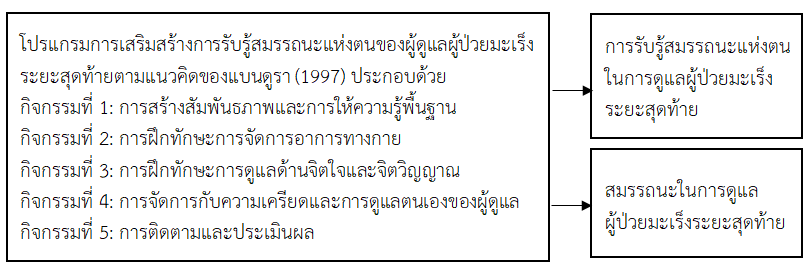
Methods: A quasi-experimental one-group pretest-posttest design was conducted with 30 caregivers of patients with terminal cancer at Banpong Hospital. Participants received a self-efficacy enhancement program developed based on Bandura's self-efficacy theory, consisting of four sessions over six weeks. Data were collected using a self-efficacy scale and a caregiving competency assessment tool. Data were analyzed using descriptive statistics and paired t-test.
Results: Caregivers' mean self-efficacy scores increased significantly from a moderate level before the program (x̄ = 2.91, SD = 0.62) to a high level after the program (x̄ = 4.22, SD = 0.54) (t = 12.16, p < .001). Mean caregiving competency scores also increased significantly from a moderate level (x̄ = 2.83, SD = 0.65) to a high level (x̄ = 4.29, SD = 0.51) (t = 12.70, p < .001).
Conclusion: The self-efficacy enhancement program improved both self-efficacy and caregiving competency among caregivers of patients with terminal cancer. These findings can be applied to enhance the quality of home-based palliative care and may serve as a framework for developing caregiver support programs in other contexts.
References
World Health Organization. Cancer [Internet]. 2023 [cited 2024 Oct 18]. Available from: https://www.who.int/news-room/fact-sheets/detail/cancer
กระทรวงสาธารณสุข. สถิติสาธารณสุข พ.ศ. 2566. นนทบุรี: กระทรวงสาธารณสุข; 2567.
อรพรรณ ลือบุญธวัชชัย, นฤมล บุญบางยาง, สายสมร เฉลยกิติ. ประสบการณ์การใช้สัมพันธภาพบำบัดในการดูแลแบบประคับประคองสำหรับผู้ป่วยและครอบครัว. วารสารพยาบาลตำรวจ. 2565;14(1):204-213.
World Health Organization. Palliative care [Internet]. 2023 [cited 2024 Oct 18]. Available from: https://www.who.int/news-room/fact-sheets/detail/palliative-care
Brennan F. Palliative care as an international human right. J Pain Symptom Manage. 2018;55(5):1196-1203.
กรมการแพทย์ กระทรวงสาธารณสุข. แนวทางการดูแลผู้ป่วยระยะสุดท้าย (Palliative Care). นนทบุรี: กรมการแพทย์; 2565.
Alshakhs S, Park T, McDarby M, Reid MC, Czaja S, Adelman R, et al. Interventions for family caregivers of patients receiving palliative/hospice care at home: a scoping review. J Palliat Med. 2024;27(1):112-27. doi: 10.1089/jpm.2023.0160.
Nacak UA, Erden Y. End-of-life care and nurse's roles. Eurasian J Med. 2022;54(Suppl 1):141-4. doi: 10.5152/eurasianjmed.2022.22324.
กัมพล อินทรทะกูล, สุรีพร ธนศิลป์, ปิ่นหทัย ศุภเมธาพร. ประสบการณ์การดูแลผู้ป่วยมะเร็งระยะลุกลามที่บ้านของผู้ดูแลในครอบครัว. วารสารพยาบาลศาสตร์ จุฬาลงกรณ์มหาวิทยาลัย. 2566;35(2):12-23.
Karimi Moghaddam Z, Rostami M, Zeraatchi A, Mohammadi Bytamar J, Saed O, Zenozian S. Caregiving burden, depression, and anxiety among family caregivers of patients with cancer: an investigation of patient and caregiver factors. Front Psychol. 2023;14:1059605. doi: 10.3389/fpsyg.2023.1059605.
เพ็ญศรี จาบประไพ, บุญสืบ โสโสม, สุนันทา เตโช. การพัฒนารูปแบบการดูแลผู้ป่วยมะเร็งระยะสุดท้ายแบบประคับประคอง: การดูแลแบบไร้รอยต่อเครือข่ายโรงพยาบาลพระพุทธบาท. วารสารวิชาการสาธารณสุข. 2564;30(6):1101-11.
Bedaso A, Dejenu G, Duko B. Depression among caregivers of cancer patients: updated systematic review and meta-analysis. Psychooncology. 2022;31(11):1809-20. doi: 10.1002/pon.6045.
Chow R, Mathews JJ, Cheng EY, Lo S, Wong J, Alam S, et al. Interventions to improve outcomes for caregivers of patients with advanced cancer: a meta-analysis. J Natl Cancer Inst. 2023;115(8):896-908. doi: 10.1093/jnci/djad075.
Bandura A. Self-efficacy: The exercise of control. New York: W.H. Freeman; 1997.
Hebdon MCT, Coombs LA, Crane TE. Self-efficacy in caregivers of adults diagnosed with cancer: an integrative review. Eur J Oncol Nurs. 2021;52:101933. doi: 10.1016/j.ejon.2021.101933.
ปรารถนา กันทอน, เกษร สำเภาทอง. ประสิทธิผลของโปรแกรมส่งเสริมพฤติกรรมการดูแลผู้ป่วยมะเร็งที่ได้รับยาเคมีบำบัดของผู้ดูแล. วารสารพยาบาลวิชาชีพ [อินเทอร์เน็ต]. 2564 [เข้าถึงเมื่อ 14 ม.ค. 2569];23(2):14-29. เข้าถึงได้จาก: https://he02.tci-thaijo.org/index.php/vnj/article/view/252697
Kajiwara K, Kobayashi M, Morikawa M, Kanno Y, Nakano K, Matsuda Y, et al. Nursing support for caregiver burden in family caregivers of patients with cancer: a scoping review. Am J Hosp Palliat Care. 2024;41(10):1184-94. doi: 10.1177/10499091231215808.
โรงพยาบาลบ้านโป่ง. รายงานประจำปี 2566 หน่วยงานการดูแลแบบประคับประคอง. ราชบุรี: โรงพยาบาลบ้านโป่ง; 2567.
โรงพยาบาลบ้านโป่ง. ทะเบียนผู้ป่วยที่ได้รับการดูแลแบบประคับประคองที่บ้าน ปีงบประมาณ 2568. ราชบุรี: หน่วยงานการดูแลแบบประคับประคอง โรงพยาบาลบ้านโป่ง; 2568.
Thailand Nursing and Midwifery Council. มาตรฐานการปฏิบัติการพยาบาลและการผดุงครรภ์. พิมพ์ครั้งที่ 3. กรุงเทพฯ: สภาการพยาบาล; 2564.
Best JW. Research in education. Englewood Cliffs (NJ): Prentice-Hall; 1977.
Downloads
Published
How to Cite
Issue
Section
License
Copyright (c) 2026 Ratchabhiwat Medical Journal

This work is licensed under a Creative Commons Attribution-NonCommercial-NoDerivatives 4.0 International License.
Articles in this journal are copyrighted by the x may be read and used for academic purposes, such as teaching, research, or citation, with proper credit given to the author and the journal.use or modification of the articles is prohibited without permission.
statements expressed in the articles are solely the opinions of the authors.
authors are fully responsible for the content and accuracy of their articles.
other reuse or republication requires permission from the journal."


