
The Results of the Health Literacy Development Program and Self-Care Behavior of Patients with End-Stage Chronic Kidney Disease Receiving Renal Replacement Therapy at Langsuan Hospital, Chumphon
Keywords:
End-stage chronic kidney disease, Participatory action research, Health literacy, Self-careAbstract
Background: Thailand has seen a continuous increase in patients with end-stage renal disease (ESRD), with an annual growth rate of 15–20%. These patients require renal replacement therapy, which carries inherent risks of complications during hemodialysis. The effectiveness of treatment depends not only on medical equipment but also significantly relies on health literacy.
Objective: To develop and examine the effects of a health literacy development program on the self-care behaviors of patients with end-stage chronic kidney disease receiving hemodialysis at Langsuan Hospital, Chumphon.
Methods: This study was a collaborative action research project divided into four phases. Phase 1: Situation Analysis involved examining patient statistics from 2022 to 2024 and conducting in-depth interviews with registered nurses. Phase 2: Program Development focused on creating educational media, which included an information brochure and a 5-minute video, both validated by experts. Phase 3: Implementation was conducted with a sample of 32 patients at Lang Suan Hospital from August 1 to October 31, 2025. Phase 4: Evaluation assessed health literacy and monitored complications. The research instruments consisted of questionnaires and the Langsuan Health Literacy Model (L-HL Model). Data analysis was performed using descriptive statistics and content analysis.
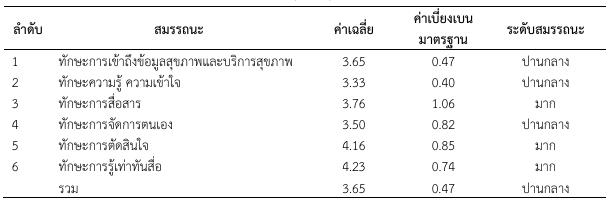
Results: The majority of participants were elderly, with a mean age of 66.88 years. After participating in the program, most participants achieved a "relatively good" level of health literacy (68.74%), with an overall mean score of 72.93%. The highest-scoring dimensions were Media Literacy Skills and Decision-Making Skills. The dimension requiring further development was Cognitive Skills (knowledge and understanding), which received the lowest scores. Regarding clinical outcomes, no severe complications (such as acute pulmonary edema or hyperkalemia) were found during hemodialysis after the program implementation.
Conclusion: The developed health literacy program is effective in promoting self-care behaviors and significantly reduces the risk of complications during hemodialysis.
The participation of healthcare personnel ensured that the media and processes were aligned with the actual context of a community hospital. Given that most participants are elderly, future educational efforts should focus on simple language and clear visual illustrations to further improve foundational knowledge and understanding.
References
National Kidney Foundation. K/DOQI clinical practice guidelines for chronic kidney disease: evaluation, classification, and stratification. Am J Kidney Dis. 2002;39(2 Suppl 1):S1-S266.
Shrestha N, Gautam S, Mishra SR, Virani SS, Dhungana RR. Burden of chronic kidney disease in the general population and high-risk groups in South Asia: a systematic review and meta-analysis. PLoS One. 2021;16(10):e0258494. doi: 10.1371/journal.pone.0258494.
GBD 2019 Diseases and Injuries Collaborators. Global burden of 369 diseases and injuries in 204 countries and territories, 1990-2019: a systematic analysis for the Global Burden of Disease Study 2019. Lancet. 2020;396(10258):1204-1222. doi: 10.1016/S0140-6736(20)30925-9.
Chuasuwan A, Praditpornsilpa K. Thailand renal replacement therapy year 2014. Bangkok: The Nephrology Society of Thailand; 2014.
Ishikawa H, Takeuchi T, Yano E. Measuring functional, communicative, and critical health literacy among diabetic patients. Diabetes Care. 2008;31(5):874-9. doi: 10.2337/dc07-1932.
กองสุขศึกษา. การสร้างเสริมและประเมินความรู้ด้านสุขภาพและพฤติกรรมสุขภาพ กลุ่มประชาชนอายุ 15 ปี ขึ้นไป. กรุงเทพฯ: กรมสนับสนุนบริการสุขภาพ กระทรวงสาธารณสุข; 2561.
ขวัญเมือง แก้วดำเกิง. ความรอบรู้ด้านสุขภาพ: เข้าถึง เข้าใจ และการนำไปใช้. พิมพ์ครั้งที่ 2. กรุงเทพฯ: อมรินทร์พริ้นติ้ง แอนด์ พับลิชชิ่ง; 2561.
Wayne G. Dorothea Orem: self-care deficit nursing theory. Nurseslabs [Internet]. 2023 [cited 2026 Jun 27]; Available from: https://nurseslabs.com/dorothea-orems-self-care-theory
บุญใจ ศรีสถิตย์นรากูร. การพัฒนาและตรวจสอบคุณภาพเครื่องมือวิจัย: คุณสมบัติการวัดเชิงจิตวิทยา. กรุงเทพฯ: โรงพิมพ์แห่งจุฬาลงกรณ์มหาวิทยาลัย; 2555.
ประคอง กรรณสูต. สถิติเพื่อการวิจัยทางพฤติกรรมศาสตร์. พิมพ์ครั้งที่ 2. กรุงเทพฯ: โรงพิมพ์แห่งจุฬาลงกรณ์มหาวิทยาลัย; 2538.
Donabedian A. An introduction to quality assurance in health care. New York: Oxford University Press; 2003.
Titler MG, Kleiber C, Steelman VJ, Rakel BA, Budreau G, Everett LQ, et al. The Iowa model of evidence-based practice to promote quality care. Crit Care Nurs Clin North Am. 2001;13(4):497-509.
Morfin JA, Fluck RJ, Weinhandl ED, Kansal S, McCullough PA, Komenda P. Intensive hemodialysis and treatment complications and tolerability. Am J Kidney Dis. 2016;68(5S1):S43-S50. doi: 10.1053/j.ajkd.2016.05.021.
Singh RG, Singh S, Rathore SS, Choudhary TA. Spectrum of intradialytic complications during hemodialysis and its management: a single-center experience. Saudi J Kidney Dis Transpl. 2015;26(1):168-72. doi: 10.4103/1319-2442.148771.
Douvris A, Zeid K, Hiremath S, Bagshaw SM, Wald R, Beaubien-Souligny W, et al. Mechanisms for hemodynamic instability related to renal replacement therapy: a narrative review. Intensive Care Med. 2019;45(10):1333-1346. doi: 10.1007/s00134-019-05707-w.
Kuipers J, Verboom LM, Ipema KJR, Paans W, Krijnen WP, Gaillard CAJM, et al. The prevalence of intradialytic hypotension in patients on conventional hemodialysis: a systematic review with meta-analysis. Am J Nephrol. 2019;49(6):497-506. doi: 10.1159/000500877.
ประนอม บัวสรวง. อุบัติการณ์การเกิดภาวะแทรกซ้อนของผู้ป่วยวิกฤตที่มีไตวายเฉียบพลันระหว่างฟอกเลือดด้วยเครื่องไตเทียมในหอผู้ป่วยหนัก. วารสารโรงพยาบาลสิงห์บุรี. 30(3):48–63.
สมาคมโรคไตแห่งประเทศไทย. คู่มือการรักษาด้วยการฟอกเลือดและการกรองพลาสมาสำหรับผู้ป่วยโรคไต พ.ศ. 2561. กรุงเทพฯ: สมาคมโรคไตแห่งประเทศไทย; 2561.
Downloads
Published
How to Cite
Issue
Section
License
Copyright (c) 2026 Ratchabhiwat Medical Journal

This work is licensed under a Creative Commons Attribution-NonCommercial-NoDerivatives 4.0 International License.
Articles in this journal are copyrighted by the x may be read and used for academic purposes, such as teaching, research, or citation, with proper credit given to the author and the journal.use or modification of the articles is prohibited without permission.
statements expressed in the articles are solely the opinions of the authors.
authors are fully responsible for the content and accuracy of their articles.
other reuse or republication requires permission from the journal."


