
Clinical Characteristics and Outcome of Tuberculosis Preventive Treatment in People Living with HIV at Makarak Hospital
Keywords:
Tuberculosis preventive treatment, Latent tuberculosis infection, Adverse drug reactions, People living with HIVAbstract
Background: Tuberculosis remains the leading cause of mortality among people living with HIV (PLHIV). Tuberculosis preventive treatment (TPT) is a key strategy to reduce progression from latent tuberculosis infection (LTBI) to active disease. However, real-world data on TPT outcomes in Thailand remain limited.
Objective: To evaluate clinical characteristics, treatment outcomes, adverse drug effects, and factors associated with incomplete TPT among PLHIV at Makarak Hospital, Kanchanaburi, Thailand.
Methods: A retrospective chart review was conducted among PLHIV aged ≥15 years who received TPT between January 1, 2021, and December 31, 2025.
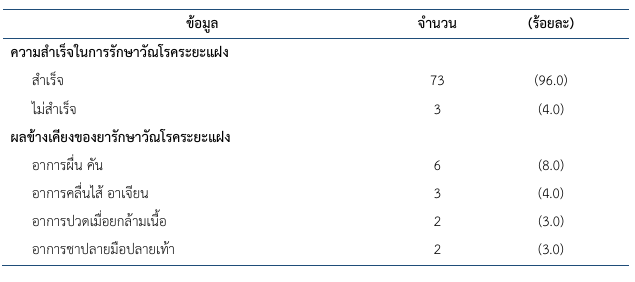
Results: A total of 76 patients were included, with a nearly equal distribution of males and females. The mean age was 36.4 ± 12.6 years, and the mean CD4 count was 309.4 ± 290.2 cells/mm³. Most patients (95%) had received antiretroviral therapy for less than one year. The predominant antiretroviral regimen was tenofovir/lamivudine/dolutegravir (88%), and the most common TPT regimen was 1HP (88%). The treatment completion rate was 96%, while 4% of patients did not complete treatment. Causes of incomplete treatment included treatment interruption, death, and drug-related rash. Adverse events included pruritic rash (8%), nausea and vomiting (4%), myalgia (3%), and peripheral neuropathy (3%). Factors significantly associated with incomplete treatment were the 9H regimen (p = 0.003), pruritic rash (p = 0.008), and peripheral neuropathy (p = 0.020). Patients with incomplete treatment had a lower mean CD4 count than those with complete treatment (61.7 vs. 319.6 cells/mm³), although the difference was not statistically significant.
Conclusion: Treatment of latent tuberculosis infection among people living with HIV demonstrated a high treatment success rate, particularly with short-course regimens. Adverse events were uncommon; however, pruritic rash was associated with incomplete treatment outcomes. Other causes of treatment failure included loss to follow-up and death among patients receiving long-course regimens. In addition, patients with incomplete treatment outcomes had lower CD4 cell counts than those with complete treatment outcomes, although this difference was not statistically significant.
References
World Health Organization. Global tuberculosis report 2025. Geneva: World Health Organization; 2025.
Division of Tuberculosis, Department of Disease Control, Ministry of Public Health. Clinical practice guideline for tuberculosis preventive treatment. Bangkok: Department of Disease Control; 2023.
Suthar AB, Lawn SD, del Amo J, Getahun H, Dye C, Sculier D, et al. Antiretroviral therapy for prevention of tuberculosis in adults with HIV: a systematic review and meta-analysis. PLoS Med. 2012;9(7):e1001270. doi: 10.1371/journal.pmed.1001270.
Rangaka MX, Wilkinson RJ, Boulle A, Glynn JR, Fielding K, van Cutsem G, et al. Isoniazid plus antiretroviral therapy to prevent tuberculosis: a randomised double-blind, placebo-controlled trial. Lancet. 2014;384(9944):682-90. doi: 10.1016/S0140-6736(14)60162-8.
World Health Organization. HIV statistics, globally and by WHO region, 2025. Geneva: World Health Organization; 2025.
Zenner D, Beer N, Harris RJ, Lipman MC, Stagg HR, van der Werf MJ. Treatment of latent Tuberculosis infection: an updated network meta-analysis. Ann Intern Med. 2017;167(4):248-55. doi: 10.7326/M17-0609.
World Health Organization. WHO operational handbook on tuberculosis. module 1: prevention - tuberculosis preventive treatment. Geneva: World Health Organization; 2020.
Gunde L, Wang A, Payne D, O'Connor S, Kabaghe A, Kalata N, et al. Characteristics of TPT initiation and completion among people living with HIV. IJTLD Open. 2024;1(1):11-9. doi: 10.5588/ijtldopen.23.0194.
Sterling TR, Villarino ME, Borisov AS, Shang N, Gordin F, Bliven-Sizemore E, et al. Three months of rifapentine and isoniazid for latent tuberculosis infection. N Engl J Med. 2011;365(23):2155-66. doi: 10.1056/NEJMoa1104875.
Swindells S, Ramchandani R, Gupta A, Benson CA, Leon-Cruz J, Mwelase N, et al. One month of rifapentine plus Isoniazid to prevent HIV-related tuberculosis. N Engl J Med. 2019;380(11):1001-11. doi: 10.1056/NEJMoa1806808.
An Y, Khun KE. Factors associated with incomplete tuberculosis preventive treatment: a retrospective analysis of six-years programmatic data in Cambodia. Sci Rep. 2024;14(1):18458. doi: 10.1038/s41598-024-67845-6.
Sterling TR, Moro RN, Borisov AS, Phillips E, Shepherd G, Adkinson NF, et al. Flu-like and other systemic drug reactions among persons receiving weekly rifapentine plus isoniazid or daily isoniazid for treatment of latent tuberculosis infection in the PREVENT tuberculosis study. Clin Infect Dis. 2015;61(4):527-35. doi: 10.1093/cid/civ323.
Downloads
Published
How to Cite
Issue
Section
License
Copyright (c) 2026 Ratchabhiwat Medical Journal

This work is licensed under a Creative Commons Attribution-NonCommercial-NoDerivatives 4.0 International License.
Articles in this journal are copyrighted by the x may be read and used for academic purposes, such as teaching, research, or citation, with proper credit given to the author and the journal.use or modification of the articles is prohibited without permission.
statements expressed in the articles are solely the opinions of the authors.
authors are fully responsible for the content and accuracy of their articles.
other reuse or republication requires permission from the journal."


