
Prevalence, Clinical Characteristics, and Etiologies of Mental Disorders Due to Another Medical Condition at Photharam Hospital
Keywords:
Psychiatric disorder, Organic mental disorder, Prevalence, Etiologies, DementiaAbstract
Background: The diagnosis of psychiatric disorders requires careful evaluation to determine whether the psychiatric symptoms are attributable to an underlying medical condition. However, data on the prevalence of mental disorders due to another medical condition in Thailand remain limited.
Objective: To determine the prevalence, clinical characteristics, and etiologies of mental disorders due to another medical condition and to identify factors associated with whether the underlying medical condition was diagnosed before or after the psychiatric diagnosis.
Methods: This retrospective study retrieved the medical records of all outpatients who received a psychiatric diagnosis at Photharam Hospital between 1 January and 31 December 2024. Medical records of patients diagnosed with mental disorders due to another medical condition were subsequently reviewed, excluding those with the diagnosis of delirium or mental disorders due to psychoactive substance use.
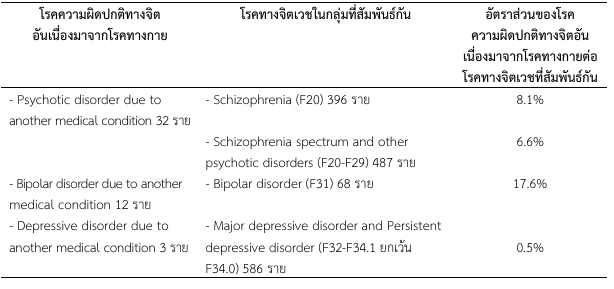
Results: Among 2,033 patients with any mental disorders, 52 patients were diagnosed with mental disorders due to another medical condition corresponding to a prevalence of 2.56% (95% CI, 1.92-3.34). Psychotic disorder due to another medical condition was the most common diagnosis. When comparing patients with primary psychiatric disorders and those with mental disorders due to another medical condition, the patients with bipolar disorder due to another medical condition accounted for 17.6% of patients with bipolar disorder. Among patients with mental disorder due to another medical condition, 40.4% had no prior diagnosis of the underlying medical condition. Age ≥ 60 years was independently associated with receiving a diagnosis of the underlying medical condition only after the psychiatric diagnosis. The most common underlying medical conditions were dementia, traumatic brain injury, and epilepsy.
Conclusion: The prevalence of mental disorders due to another medical condition was 2.56% among patients with any psychiatric disorders. Given that 40.4% of patients had no prior diagnosis of the causative medical condition, clinicians should consider evaluating possible medical etiologies through comprehensive history taking, physical examination, and appropriate investigations. Older adults were more likely to be diagnosed with the underlying medical condition after presenting with psychiatric symptoms.
References
American Psychiatric Association. Diagnostic and statistical manual of mental disorders. 5th ed., text revision. Washington (DC): American Psychiatric Association; 2022.
Keshavan MS, Kaneko Y. Secondary psychoses: an update. World Psychiatry. 2013;12(1):4-15. doi:10.1002/wps.20001.
Howell C, Segal D. Depressive disorder due to another medical condition. In: Friedman-Wheeler DG, Wenzel A, editors. The SAGE encyclopedia of mood and anxiety disorders Vol.3. Thousand Oaks (CA): SAGE Publications; 2025. p. 396-7.
Ovsiew F. The neuropsychiatric approach to the patient. In: Sadock BJ, Sadock VA, Ruiz P, editors. Kaplan & Sadock's comprehensive textbook of psychiatry. 10th ed. Philadelphia: Wolters Kluwer; 2017. p. 394-419.
Herken J, Prüss H. Red flags: clinical signs for identifying autoimmune encephalitis in psychiatric patients. Front Psychiatry. 2017;8:25. doi: 10.3389/fpsyt.2017.00025.
Li B, Guo W, Shang X. Study on the final diagnosis of nervous system diseases with psychiatric symptoms as manifestation onset. BMC Psychiatry. 2025;25(1):1071. doi: 10.1186/s12888-025-07383-1.
Yeager-Cordial E, Ison J, Becker R, Boyd C, Weinstock M. Psychiatric manifestations of organic disease: don't get fooled!. J Urgent Care Med. 2022;16(11):11-5.
Sittanomai N, Hosiri T, Witulchart C, Timjang J. Depression in child and adolescent inpatients psychiatric consultation at Siriraj Hospital between 2007-2011. J Psychiatr Assoc Thai. 2014;59(2):111-20.
Perälä J, Suvisaari J, Saarni SI, Kuoppasalmi K, Isometsä E, Pirkola S, et al. Lifetime prevalence of psychotic and bipolar I disorders in a general population. Arch Gen Psychiatry. 2007;64(1):19-28. doi:10.1001/archpsyc.64.1.19.
Zhan N, Sham PC, So HC, Lui SSY. The genetic basis of onset age in schizophrenia: evidence and models. Front Genet. 2023;14:1163361. doi: 10.3389/fgene.2023.1163361.
Binbay T, Alptekin K, Elbi H, Zağlı N, Drukker M, Aksu Tanık F, et al. Lifetime prevalence and correlates of schizophrenia and disorders with psychotic symptoms in the general population of Izmir, Turkey. Turk Psikiyatri Derg. 2012;23(3):149-60.
Nikogosyan GM, Torncello E, MacDonald S. Secondary mania of medical and neurological disorders [Internet]. London: IntechOpen; 2024 [cited 2026 May 25]. Available from: https://www.intechopen.com/chapters/1202947
Drange OK, Vaaler AE, Morken G, Andreassen OA, Malt UF, Finseth PI. Clinical characteristics of patients with bipolar disorder and premorbid traumatic brain injury: a cross-sectional study. Int J Bipolar Disord. 2018;6(1):19. doi:10.1186/s40345-018-0128-6.
Ng IKS, Chua JW, Lui YS, Tan LF, Teo DBS. Approach to acute psychosis in older adults. Singapore Med J. 2023 Jun;64(6):391-6. doi:10.4103/singaporemedj.SMJ-2022-150.
Downloads
Published
How to Cite
Issue
Section
License
Copyright (c) 2026 Ratchabhiwat Medical Journal

This work is licensed under a Creative Commons Attribution-NonCommercial-NoDerivatives 4.0 International License.
Articles in this journal are copyrighted by the x may be read and used for academic purposes, such as teaching, research, or citation, with proper credit given to the author and the journal.use or modification of the articles is prohibited without permission.
statements expressed in the articles are solely the opinions of the authors.
authors are fully responsible for the content and accuracy of their articles.
other reuse or republication requires permission from the journal."


