
Effectiveness of the D-METHOD F-P Guideline on Family Caregiver Preparedness and 28-Day Readmission Rate among Stroke Patients in the female Medical Ward, Sanpatong Hospital
Keywords:
การวางแผนจำหน่าย, ญาติผู้ดูแล, ผู้ป่วยโรคหลอดเลือดสมอง, แนวทาง D-METHOD F-PAbstract
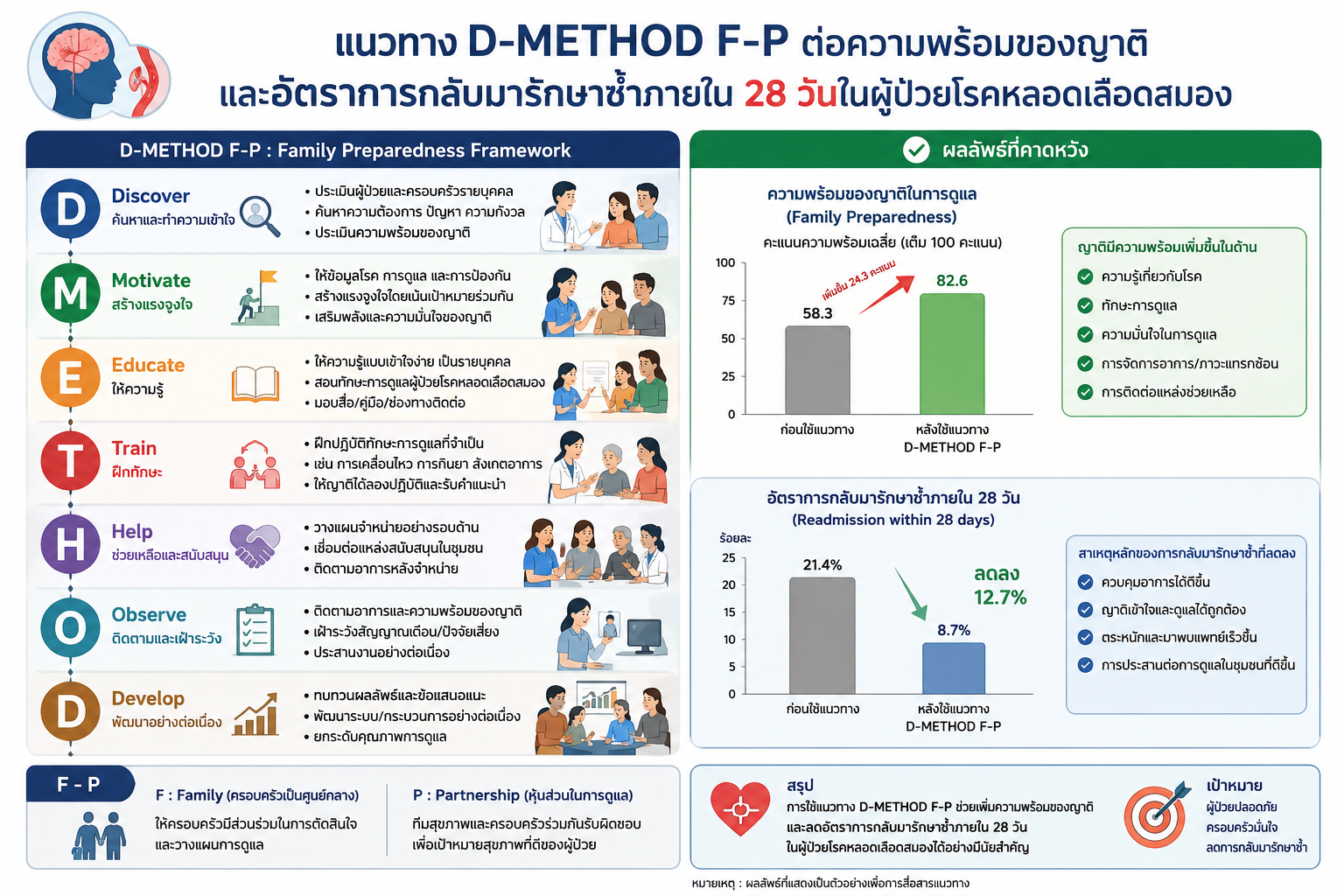
Introduction: Stroke is a major public health problem associated with high rates of disability and hospital readmission. After discharge, patients and caregivers often lack adequate preparedness for ongoing care. The D-METHOD F-P guideline is a structured discharge planning approach emphasizing participation and systematic preparation. This study aimed to examine the effects of this approach on caregivers’ knowledge, readiness, and 28-day readmission rates. Methods: A quasi-experimental two-group pretest–posttest design was conducted. The sample consisted of 40 stroke patients and 40 primary caregivers, equally assigned to control and experimental groups (20 pairs each). The experimental group received discharge planning based on the D-METHOD F-P guideline, while the control group received usual care. Data were analyzed using descriptive statistics, paired-samples t-test, independent-samples t-test, chi-square test, and Fisher’s exact test.
Results: Post-intervention, both groups demonstrated significant improvements in caregivers’ knowledge and readiness (p < .001). The experimental group had significantly higher posttest scores than the control group in both knowledge (p < .001, 95% CI 4.47–10.24) and readiness (p < .001, 95% CI 4.26–11.54). In the experimental group, 35.00% of caregivers achieved a high level of readiness, whereas none in the control group did. The 28-day readmission rate was lower in the experimental group than in the control group (5.00% vs. 20.00%); however, the difference was not statistically significant (p = .342). Caregivers in the experimental group reported high levels of satisfaction with the discharge planning process.
Conclusion: The D-METHOD F-P guideline improved caregivers’ knowledge and readiness and showed a trend toward reducing 28-day readmission rates. However, the study was limited by a small sample size and a single-center setting, which may restrict generalizability.
References
World Health Organization. Stroke, cerebrovascular accident fact sheet. Geneva: World Health Organization; 2023.
Department of Disease Control. Thailand public health statistics report 2023. Bangkok: Ministryof Public Health; 2023. (in Thai).
Dajpratham P. Stroke rehabilitation. Bangkok: Faculty of Medicine Siriraj Hospital; 2018.
(in Thai)
Gonçalves-Bradley DC, Lannin NA, Clemson LM, Cameron ID, Shepperd S. Discharge planning from hospital. Cochrane Database Syst Rev. 2022;(2):CD000313.
Sahay S, Nair S, Gupta S. Readmission after stroke: incidence, risk factors, and prevention strategies. Stroke Res Treat. 2021;2021:1–8.
Office of the Permanent Secretary. Intermediate care service plan. Bangkok: Ministry of Public Health; 2019. (in Thai).
Levine DA, Langa KM, Vijan S, Hayward RA, Willis AW, Kabeto MU. Risk factors for 30-day readmission after stroke. Stroke. 2018;49(12):2999–3005.
Naylor MD, Aiken LH, Kurtzman ET, Olds DM, Hirschman KB. The importance of transitional care in achieving health reform. Health Aff (Millwood). 2011;30(4):746–54.
Jack BW, Chetty VK, Anthony D, Greenwald JL, Sanchez GM, Johnson AE, et al. A reengineered hospital discharge program to decrease rehospitalization. Ann Intern Med. 2009;150(3):178–87.
Prayin P, Saengsawang M, Jitrak S. Development of a care model for stroke patients during the rehabilitation phase. J Thai Nurs Counc. 2022;37(4):112–25.
Cohen J. Statistical power analysis for the behavioral sciences. 2nd ed. New York: Lawrence Erlbaum Associates; 1988.
12. Naylor MD, Shaid EC, Carpenter D, Gass B, Levine C, Li J, et al. Components of comprehensive and effective transitional care. J Am Geriatr Soc. 2017;65(6):1119–25.
Polit DF, Beck CT. Nursing research: Generating and assessing evidence for nursing practice. 11th ed. Philadelphia: Wolters Kluwer; 2021.
Feigin VL, Norrving B, Mensah GA. Global burden of stroke. Circ Res. 2017;120(3):439–48.
World Health Organization. World stroke fact sheet. Geneva: World Health Organization; 2022.
Cameron JI, Naglie G, Silver FL, Gignac MA. Stroke family caregivers’ support needs change across the care continuum: a qualitative study. Patient Educ Couns. 2016;99(3):365–72.
Bakas T, Clark PC, Kelly-Hayes M, King RB, Lutz BJ, Miller EL. Evidence for stroke family caregiver and dyad interventions: a statement for healthcare professionals. Stroke. 2019;50(9):2836–45.
Bakker M, de Vries B, van den Heuvel W, Hagedoorn M. Supporting stroke caregivers: a systematic review of caregiver education and training programs. Clin Rehabil. 2019;33(3): 459–71.
Camicia M, Lutz BJ, Markoff N, Catlin A. Determining the needs of family caregivers of stroke survivors during inpatient rehabilitation. Rehabil Nurs. 2019;44(2):83–91.
Jones F, Partridge C, Reid F. The Stroke Self-Management Programme: a randomized controlled trial. Clin Rehabil. 2020;34(3):347–59.
Bakas T, McCarthy M, Miller ET, Clark PC. Update on the state of the evidence for stroke family caregiver and dyad interventions. Stroke. 2019;50(5):e122–5.
Harrison JD, Auerbach AD, Quinn K, Kynoch K, Mourad M. Assessing the impact of nurse-led discharge planning on patient outcomes: a systematic review. J Clin Nurs. 2016;25 (17–18):2575–87.
Naylor MD, Hirschman KB, Toles MP, Jarrín OF, Shaid EC, Pauly MV. Adaptations of the transitional care model in the United States. Health Aff (Millwood). 2017;36(4):709–16.
Weiss ME, Yakusheva O, Bobay KL. Quality and cost analysis of nurse staffing, discharge preparation, and postdischarge utilization. Health Serv Res. 2017;52(5):1653–71.
Bakitas MA, Dionne-Odom JN, Pambianchi MS, Azari S, Vergara C, Kvale E. Engaging family caregivers in care planning and coordination for patients with serious illness. J Pain Symptom Manage. 2018;55(2):403–12.
Bjerkreim AT, Thomassen L, Waje-Andreassen U, Selvik HA, Næss H. Hospital readmission after ischemic stroke and TIA: a nationwide study. J Neurol Sci. 2019;405:116–21.
Lin HJ, Chang WL, Tseng MC. Factors associated with readmission in patients with stroke: a population-based study. Int J Environ Res Public Health. 2020;17(18):1–12.
Downloads
Published
How to Cite
Issue
Section
License
Copyright (c) 2026 Sanpatong Hospital Journal

This work is licensed under a Creative Commons Attribution-NonCommercial-NoDerivatives 4.0 International License.
Articles in this journal are copyrighted by the x may be read and used for academic purposes, such as teaching, research, or citation, with proper credit given to the author and the journal.use or modification of the articles is prohibited without permission.
statements expressed in the articles are solely the opinions of the authors.
authors are fully responsible for the content and accuracy of their articles.
other reuse or republication requires permission from the journal."


