
The Effects of a Family – Inclusive in Nursing Care Model on Clinical Outcomes of Pediatric Pneumonia Patients in the Pediatric Ward of San Patong Hospital Chiang Mai Province
Keywords:
pediatric pneumonia; family participation; caregiver knowledge; caregiving ability; pediatric nursingAbstract
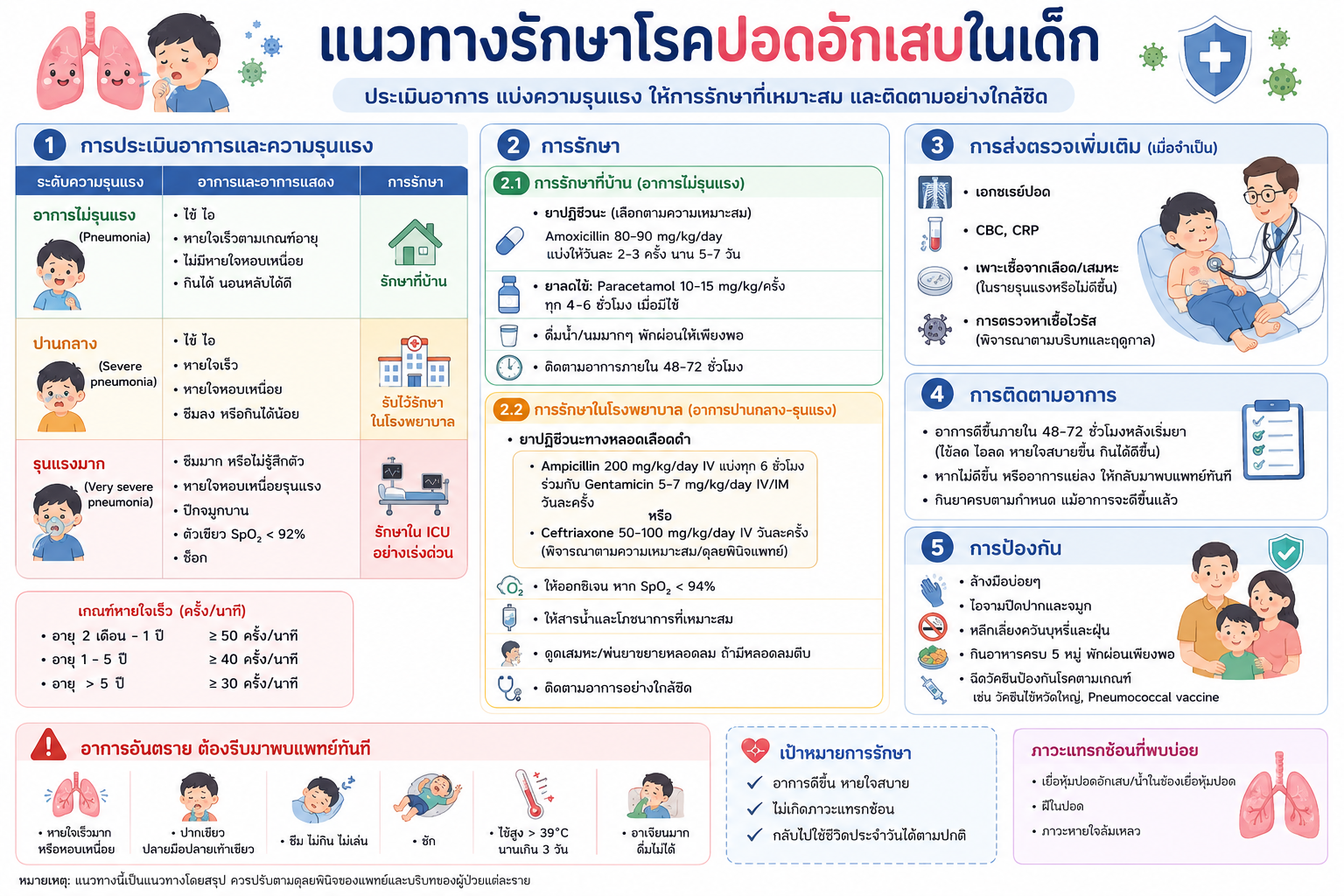
Background: Pediatric pneumonia is a significant health problem associated with morbidity and hospital readmission, particularly when caregivers lack adequate knowledge and caregiving skills. Promoting family participation is therefore considered an important strategy for improving the quality of care. This study aimed to examine the effects of a family participation-enhancing nursing model on caregivers’ knowledge, caregiving ability, and clinical outcomes of pediatric patients with pneumonia.
Methods: A quasi-experimental two-group pretest–posttest design was conducted. The sample consisted of 60 pairs of pediatric patients aged 1 month to 5 years and their primary caregivers, divided into a control group and an experimental group (30 pairs each). The experimental group received the developed nursing model. Data collection tools included a knowledge test, a caregiving ability assessment, a family participation assessment, and a clinical record form. Data were analyzed using descriptive statistics and inferential statistics, including paired samples t-test, independent samples t-test, Chi-square test, and Fisher’s exact test.
Results: After the intervention, both groups showed significant improvements in knowledge and caregiving ability (p < .001). Based on change scores, the experimental group demonstrated significantly greater improvements than the control group in all outcomes: knowledge (95% CI: −2.67 to −1.19; p < .001), caregiving ability (95% CI: −2.58 to −0.49; p = .005), and family participation (95% CI: −3.91 to −1.69; p < .001), with large effect sizes. However, no significant differences were found in clinical outcomes, including length of hospital stay, HFNC use, ICU admission, and 28-day readmission (p > .05).
Conclusion: The family participation–based nursing model significantly improved caregivers’ knowledge, ability, and participation. Although no significant differences in clinical outcomes were observed, the positive trends suggest the potential effectiveness of this care model.
References
World Health Organization. Pneumonia in children. Geneva: World Health Organization; 2023.
Department of Disease Control. Surveillance report of pneumonia cases from the disease surveillance system. Nonthaburi: Bureau of Epidemiology; 2022. (in Thai)
Department of Disease Control. Annual epidemiological surveillance report.
Nonthaburi: Department of Disease Control; 2023. (in Thai)
Shields L, Zhou H, Pratt J, Taylor M, Hunter J, Pascoe E. Family-centred care for
hospitalised children aged 0-12 years. Cochrane Database Syst Rev. 2012;10: CD004811.
Smith J, Swallow V, Coyne I. Involving parents in managing their child's long-term
condition: a concept synthesis of family-centered care and partnership-in-care. J
Pediatr Nurs. 2020;52: e102-15.
Kulkongka T. Effectiveness of a nursing practice guideline to promote family
participation in the care of children with pneumonia in hospital. Mahidol Univ J Nurs
Sci. 2019;37(1): 50-61. (in Thai)
Sheppard JJ. Family-centered care in pediatric practice. Pediatr Nurs. 1995;21(4): 379-81.
Shields L, Pratt J, Hunter J. Family centred care: a review of qualitative studies. J Clin Nurs. 2006;15(10): 1317-23.
Coyne I, O’Neill C, Murphy M, Costello T, O’Shea R. What does family-centred care
Mean to nurses and how do they think it could be enhanced in practice? J Adv Nurs.
;72(11): 2614-26.
Al-Mutair A, Plummer V, O’Brien A, Clerehan R. Family participation in the care of
hospitalized patients: a systematic review. Int J Nurs Stud. 2021;112: 103725.
Cohen J. Statistical power analysis for the behavioral sciences. 2nd ed. Hillsdale, NJ:
Lawrence Erlbaum Associates; 1988.
Seniwati T, Rustina Y, Nurhaeni N, Wanda D. Patient and family-centered care for
children: A concept analysis. Belitung Nurs J. 2023;9(1): 17-24.
Purwati NH, Rustina Y, Supriyatno B. Knowledge and healthcare-seeking behavior of
family caregivers of children with pneumonia: A qualitative study in an urban community in Indonesia. Belitung Nurs J. 2021;7(2): 107-12.
Srisdipaisarn L, Wittaya K, Nuwong K. Model development and evaluation of the
effectiveness of family-centered care for pediatric patients with acute lower respiratory tract infections at Phrapokklao Hospital. J Prapokklao Hosp Clin Med Educat Center.2025;42(1): 75-83. (in Thai)
Pediatric Respiratory and Critical Care Society of Thailand. Clinical practice guidelines for the management of acute respiratory tract infections in children. 1st ed. Bangkok:Beyond Enterprise; 2019. (in Thai)
Franklin D, Babl FE, Schlapbach LJ, Oakley E, Craig S, Neutze J, et al. A randomized trial of high-flow oxygen therapy in infants with bronchiolitis. N Engl J Med. 2018;378(12): 1121-31.
Hockenberry MJ, Wilson D. Wong’s nursing care of infants and children. 12th ed. St. Louis: Elsevier; 2021.
Centers for Disease Control and Prevention. Pneumococcal disease and vaccination.
Atlanta: CDC; 2024.
Kuo DZ, Houtrow AJ, Arango P, Kuhlthau KA, Simmons JM, Neff JM. Family-centered care: current applications and future directions in pediatric health care. Matern Child Health J. 2018;22(6): 745-52.
Okan O, Bauer U, Levin-Zamir D, Pinheiro P, Sørensen K. International handbook of
health literacy. Bristol: Policy Press; 2019.
Institute for Patient- and Family-Centered Care. Advancing the practice of patient- and family-centered care in hospitals. Bethesda: IPFCC; 2017.
World Health Organization. Pocket book of hospital care for children: guidelines for the management of common childhood illnesses. 2nd ed. Geneva: World Health
Organization; 2019.
Wongwaithongdee P, Mikki K. Effects of a pneumonia care program on knowledge and caregiving behaviors among caregivers of children with pneumonia. R3 Med PHJ.
;22(2): 96-104. (in Thai).
Pinhom S, Sananruangsak S, Teerarungsikul N. Effects of a maternal guidance program on maternal caregiving behaviors for children with pneumonia. Bamrasnaradura Infect DisInst J. 2021;15(2): 82-93. (in Thai).
Hill C, Knafl KA, Santacroce SJ. Family-centered care from the perspective of parents of children cared for in a pediatric intensive care unit: an integrative review. J Pediatr Nurs. 2018;41: 22-33.
Foster M, Whitehead L, Maybee P, Cullens V. The parents’, hospitalized child’s, and
health care providers’ perceptions and experiences of family-centered care within a
pediatric critical care setting. J Fam Nurs. 2016;22(4): 432-57.
Hodgson KA, Brown SR, McLean L, Thompson DR. Family engagement in pediatric
health care: a systematic review of family-centered care and caregiver satisfaction.
J Pediatr Nurs. 2024;74: 45-52.
Pediatric Respiratory Critical Care Club. Clinical practice guideline for management of pneumonia in children. Bangkok: The Royal College of Pediatricians of Thailand; 2019. (in Thai).
Florin TA, Ambroggio L, Brokamp C, Zhang Y, Rattan MS, Crotty EJ, et al. Reliability of
examination findings in suspected community-acquired pneumonia. Pediatrics.
;140(3): e20170310.
Kulkongka T. Effectiveness of a nursing practice guideline to promote family
Participation in the care of children with pneumonia in hospital. Mahidol Univ J Nurs
Sci. 2019;37(1): 50-61. (in Thai).
Button KS, Ioannidis JPA, Mokrysz C, Nosek BA, Flint J, Robinson ESJ, et al. Power failure: why small sample size undermines the reliability of neuroscience. Nat Rev Neurosci. 2013;14(5): 365-76.
Downloads
Published
How to Cite
Issue
Section
License
Copyright (c) 2026 Sanpatong Hospital Journal

This work is licensed under a Creative Commons Attribution-NonCommercial-NoDerivatives 4.0 International License.
Articles in this journal are copyrighted by the x may be read and used for academic purposes, such as teaching, research, or citation, with proper credit given to the author and the journal.use or modification of the articles is prohibited without permission.
statements expressed in the articles are solely the opinions of the authors.
authors are fully responsible for the content and accuracy of their articles.
other reuse or republication requires permission from the journal."


