
Factors associated with persistent medication non-adherence in ethnic patients with chronic disease at the Subdistrict Health Promotion Hospital, Mae Chaem District, Chiang Mai Province
Keywords:
Medication adherence, Ethnic minorities, Healthcare accessibilityAbstract
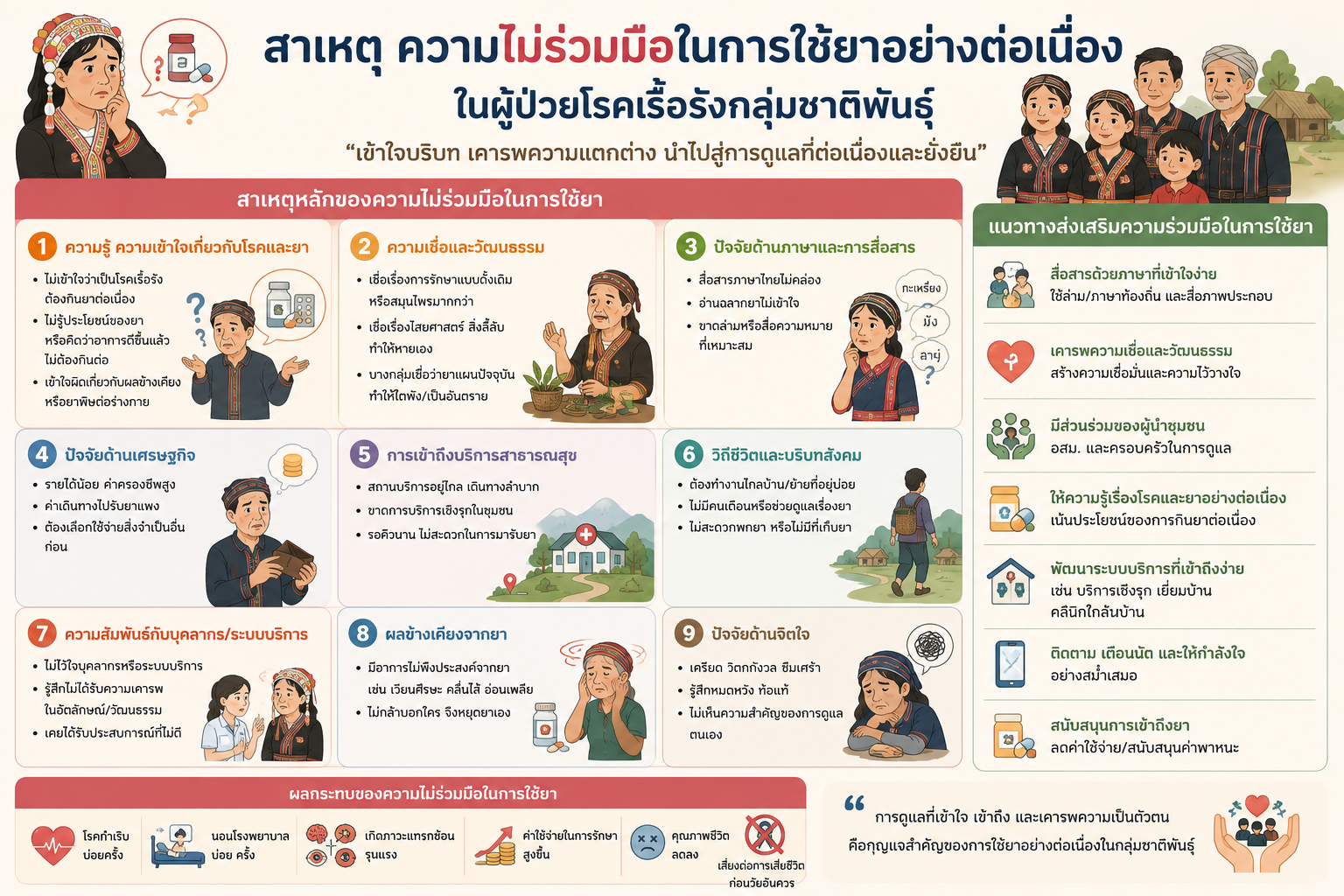
Background Ethnic minority patients with chronic diseases in remote areas such as Mae Chaem District, Chiang Mai Province, face multiple barriers to continuous medication use, including sociocultural factors, language difficulties, and limited healthcare access, all of which directly affect clinical outcomes.
Methods A descriptive cross-sectional study was conducted among 180 ethnic patients with chronic diseases between May and October 2025. Multi-stage random sampling was employed. Medication adherence was assessed using the TMARS and TMARS-VAS scales. Data were analyzed using Chi-square/Fisher's Exact Test and Multiple Logistic Regression.
Results Most participants were of Karen ethnicity (56.11%), engaged in agriculture, and earned below 10,000 baht per month. The most common non-adherent behaviors were forgetting doses (38.3%) and taking medication late (32.8%). Significant associated factors included ethnicity, religion, occupation, marital status, disease type, number of medications, illness duration, distance, transportation, herbal medicine beliefs, and Thai language proficiency.
Conclusion Distance from home to hospital was the sole statistically significant predictor of non-adherence. Patients living more than 10 kilometers away were 4.62 times more likely to be non-adherent than those within 5 kilometers (Adjusted OR = 4.62, 95% CI = 1.85–11.57, p = 0.001), indicating that structural barriers outweigh individual factors.
References
Wichai E, Nuntakorn T, Piyamitr S, Alongkorn A. Thailand national health examination survey V. Nonthaburi: Health Systems Research Institute; 2021.
World Health Organization. Noncommunicable diseases: Key facts [Internet]. Geneva: WHO; 2022 [cited 2025 Aug 14]. Available from: https://www.who.int/news-room/fact-sheets/detail/noncommunicable-diseases
Moonpanane K, Thungjaroenkul P, Jaitrong W. Language barriers and medication adherence among ethnic minority patients in northern Thailand. J Transcult Nurs. 2022;33(4):478–86.
Srichoompun P, Kulsomboon V, Ngorsuraches S. Geographical access to health facilities and medication adherence among patients with hypertension and diabetes in rural Thailand. J Prim Care Community Health. 2023;14:1–9.
World Health Organization. Adherence to long-term therapies: Evidence for action. Geneva: WHO; 2003.
Rosenstock IM. The health belief model and preventive health behavior. Health Educ Monogr. 1974;2(4):354–86.
Andersen RM. Revisiting the behavioral model and access to medical care: Does it matter? J Health Soc Behav. 1995;36(1):1–10.
McLeroy KR, Bibeau D, Steckler A, Glanz K. An ecological perspective on health promotion programs. Health Educ Q. 1988;15(4):351–77.
Yoon S, Kwan YH, Yap WL, Lim ZY, Phang JK, Loo YX, et al. Factors influencing medication adherence in multi-ethnic Asian patients with chronic diseases in Singapore: A qualitative study. Front Pharmacol. 2023;14:1124297.
Yawilo R, Boonyathee S. Factors affecting medication adherence among ethnic patients with hypertension at Mae Sai Sub-district Health Promoting Hospital, Mae Sai District, Chiang Rai Province. Academic Journal of Community Public Health. 2024;10(4):235–50.
Bagonza J, Rutebemberwa E, Bazeyo W. Influence of distance to health facilities on adherence to antihypertensive and antidiabetic medications: A cross-sectional study in rural communities. BMC Public Health. 2022;22(1):1205.
Gregory PAM, Austin Z. Impact of distance and transportation on healthcare access for rural populations with chronic conditions. Healthc Policy. 2021;16(3):45–58.
Suijaitat S, Sutjachit S, Suwanprom P. Health system complexity affecting antibiotic use behaviors among ethnic groups in Mae Chaem District, Chiang Mai Province. Thai Journal of Pharmacy and Health Sciences. 2020;12(4):1065–77.
Daniel WW. Biostatistics: A foundation for analysis in the health sciences. 7th ed. New York: John Wiley & Sons; 1999.
Tourangeau R, Yan T. Sensitive questions in surveys. Psychol Bull. 2007;133(5):859–83.
Basu S, Garg S, Sharma N, Singh MM. Factors influencing adherence to noncommunicable disease medication in India: Secondary analysis of cross-sectional data from WHO-SAGE2. PLoS One. 2023;18(1):e0280407.
Sengupta S. Navigating the double burden: Mental health challenges and treatment adherence in women with chronic conditions. J Womens Health Care Manag. 2025;4(1):12–25.
Sankhi S. Factors associated with disease knowledge and medication adherence among chronic patients: A cross-sectional study. PLoS One. 2026;21(1):e0310204.
Pornthip S, Charoenwong A, Namfon K. Effects of a health literacy promotion program on medication adherence among Thai older adults with chronic diseases. Journal of Faculty of Nursing Burapha University. 2024;32(1):45–58.
Al Khalil R, Kaptein AA, Fischer MJ, van Dijk L. Self-reported medication adherence among patients with diabetes or hypertension: A mixed-methods study. PLoS One. 2021;16(5):e0251316.
Erkin Ö, Aytekin A. Effects of education on treatment adherence and fatigue in individuals with treatment-inadherent chronic conditions: A randomized trial. Patient Prefer Adherence. 2026;20:115–26.
Rahmat H, Arifin S. An ethnographic study on traditional healing practices and their influence on medical treatment adherence. Golden Ratio Data Summ. 2024;4(1):88–102.
Tegegne MD, Mossie TB, Gebrie MH, Tegegne BS, Alemu YM. Barriers to medication adherence among patients with noncommunicable disease in public hospitals: Socio-ecologic perspective. Patient Prefer Adherence. 2024;18:763–75.
Phongthep V, Wongchan N, Jaisan S. Healthcare access barriers and self-management behaviors among patients with chronic diseases in the northern highlands of Thailand. Journal of Primary Care and Family Medicine. 2024;7(2):34–46.
Awwad O, Akour A, Al-Muhaissen S, Morisky D. The influence of patients' knowledge on adherence to their chronic medications: A cross-sectional study in Jordan. Int J Clin Pharm. 2024;37(3):504–10.
Wagner EH, Austin BT, Von Korff M. Improving outcomes in chronic illness. Manag Care Q. 1996;4(2):12–25.
Thanwa P, Patcharaporn I, Chantawat S. Prevalence and associated factors of medication adherence among patients with uncontrolled hypertension at San Sai Hospital. Nakornping Hospital Journal. 2024;15(1):163–74.
Downloads
Published
How to Cite
Issue
Section
License
Copyright (c) 2026 Sanpatong Hospital Journal

This work is licensed under a Creative Commons Attribution-NonCommercial-NoDerivatives 4.0 International License.
Articles in this journal are copyrighted by the x may be read and used for academic purposes, such as teaching, research, or citation, with proper credit given to the author and the journal.use or modification of the articles is prohibited without permission.
statements expressed in the articles are solely the opinions of the authors.
authors are fully responsible for the content and accuracy of their articles.
other reuse or republication requires permission from the journal."


