
Seizure Outcome after Surgical Treatment for Temporal Lobe Epilepsy with Hippocampal Sclerosis
Keywords:
Hippocampal sclerosis, Temporal lobe epilepsy, Drug-resistant epilepsyAbstract
Objective: To study seizure outcomes in patients with temporal lobe epilepsy (TLE) with hippocampal sclerosis (HS) and predictive factors associated with seizure outcome.
Material and Methods: One hundred and forty-seven patients with drug-resistance temporal lobe epilepsy with hippocampal sclerosis were retrospectively reviewed at Neurological Institute of Thailand between 2011 and 2021. All patients underwent temporal lobectomy and had pathologically proven hippocampal sclerosis. A minimum follow-up period was two years and seizure outcomes were classified as being seizure free and not seizure free using Engel’s classification.
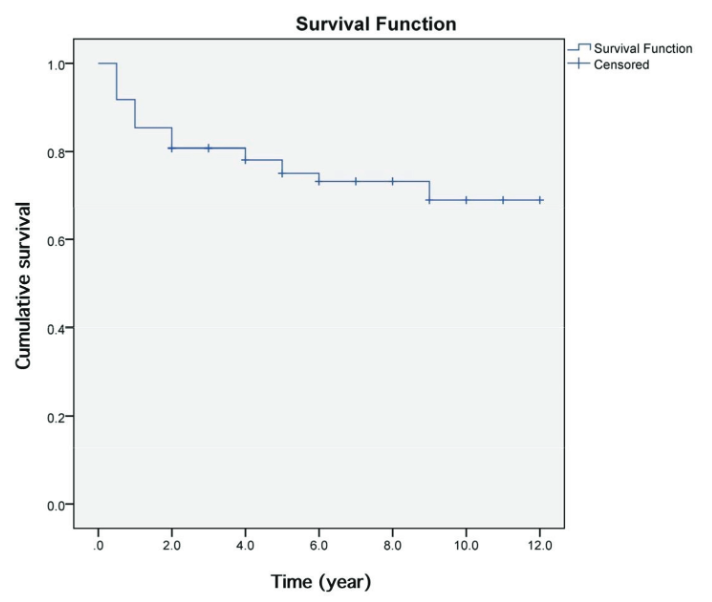
Results: A total of 109 patients were included in the study, there were 47 males and 62 females. The median follow-up duration was 4 years. Long-term seizure freedom at 2 years was 86.2% and at 5 years was 85.1%. Overall, 93 (85.3%) patients were seizure free (Engel I) at their last follow-up. Ninetyfour (86.2%) patients were seizure free at a minimum of two years after surgery. Thirty-four patients were able to discontinue anti-seizure medication. There was 14% morbidity rate with no mortality. No predictive factors were found associated with seizure outcome in this study.
Conclusion: Temporal lobectomy is effective in drug-resistant temporal lobe epilepsy with hippocampal sclerosis. Favorable seizure free outcomes at least two years can be achieved. However, there are no predictive factors associated with seizure outcome in this study.
Downloads
References
Fiest KM, Sauro KM, Wiebe S, et al. Prevalence and incidence of epilepsy: A systematic review and meta-analysis of international studies. Neurology. 2017;89(6):642.
Leonardi M, Ustun TB. The global burden of epilepsy. Epilepsia. 2002;43 Suppl 6:21-5.
Engel J Jr. Surgery for seizures. N Engl J Med. 1996;334(10):647-52.
Kwan P, Brodie MJ. Early identification of refractory epilepsy. N Engl J Med. 2000;342(5):314-9.
Asadi-Pooya AA, Stewart GR, Abrams DJ, Sharan A. Prevalence and incidence of drug-resistant mesial temporal lobe epilepsy in the United States. World Neurosurg. 2017;99:662-6.
Hemb M, Palmini A, Paglioli E, et al. An 18-year follow-up of seizure outcome after surgery for temporal lobe epilepsy and hippocampal sclerosis. J Neurol Neurosurg Psychiatry. 2013;84(7):800-5.
Engel J Jr, McDermott MP, Wiebe S, et al. Early surgical therapy for drug-resistant temporal lobe epilepsy: a randomized trial. JAMA. 2012;307(9):922-30.
Quarato PP, Di Gennaro G, Mascia A, et al. Temporal lobe epilepsy surgery: different surgical strategies after a non-invasive diagnostic protocol. J Neurol Neurosurg Psychiatry. 2005;76(6):815-24.
Wiebe S, Blume WT, Girvin JP, Eliasziw M. Effectiveness and Efficiency of Surgery for Temporal Lobe Epilepsy Study Group. A randomized, controlled trial of surgery for temporal-lobe epilepsy. N Engl J Med. 2001;345(5):311-8.
McIntosh AM, Kalnins RM, Mitchell LA, Fabinyi GC, Briellmann RS, Berkovic SF. Temporal lobectomy: long-term seizure outcome, late recurrence and risks for seizure recurrence. Brain. 2004;127(Pt 9):2018-30.
Cohen-Gadol AA, Wilhelmi BG, Collignon F, et al. Long-term outcome of epilepsy surgery among 399 patients with nonlesional seizure foci including mesial temporal lobe sclerosis. J Neurosurg. 2006;104(4):513-24.
Downloads
Published
How to Cite
Issue
Section
License

This work is licensed under a Creative Commons Attribution-NonCommercial-NoDerivatives 4.0 International License.
Articles in this journal are copyrighted by the x may be read and used for academic purposes, such as teaching, research, or citation, with proper credit given to the author and the journal.use or modification of the articles is prohibited without permission.
statements expressed in the articles are solely the opinions of the authors.
authors are fully responsible for the content and accuracy of their articles.
other reuse or republication requires permission from the journal."


