
Risk factors associated with secondary delayed contralateral expanding hematoma in patient with bilateral acute traumatic intracranial hematomas
Keywords:
traumatic brain injury, epidural hematoma, subdural hematoma, skull fracture, coagulopathyAbstract
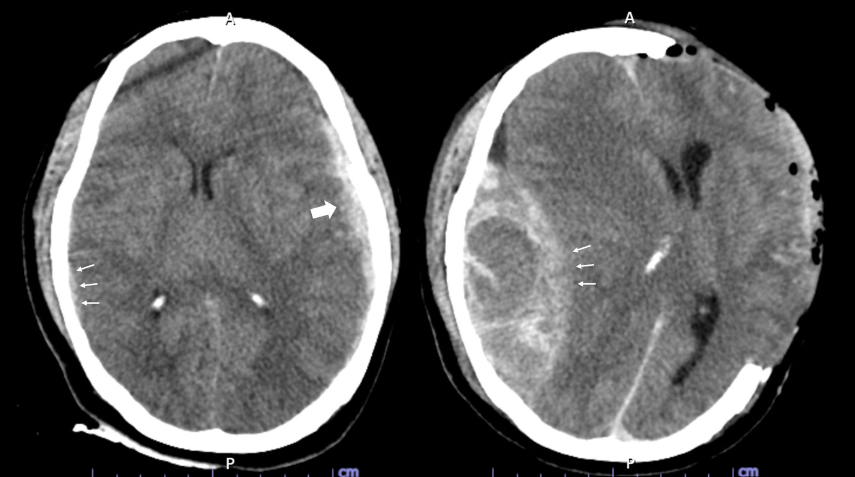
Background: Secondary delayed contralateral expanding hematoma (SDCEH) may occur after unilateral surgery in patients with bilateral acute traumatic intracranial hematomas and can lead to neurological deterioration. Identifying patients at risk may help guide early postoperative imaging and timely intervention.
Methods: We performed a retrospective cohort study of adult patients with bilateral acute traumatic intracranial hematomas who underwent unilateral surgical evacuation at a Level I trauma center between January 2021 and February 2024. Postoperative CT was obtained within 24 hours based on predefined clinical criteria. SDCEH was defined as a postoperative increase in contralateral hematoma volume or thickness by >30% requiring contralateral surgical intervention. Patients were categorized into progression (SDCEH) and non-progression groups. Variables associated with SDCEH were assessed using univariate analysis and multivariable logistic regression.
Results: Sixty-one patients were included; 29 (47.5%) developed SDCEH. On univariate analysis, midline shift, contralateral skull fracture, and postoperative coagulopathy were associated with SDCEH. In multivariable analysis, contralateral skull fracture (p=0.048) and postoperative coagulopathy (p=0.011) remained independent predictors, whereas midline shift was not significant after adjustment.
Conclusions: SDCEH occurred in nearly half of patients with bilateral acute traumatic intracranial hematomas treated with unilateral surgery. Contralateral skull fracture and postoperative coagulopathy independently predicted SDCEH. Patients with these features may benefit from intensive postoperative surveillance and early serial CT imaging to facilitate prompt detection and management.
Downloads
References
Dewan MC, Rattani A, Gupta S, Baticulon RE, Hung YC, Punchak M, et al. Estimating the global incidence of traumatic brain injury. J Neurosurg. 2019;130(4):1080-97.doi: 10.3171/2017.10.JNS17352.
World Health Organization. Global status report on road safety 2018 [Internet]. Geneva: World Health Organization; 2018 [cited 2025 Sep 17]. Available from: https://www.who.int/publications/i/item/9789241565684
Xue S, Zhang Z, Liu Y. Effects of intracranial pressure monitoring in pediatric severe traumatic brain injury: a meta-analysis of cohort studies. Front Neurol. 2025;16:1557820. doi: 10.3389/fneur.2025.1557820.
Fokin AA, Wycech Knight J, Davis B, Stalder R, Mendes MAP, Darya M, et al. The timing and value of early postoperative computed tomography after head surgery in traumatic brain injury patients. Clin Neurol Neurosurg. 2023;226:107606. doi: 10.1016/j.clineuro.2023.107606.
Cepeda S, Gómez PA, Castaño-Leon AM, Martínez-Pérez R, Munarriz PM, Lagares A. Traumatic intracerebral hemorrhage: risk factors associated with progression. J Neurotrauma. 2015;32(16):1246-53. doi: 10.1089/neu.2014.3808.
Jung IH, Yun JH, Lee SK, KNTDB Investigators. Risk factors for postoperative contralateral hemorrhage in patients with traumatic brain injury who underwent surgical treatment: a multicenter study. Korean J Neurotrauma. 2023; 19(1):42-52. doi: 10.13004/kjnt.2023.19.e3.
Chen P, Deng YB, Hu X, Zhou W, Zhang QT, Zhang LY, et al. Risk factors associated with the progression of extra-axial hematoma in the original frontotemporoparietal site after contralateral decompressive surgery in traumatic brain injury patients. Chin J Traumatol. 2020; 23(1):45-50. doi: 10.1016/j.cjtee.2019.10.005.
Fu S, Hou P, Wang G, Wang S. Causes and risk factors of an unplanned second craniotomy in patients with traumatic brain injury. BMC Surg. 2023;23(1):78. doi: 10.1186/s12893-023-01977-w.
Kurland D, Hong C, Aarabi B, Gerzanich V, Simard JM. Hemorrhagic progression of a contusion after traumatic brain injury: a review. J Neurotrauma. 2012;29(1):19-31. doi: 10.1089/neu.2011.2122.
Yokota H. Cerebral endothelial damage after severe head injury. J Nippon Med Sch. 2007; 74(5):332-7. doi: 10.1272/jnms.74.332.
Downloads
Published
How to Cite
Issue
Section
License
Copyright (c) 2026 Thai Journal of Neurological Surgery

This work is licensed under a Creative Commons Attribution-NonCommercial-NoDerivatives 4.0 International License.
Articles in this journal are copyrighted by the x may be read and used for academic purposes, such as teaching, research, or citation, with proper credit given to the author and the journal.use or modification of the articles is prohibited without permission.
statements expressed in the articles are solely the opinions of the authors.
authors are fully responsible for the content and accuracy of their articles.
other reuse or republication requires permission from the journal."


