
A Retrospective Review of the Clinical Outcomes of Stereotactic Radiation for Pituitary Adenoma In Ramathibodi Hospital
Keywords:
Pituitary adenoma, Stereotactic radiosurgery, Stereotactic radiotherapy, Hypopituitarism, Treatment outcomeAbstract
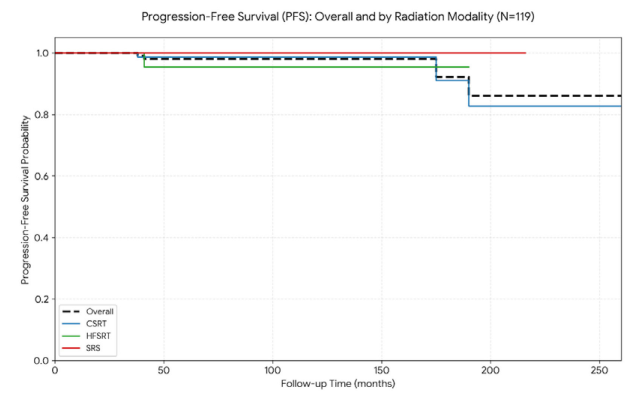
Background: Stereotactic radiation, including conventional stereotactic radiotherapy (CSRT), hypofractionated stereotactic radiotherapy (HFSRT), and stereotactic radiosurgery (SRS), plays a crucial role in the management of nonfunctioning pituitary adenomas (NFPAs) and functioning. However, the optimal selection of treatment modality to maximize long-term control while minimizing late toxicities, particularly delayed hypopituitarism, remains a subject of ongoing clinical debate. Objective: To evaluate the long-term efficacy and safety of a tailored, risk-adapted stereotactic radiation strategy for the management of pituitary adenomas. Material and method: We retrospectively reviewed 127 patients with pituitary adenomas treated with conventional stereotactic radiotherapy (CSRT) (n=86), hypofractionated stereotactic radiotherapy (HFSRT) (n=29), or stereotactic radiosurgery (SRS) (n=12). The primary outcomes were radiographic tumor local control and biochemical control in functioning adenomas. Secondary outcomes included late toxicities and the evaluation of predictors for new-onset hypopituitarism, which was specifically analyzed using Cox proportional hazards regression in a subgroup of preoperatively hormonally intact patients (n=73). Results: The overall radiographic tumor control rate was 96.6%, with no significant difference in progression-free survival (PFS) across the three modalities (p = 0.823). Among functioning adenomas, the overall biochemical control rate was 87.9%, with 69.7% achieving remission off medication. Regarding secondary outcomes, the treatment demonstrated a highly favorable safety profile; zero instances of Grade 3-4 severe toxicities, radiation necrosis, or cerebrovascular events were observed. New-onset hypopituitarism occurred in 12.6% of the cohort (all Grade 1-2). In the preoperatively hormonally intact subgroup, multivariate analysis revealed that the specific radiation modality was not an independent predictor of new endocrine deficits. Conclusion: A tailored, risk-adapted stereotactic radiation strategy provides excellent and comparable long-term local control and biochemical control for pituitary adenomas. The choice of radiation modality does not independently predict delayed hypopituitarism. Instead, the risk of endocrine decline is likely multifactorial, emphasizing the importance of baseline tumor complexity and the preexisting functional reserve of the gland when counseling patients.
Downloads
References
Amar AP, Weiss MH. Pituitary anatomy and physiology. Neurosurg Clin N Am. 2003;14(1):11- 23. https://doi.org/10.1016/S1042-3680(02)00017-7 PMid:12690976
Fernandez A, Karavitaki N, Wass JA. Prevalence of pituitary adenomas: a community-based, cross-sectional study in Banbury (Oxfordshire, UK). Clin Endocrinol (Oxf). 2010;72(3):377-82. https://doi.org/10.1111/j.1365-2265.2009.03667.x PMid:19650784
Daly AF, Rixhon M, Adam C, Dempegioti A, Tichomirowa MA, Beckers A. High prevalence of pituitary adenomas: a cross-sectional study in the province of Liege, Belgium. J Clin Endocrinol Metab. 2006;91(12):4769-75. https://doi.org/10.1210/jc.2006-1668 PMid:16968795
Ntali G, Wass JA. Epidemiology, clinical presentation and diagnosis of non-functioning pituitary adenomas. Pituitary. 2018;21(2):111-8. https://doi.org/10.1007/s11102-018-0869-3 PMid:29368293
Chin SO. Epidemiology of Functioning Pituitary Adenomas. Endocrinol Metab (Seoul).2020; 35(2):237-42. https://doi.org/10.3803/EnM.2020.35.2.237 PMid:32615708 PMCid:PMC7386114
Esposito D, Olsson DS, Ragnarsson O, Buchfelder M, Skoglund T, Johannsson G. Non-functioning pituitary adenomas: indications for pituitary surgery and post-surgical management. Pituitary. 2019;22(4):422-34. https://doi.org/10.1007/s11102-019-00960-0 PMid:31011999 PMCid:PMC6647426
Hata A, Oda M, Ono T, Suzuki A, Hanyu N, Takahashi M, et al. Long-term Outcomes of Hypofractionated Stereotactic Radiotherapy for the Treatment of Perioptic Nonfunctioning Pituitary Adenomas. Neurol Med Chir (Tokyo). 2021;61(7):404-13. https://doi.org/10.2176/nmc.oa.2020-0378 PMid:33994449 PMCid:PMC8280324
Iwata H, Sato K, Tatewaki K, Yokota N, Inoue M, Baba Y, et al. Hypofractionated stereotactic radiotherapy with CyberKnife for nonfunctioning pituitary adenoma: high local control with low toxicity. Neuro Oncol. 2011;13(8):916-22. https://doi.org/10.1093/neuonc/nor055 PMid:21665918 PMCid:PMC3145469
Varlamov EV, McCartney S, Fleseriu M. Functioning Pituitary Adenomas - Current Treatment Options and Emerging Medical Therapies. Eur Endocrinol. 2019;15(1):30-40. https://doi.org/10.17925/EE.2019.15.1.30 PMid:31244908 PMCid:PMC6587904
Eisenhauer EA, Therasse P, Bogaerts J, Schwartz LH, Sargent D, Ford R, Dancey J, Arbuck S, Gwyther S, Mooney M, Rubinstein L, Shankar L, Dodd L, Kaplan R, Lacombe D, Verweij J. New response evaluation criteria in solid tumours: revised RECIST guideline (version 1.1). Eur J Cancer. 2009 Jan;45(2):228-47. https://doi.org/10.1016/j.ejca.2008.10.026 PMid:19097774
Melmed S. Pituitary-Tumor Endocrinopathies. N Engl J Med. 2020;382(10):937-950. https://doi.org/10.1056/NEJMra1810772 PMid:32130815
Holladay JT. Proper method for calculating average visual acuity. J Refract Surg. 1997;13(4): 388-391. https://doi.org/10.3928/1081-597X-19970701-16 PMid:9268940
Colenbrander A. Visual Standards: Aspects and Ranges of Vision Loss with Emphasis on Population Surveys. Report prepared for the International Council of Ophthalmology (ICO). Sydney: International Council of Ophthalmology; 2002.
Rosser DA, Cousens SN, Murdoch IE, Fitzke FW, Laidlaw DA. How sensitive to clinical change are ETDRS logMAR visual acuity measurements? Invest Ophthalmol Vis Sci. 2003;44(8):3278-3281. https://doi.org/10.1167/iovs.02-1100 PMid:12882770
U.S. Department of Health and Human Services, National Institutes of Health, National Cancer Institute. Common Terminology Criteria for Adverse Events (CTCAE) Version 5.0. Published November 27, 2017.
Sheehan JP, Starke RM, Mathieu D, Yu JB, Chiang V, Webb JY, et al. Gamma Knife radiosurgery for the management of nonfunctioning pituitary adenomas: a multicenter study. J Neurosurg. 2013;119(2):446-56. https://doi.org/10.3171/2013.3.JNS12766 PMid:23621595
Minniti G, Traish D, Ashley S, Gonsalves A, Brada M. Fractionated stereotactic radiotherapy for patients with pituitary adenomas. Arch Neurol. 2006;63(4):557-62.
Shaaban A, Dumot C, Mantziaris G, Dayawansa S, Peker S, Samanci Y, et al. Long-term radiographic and endocrinological outcomes of stereotactic radiosurgery for recurrent or residual nonfunctioning pituitary adenomas. J Neurosurg. 2024;141(4):773-780. https://doi.org/10.3171/2024.1.JNS232285 PMid:38518285
Kotecha R, Sahgal A, Rubens M, et al. Stereotactic radiosurgery for non-functioning pituitary adenomas: meta-analysis and International Stereotactic Radiosurgery Society practice opinion. Neuro Oncol. 2020;22(3):318-332. https://doi.org/10.1093/neuonc/noz225 PMid:31790121 PMCid:PMC7058447
Graffeo CS, Link MJ, Brown PD, Young WF Jr, Pollock BE. Hypopituitarism after single-fraction pituitary adenoma radiosurgery: dosimetric analysis based on patients treated using contemporary techniques. Int J Radiat Oncol Biol Phys. 2018;101(3):618-623. https://doi.org/10.1016/j.ijrobp.2018.02.169 PMid:29678524
Hall EJ, Giaccia AJ. Radiobiology for the Radiologist. 8th ed. Philadelphia, PA: Wolters Kluwer; 2018. Chapter 22, Time, dose, and fractionation in radiotherapy; p. 391-411.
Asa SL, Mete O, Perry A, Osamura RY. Overview of the 2022 WHO Classification of Pituitary Tumors. Endocr Pathol. 2022;33(1):6-26. https://doi.org/10.1007/s12022-022-09703-7 PMid:35291028
Downloads
Published
How to Cite
Issue
Section
License
Copyright (c) 2026 Thai Journal of Neurological Surgery

This work is licensed under a Creative Commons Attribution-NonCommercial-NoDerivatives 4.0 International License.
Articles in this journal are copyrighted by the x may be read and used for academic purposes, such as teaching, research, or citation, with proper credit given to the author and the journal.use or modification of the articles is prohibited without permission.
statements expressed in the articles are solely the opinions of the authors.
authors are fully responsible for the content and accuracy of their articles.
other reuse or republication requires permission from the journal."


