Successful therapeutic response of intravenous immunoglobulin in Guillain-Barre syndrome with onset more than two weeks: a case report
Keywords:
Albumin, c-reactive protein, Guillain-Barre syndrome, immunoglobulins, intravenous, polyradiculoneuropathyAbstract
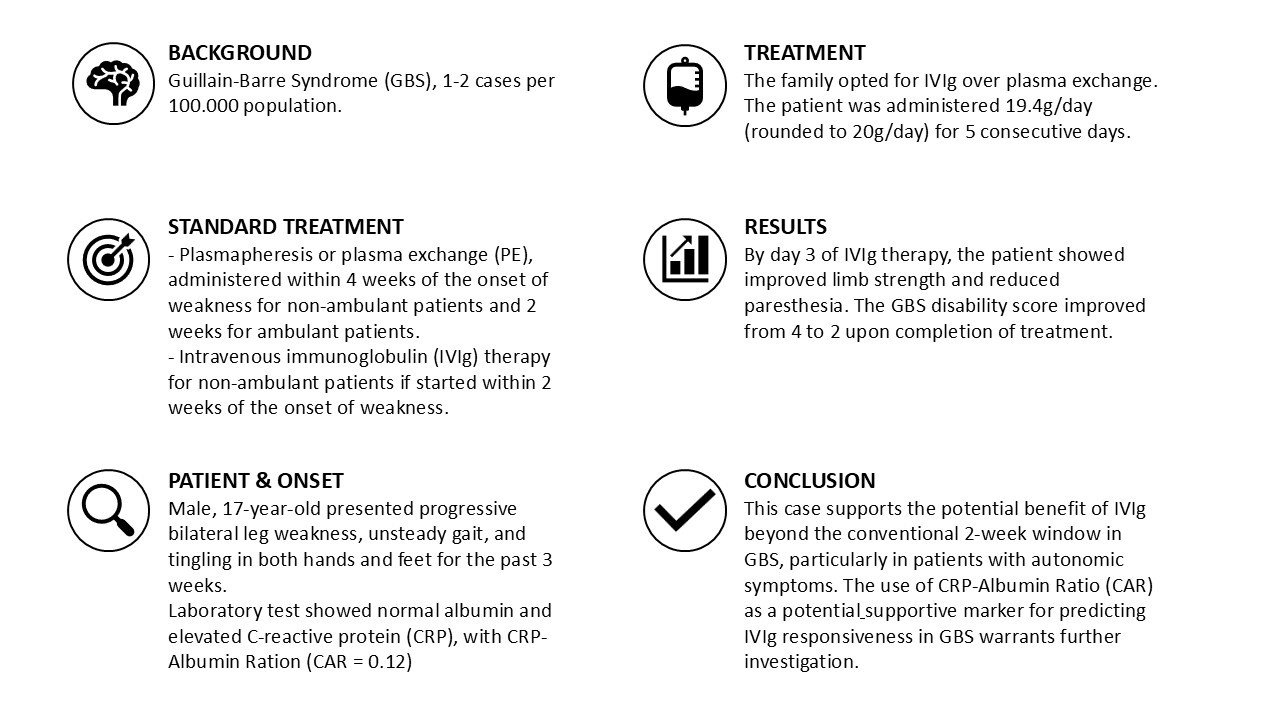
Guillain-Barré syndrome (GBS) has a global incidence of 1–2 cases per 100,000 individuals annually and remains the most common cause of acute flaccid paralysis. Standard treatment includes plasma exchange within 4 weeks or intravenous immunoglobulin (IVIg) within 2 weeks of symptom onset. However, select late-presenting cases may still benefit from IVIg treatment. Here, we report a case of a 17-year-old male who presented with progressive bilateral limb weakness and paresthesia that began approximately 3 weeks prior to admission. Furthermore, he experienced a brief syncope episode and defecation syncope, thus indicating possible autonomic involvement. On hospital day 3, after shared decision-making, the family opted for IVIg over plasma exchange. The laboratory tests on admission and before IVIg treatment showed normal albumin and elevated c-reactive protein (CRP) levels, which resulted in a low CRP-albumin ratio (CAR = 0.12). Although the value of CAR has not been elucidated in GBS, studies on Kawasaki disease suggest that a lower CAR may be associated with a favorable response to IVIg treatment. The patient received IVIg at 0.4 g/kg/day for 5 days, starting on hospital day 4 (approximately day 24 of symptom onset). By day 3 of IVIg therapy, the patient exhibited improved limb strength and reduced paresthesia. Moreover, the GBS disability score improved from 4 to 2 upon completion of treatment. This case supports the potential benefit of IVIg beyond the conventional 2-week window in GBS, particularly in patients exhibiting autonomic symptoms. The use of CAR as a potential supportive marker for predicting the response of patients with GBS to IVIg treatment warrants further investigation.
Downloads
References
Singh J, Raja V Sr, Irfan M, Hashmat O, Syed M, Shahbaz NN. Frequency of autonomic dysfunction in patients of guillain barre syndrome in a tertiary care hospital. Cureus 2020;12:e12101.
https://doi.org/10.7759/cureus.12101
Leonhard SE, Mandarakas MR, Gondim FAA, Bateman K, Ferreira MLB, Cornblath DR, et al. Diagnosis and management of Guillain-Barré syndrome in ten steps. Nat Rev Neurol 2019;15:671−83.
https://doi.org/10.1038/s41582-019-0250-9
Hughes RA, Swan AV, Van Doorn PA. Intravenous immunoglobulin for Guillain-Barré syndrome. Cochrane Database Syst Rev 2014;2019:CD002063.
https://doi.org/10.1002/14651858.CD002063.pub6
Sejvar JJ, Baughman AL, Wise M, Morgan OW. Population incidence of Guillain-Barré syndrome: a systematic review and meta-analysis. Neuroepidemiology 2011;36:123−33.
https://doi.org/10.1159/000324710
Altaweel YA, Abdelaziz S, Fathy HA, AbdelBadea S. Correlative study between c-reactive protein, clinical severity, and nerve conduction studies in Guillain-Barrè syndrome. Egypt J Neurol Psychiatr Neurosurg 2018;54:4.
https://doi.org/10.1186/s41983-018-0006-2
Putri GHG, Yasmin NNR, Kurniawan SN. Guillain-barré syndrome. JPHV 2023;4:46−50.
https://doi.org/10.21776/ub.jphv.2023.004.02.4
Palaiodimou L, Stefanou M-I, Katsanos AH, Fragkou PC, Papadopoulou M, Moschovos C, et al. Prevalence, clinical characteristics and outcomes of Guillain-Barré syndrome spectrum associated with COVID 19: a systematic review and meta analysis. Eur J Neurol 2021;28:3517−29.
https://doi.org/10.1111/ene.14860
Anandan C, Khuder SA, Koffman BM. Prevalence of autonomic dysfunction in hospitalized patients with Guillain-Barré syndrome. Muscle Nerve 2017;56:331−3.
https://doi.org/10.1002/mus.25551
Islam B, Islam Z, Rahman S, Endtz HP, Vos MC, Van der Jagt M, et al. Small volume plasma exchange for GuillainBarré syndrome in resource-limited settings: a phase II safety and feasibility study. BMJ Open 2018;8: e022862.
https://doi.org/10.1136/bmjopen-2018-022862
Harms M. Inpatient management of Guillain-Barré syndrome. Neurohospitalist 2011;1:78−84.
https://doi.org/10.1177/1941875210396379
Hughes RAC, Wijdicks EFM, Barohn R, Benson E, Cornblath DR, Hahn AF, et al. Practice parameter: immunotherapy for Guillain-Barré syndrome: report of the quality standards subcommittee of the American Academy of Neurology. Neurology 2003;61:736−40.
https://doi.org/10.1212/WNL.61.6.736
Dalakas MC. Mechanisms of action of IVIg and therapeutic considerations in the treatment of acute and chronic demyelinating neuropathies. Neurology 2002;59 Suppl 6:S13−21.
https://doi.org/10.1212/WNL.59.12_suppl_6.S13
Zaeem Z, Siddiqi ZA, Zochodne DW. Autonomic involvement in Guillain-Barré syndrome: an update. Clin Auton Res. 2019;29:289−99.
https://doi.org/10.1007/s10286-018-0542-y
Verboon C, Van Doorn PA, Jacobs BC. Treatment dilemmas in Guillain-Barré syndrome. J Neurol Neurosurg Psychiatry 2017;88:346−52.
https://doi.org/10.1136/jnnp-2016-314862
Chaudhuri JR, Alladi S, Mridula KR, Boddu B, Rao M, Hemanth C, et al. Clinical outcome of Guillain-Barré syndrome with various treatment methods and cost effectiveness: a study from tertiary care center in SouthIndia: Yashoda GBS Registry. Neurol Asia 2014;19: 263−70.
Van Den Berg B, Walgaard C, Drenthen J, Fokke C, Jacobs BC, Van Doorn PA. Guillain-Barré syndrome: pathogenesis, diagnosis, treatment and prognosis. Nat Rev Neurol 2014;10:469−82.
https://doi.org/10.1038/nrneurol.2014.121
Kazatchkine MD, Kaveri SV. Immunomodulation of autoimmune and inflammatory diseases with intravenous immune globulin. N Engl J Med 2001;345:747−55.
https://doi.org/10.1056/NEJMra993360
Savithri Nandeesha S, Kasagga A, Hawrami C, Ricci E, Hailu KT, Salib K, et al. Treatment efficacy of plasmapheresis versus intravenous immunoglobulin in Guillain-Barré syndrome management: a systematic review. Cureus 2024;16:e57066.
https://doi.org/10.7759/cureus.57066
van der Meché FG, Schmitz PI. A randomized trial comparing intravenous immune globulin and plasma exchange in Guillain-Barré syndrome. N Engl J Med 1992;326:1123−9.
https://doi.org/10.1056/NEJM199204233261705
El-Bayoumi MA, El-Refaey AM, Abdelkader AM, ElAssmy MM, Alwakeel AA, El-Tahan HM. Comparison of intravenous immunoglobulin and plasma exchange in treatment of mechanically ventilated children with Guillain Barré syndrome: a randomized study. Crit Care 2011;15:R164.
https://doi.org/10.1186/cc10305
Zaki HA, Iftikhar H, Najam M, Masood M, Al-Marri NDR, Elgassim MAM, et al. Plasma exchange (PE) versus intravenous immunoglobulin (IVIG) for the treatment of Guillain-Barré syndrome (GBS) in patients with severe symptoms: a systematic review and metaanalysis. eNeurologicalSci 2023;31:100468.
https://doi.org/10.1016/j.ensci.2023.100468
Willison HJ, Jacobs BC, Van Doorn PA. Guillain-Barré syndrome. Lancet 2016;388:717−27.
https://doi.org/10.1016/S0140-6736(16)00339-1
Zhang R, Shuai S, Zhang H, Cai J, Cui N, Tang M, et al. Predictive value of albumin for intravenous immunoglobulin resistance in a large cohort of Kawasaki disease patients. Ital J Pediatr 2023;49:78.
https://doi.org/10.1186/s13052-023-01482-z
Tang Y, Yan W, Sun L, Huang J, Qian W, Ding Y, et al. Prediction of intravenous immunoglobulin resistance in Kawasaki disease in an East China population. Clin Rheumatol 2016;35:2771−6.
https://doi.org/10.1007/s10067-016-3370-2
Lam JY, Song MS, Kim GB, Shimizu C, Bainto E, Tremoulet AH, et al. Intravenous immunoglobulin resistance in Kawasaki disease patients: prediction using clinical data. Pediatr Res 2024;95:692−7.
https://doi.org/10.1038/s41390-023-02519-z
Xie T, Wang Y, Fu S, Wang W, Xie C, Zhang Y, et al. Predictors for intravenous immunoglobulin resistance and coronary artery lesions in Kawasaki disease. Pediatr Rheumatol Online J 2017;15:17.
https://doi.org/10.1186/s12969-017-0149-1
Ning P, Yang B, Yang X, Huang H, Shen Q, Zhao Q, et al. Clinical value of c-reactive protein/albumin ratio in Guillain-Barré syndrome. Neurol Sci 2021;42:3275−83.
Downloads
Published
How to Cite
Issue
Section
License
Copyright (c) 2025 Chulalongkorn Medical Journal

This work is licensed under a Creative Commons Attribution-NonCommercial-NoDerivatives 4.0 International License.