Role of perceived control over falls in older adults
Keywords:
Concern about falling, falls, perceived control, older adultsAbstract
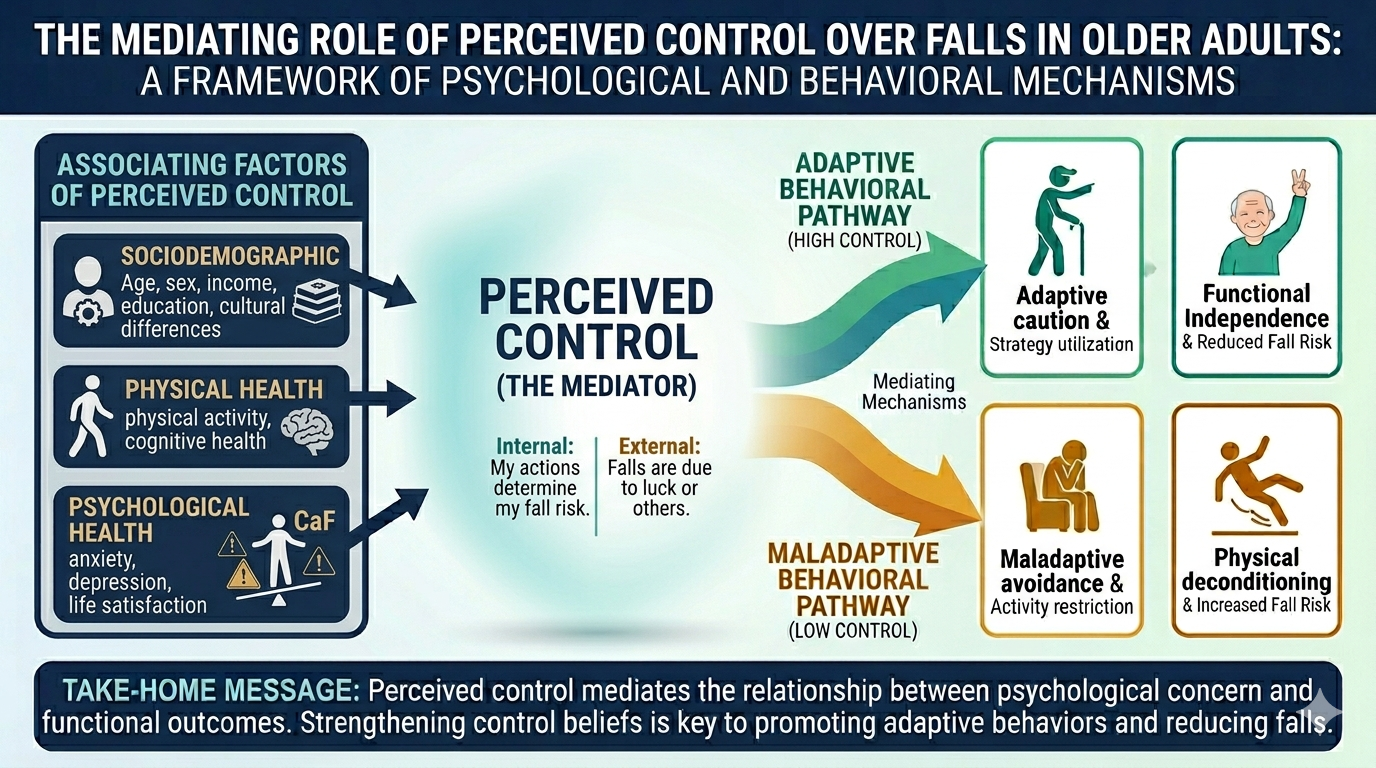
Falls among older adults constitute a considerable public health challenge, often leading to severe physical injuries, reduced independence, and a diminished quality of life. Perceived control, a critical psychological construct, plays a substantial role in sustaining physical health, cognitive function, and overall life satisfaction, and it is strongly associated with positive health outcomes. This review aims to examine the role of perceived control in fall risk among older adults. Concern about falling (CaF) is a prevalent psychological factor that influences fall risk by affecting behaviors linked to physical activity, balance, and adaptive responses. Perceived control theory provides a framework for understanding how older adults’ confidence in managing falls shapes their emotional responses and behavioral adaptations, thereby influencing fall-related outcomes and overall health. This review highlights the complex and multidimensional nature of perceived control related to falls. High levels of perceived control are positively correlated with better physical and mental health, whereas lower perceived control is associated with an increased fall risk and compromised well-being. A thorough analysis of theoretical models and empirical studies highlights perceived control as a mediator that promotes adaptive behaviors, supports emotional resilience, and encourages proactive engagement in fall prevention strategies. By identifying knowledge gaps in the existing literature, this review encourages further research on factors that influence perceived control and the development of standardized assessment tools that address the psychological and physical aspects of fall prevention. Such tools could enhance the independence and well-being of older adults.
Downloads
References
Montero-Odasso M, van der Velde N, Martin FC, Petrovic M, Tan MP, Ryg J, et al. World guidelines for falls prevention and management for older adults: a global initiative. Age Ageing 2022;51:afac205.
Salari N, Darvishi N, Ahmadipanah M, Shohaimi S, Mohammadi M. Global prevalence of falls in the older adults: a comprehensive systematic review and meta-analysis. J Orthop Surg Res 2022;17:334.
https://doi.org/10.1186/s13018-022-03222-1
O'Loughlin JL, Robitaille Y, Boivin JF, Suissa S. Incidence of and risk factors for falls and injurious falls among the community-dwelling elderly. Am J Epidemiol 1993;137:342-54.
https://doi.org/10.1093/oxfordjournals.aje.a116681
Ngamsangiam P, Suttanon P. Risk factors for falls among community-dwelling elderly people in asia: a systematic review. Sci Technol Asia 2020;25:105-26.
Ellmers TJ, Freiberger E, Hauer K, Hogan DB, McGarrigle L, Lim ML, et al. Why should clinical practitioners ask about their patients' concerns about falling? Age Ageing 2023;52:afad057.
https://doi.org/10.1093/ageing/afad057
Li Y, Hou L, Zhao H, Xie R, Yi Y, Ding X. Risk factors for falls among community-dwelling older adults: a systematic review and meta-analysis. Front Med (Lausanne) 2023;9:1019094.
https://doi.org/10.3389/fmed.2022.1019094
Vo MTH, Thonglor R, Moncatar TJR, Han TDT, Tejativaddhana P, Nakamura K. Fear of falling and associated factors among older adults in Southeast Asia: a systematic review. Public Health 2023;222:215-28.
https://doi.org/10.1016/j.puhe.2022.08.012
Scheffer AC, Schuurmans MJ, van Dijk N, van der Hooft T, de Rooij SE. Fear of falling: measurement strategy, prevalence, risk factors and consequences among older persons. Age Ageing 2008;37:19-24.
https://doi.org/10.1093/ageing/afm169
Chang HT, Chen HC, Chou P. Factors Associated with fear of falling among community-dwelling older adults in the shih-pai study in Taiwan. PLoS One 2016;11:e0150612.
https://doi.org/10.1371/journal.pone.0150612
Whipple MO, Hamel AV, Talley KMC. Fear of falling among community-dwelling older adults: A scoping review to identify effective evidence-based interventions. Geriatr Nurs 2018;39:170-7.
https://doi.org/10.1016/j.gerinurse.2017.08.005
Yardley L, Smith H. A prospective study of the relationship between feared consequences of falling and avoidance of activity in community-living older people. Gerontologist 2002;42:17-23.
https://doi.org/10.1093/geront/42.1.17
Ellmers TJ, Wilson MR, Norris M, Young WR. Standing up to threats: Translating the two-system model of fear to balance control in older adults. Exp Gerontol 2022;158:111647.
https://doi.org/10.1016/j.exger.2021.111647
Davis JR, Campbell AD, Adkin AL, Carpenter MG. The relationship between fear of falling and human postural control. Gait Posture 2009;29:275-9.
https://doi.org/10.1016/j.gaitpost.2008.09.006
Ellmers TJ, Wilson MR, Norris M, Young WR. Protective or harmful? A qualitative exploration of older people's perceptions of worries about falling. Age Ageing 2022;51:afac067.
https://doi.org/10.1093/ageing/afac067
Litwin H, Erlich B, Dunsky A. The complex association between fear of falling and mobility limitation in relation to late-life falls: a SHARE-Based analysis. J Aging Health 2018;30:987-1008.
https://doi.org/10.1177/0898264317704096
Delbaere K, Close JC, Brodaty H, Sachdev P, Lord SR. Determinants of disparities between perceived and physiological risk of falling among elderly people: cohort study. BMJ 2010;341:c4165.
https://doi.org/10.1136/bmj.c4165
Lachman ME. Perceived control over aging-related declines. Curr Dir Psychol Sci 2006;15:282-6.
https://doi.org/10.1111/j.1467-8721.2006.00453.x
Lachman ME, Neupert SD, Agrigoroaei S. The relevance of control beliefs for health and aging. In: Schaie KW, Willis SL, editors. Handbook of the psychology of aging, 7th ed. San Diego, CA: Elsevier Academic Press; 2011. p. 175-90.
https://doi.org/10.1016/B978-0-12-380882-0.00011-5
Robinson SA, Lachman ME. Perceived Control and aging: a mini-review and directions for future research. Gerontology 2017;63:435-42.
https://doi.org/10.1159/000468540
Lachman ME. Development in midlife. Annu Rev Psychol 2004;55:305-31.
https://doi.org/10.1146/annurev.psych.55.090902.141521
Lachman ME, Rosnick CB, Röcke C. The rise and fall of control beliefs and life satisfaction in adulthood: Trajectories of stability and change over ten years. In: Bosworth HB, Hertzog CK, editors. Aging and cognition: research methodologies and empirical advances. Washington, DC: American Psychological Association; 2009. p. 143-60.
https://doi.org/10.1037/11882-007
Mirowsky J, Ross CE. Life course trajectories of perceived control and their relationship to education. Am J Sociol. 2007;112:1339-82.
https://doi.org/10.1086/511800
Rowe JW, Kahn RL. Successful aging. Gerontologist 1997;37:433-40.
https://doi.org/10.1093/geront/37.4.433
Ellmers TJ, Wilson MR, Kal EC, Young WR. The perceived control model of falling: developing a unified framework to understand and assess maladaptive fear of falling. Age Ageing 2023;52:afad093.
https://doi.org/10.1093/ageing/afad093
Skinner EA. A guide to constructs of control. J Pers Soc Psychol 1996;71:549-70.
https://doi.org/10.1037/0022-3514.71.3.549
Rodin J. Control by any other name: definitions, concepts, and processes. In: Rodin J, Schooler C, Schaie KW, editors. Self-directedness: cause and effects throughout the life course. Hillsdale, NJ: Lawrence Erlbaum Associates, Inc; 1990. p. 1-17.
Bandura A. Self-efficacy: Toward a unifying theory of behavioral change. Psychol Rev 1977;84:191-215.
https://doi.org/10.1037/0033-295X.84.2.191
Pearlin LI, Pioli MF. Personal control: Some conceptual turf and future directions. In: Schaie KW, editor. Personal control in social and life course contexts. Societal impact on aging. New York, NY: Springer Publishing Co; 2003. p. 1-21.
Rothbaum F, Weisz JR, Snyder SS. Changing the world and changing the self: a two-process model of perceived control. J Pers Soc Psychol 1982;42:5-37.
https://doi.org/10.1037/0022-3514.42.1.5
Wallston KA, Wallston BS, Smith S, Dobbins CJ. Perceived control and health. Curr Psychol 1987;6:5-25.
https://doi.org/10.1007/BF02686633
Mardiyono M, Songwathana P, Petpichetchian W. Concept analysis of perceived control. Nurse Media J Nurs 2011;1:225-43.
Rotter JB. Generalized expectancies for internal versus external control of reinforcement. Psychol Monogr 1966;80:1-28.
https://doi.org/10.1037/h0092976
Bandura A. Self-efficacy: the exercise of control. New York, NY: Worth Publishers; 1997.
Bandura A. Perceived self-efficacy in the exercise of personal agency. J Appl Sport Psychol 1990;2:128-63.
https://doi.org/10.1080/10413209008406426
Lachman ME, Röcke C, Rosnick C, Ryff CD. Realism and illusion in Americans' temporal views of their life satisfaction: Age differences in reconstructing the past and anticipating the future. Psychol Sci 2008;19:889-97.
https://doi.org/10.1111/j.1467-9280.2008.02173.x
Rodin J. Aging and health: effects of the sense of control. Science 1986;233:1271-6.
https://doi.org/10.1126/science.3749877
Lachman ME, Weaver SL. The sense of control as a moderator of social class differences in health and well-being. J Pers Soc Psychol 1998;74:763-73.
https://doi.org/10.1037/0022-3514.74.3.763
Gerstorf D, Röcke C, Lachman ME. Antecedent-consequent relations of perceived control to health and social support: longitudinal evidence for between-domain associations across adulthood. J Gerontol B Psychol Sci Soc Sci 2011;66:61-71.
https://doi.org/10.1093/geronb/gbq077
Infurna FJ, Okun MA. Antecedents and outcomes of level and rates of change in perceived control: The moderating role of age. Dev Psychol 2015;51:1420-37.
https://doi.org/10.1037/a0039530
Tinetti ME, De Leon CFM, Doucette JT, Baker DI. Fear of falling and fall-related efficacy in relationship to functioning among community-living elders. J Gerontol 1994;49:M140-7.
https://doi.org/10.1093/geronj/49.3.M140
Lachman ME. Locus of control in aging research: a case for multidimensional and domain-specific assessment. Psychol Aging 1986;1:34-40.
https://doi.org/10.1037/0882-7974.1.1.34
Lefcourt HM, von Baeyer CL, Ware EE, Cox DJ. The multidimensional-multiattributional causality scale: The development of a goal specific locus of control scale. Can J Behav Sci 1979;11:286-304.
https://doi.org/10.1037/h0081598
Agrigoroaei S, Lachman ME. Personal control and aging: how beliefs and expectations matter. In: Cavanaugh JC, Cavanaugh CK, editors. Aging in america. Vol 1: psychological aspects. Santa Barbara, CA: Praeger perspectives; 2010. p. 177-201.
Montero-Odasso M, van der Velde N, Martin FC, Petrovic M, Tan MP, Ryg J, et al. World guidelines for falls prevention and management for older adults: a global initiative. Age Ageing 2022;51:afac205.
Infurna FJ, Gerstorf D, Zarit SH. Examining dynamic links between perceived control and health: longitudinal evidence for differential effects in midlife and old age. Dev Psychol 2011;47:9-18.
https://doi.org/10.1037/a0021022
Lachman ME, Firth KMP. Chapter eleven. the adaptive value of feeling in control during midlife. In: Orville Gilbert B, Carol DR, Ronald CK, editors. How healthy are we?. Chicago, IL: The University of Chicago Press; 2003. p. 320-49.
Rodin J, Timko C, Harris S. The construct of control: biological and psychosocial correlates. Annu Rev Gerontol Geriatr.1985;5:3-55.
Ribeiro O, Santos ÂR. Psychological correlates of fear of falling in the elderly. Educ Gerontol 2015;41:69-78.
https://doi.org/10.1080/03601277.2014.924272
Windsor TD, Anstey KJ. A longitudinal investigation of perceived control and cognitive performance in young, midlife and older adults. Neuropsychol Dev Cogn B Aging Neuropsychol Cogn 2008;15:744-63.
https://doi.org/10.1080/13825580802348570
Lachman ME, Andreoletti C. Strategy use mediates the relationship between control beliefs and memory performance for middle-aged and older adults. J Gerontol B Psychol Sci Soc Sci 2006;61:88-94.
https://doi.org/10.1093/geronb/61.2.P88
Windsor TD, Anstey KJ. Age differences in psychosocial predictors of positive and negative affect: a longitudinal investigation of young, midlife, and older adults. Psychol Aging 2010;25:641-52.
https://doi.org/10.1037/a0019431
Windsor TD, Anstey KJ. A longitudinal investigation of perceived control and cognitive performance in young, midlife and older adults. Neuropsychol Dev Cogn B Aging Neuropsychol Cogn 2008;15:744-63.
https://doi.org/10.1080/13825580802348570
Infurna FJ, Gerstorf D. Linking perceived control, physical activity, and biological health to memory change. Psychol Aging 2013;28:1147-63.
https://doi.org/10.1037/a0033327
Robinson SA, Lachman ME. Perceived control and cognition in adulthood: The mediating role of physical activity. Psychol Aging 2018;33:769-81.
https://doi.org/10.1037/pag0000273
Robinson SA, Lachman ME. 201Perceived Control and Behavior Change: A Personalized Approach. In: Reich JW, Infurna FJ, editors. Perceived control: theory, research, and practice in the first 50 years. Oxford: Oxford University Press; 2016. p. 201-28.
https://doi.org/10.1093/acprof:oso/9780190257040.003.0009
Miller LMS, Lachman ME. The sense of control and cognitive aging: Toward a model of mediational processes. In: Hess TM, Blanchard-Fields F, editors. Social cognition and aging. San Diego, CA: Academic Press; 1999. p. 17-41.
https://doi.org/10.1016/B978-012345260-3/50003-3
Infurna FJ, Gerstorf D. Perceived control relates to better functional health and lower cardio-metabolic risk: the mediating role of physical activity. Health Psychol 2014;33:85-94.
https://doi.org/10.1037/a0030208
White SM, Wójcicki TR, McAuley E. Social cognitive influences on physical activity behavior in middle-aged and older adults. J Gerontol B Psychol Sci Soc Sci 2012;67:18-26.
https://doi.org/10.1093/geronb/gbr064
Curtis RG, Windsor TD, Luszcz MA. Perceived control moderates the effects of functional limitation on older adults' social activity: findings from the australian longitudinal study of ageing. J Gerontol B Psychol Sci Soc Sci 2017;72:571-81.
Lachman ME, Weaver SL. Sociodemographic variations in the sense of control by domain: findings from the MacArthur studies of midlife. Psychol Aging 1998;13:553-62.
https://doi.org/10.1037/0882-7974.13.4.553
Wolinsky FD, Stump TE. Age and the sense of control among older adults. J Gerontol B Psychol Sci Soc Sci 1996;51:S217-20.
https://doi.org/10.1093/geronb/51B.4.S217
Sastry J, Ross CE. Asian ethnicity and the sense of personal control. Soc Psychol Q 1998;61:101-20.
https://doi.org/10.2307/2787064
Kitayama S, Karasawa M, Curhan K, Ryff C, Markus H. Independence and interdependence predict health and wellbeing: divergent patterns in the United States and Japan. Front Psychol 2010;1:163.
https://doi.org/10.3389/fpsyg.2010.00163
Ashman O, Shiomura K, Levy BR. Influence of culture and age on control beliefs: the missing link of interdependence. Int J Aging Hum Dev 2006;62:143-57.
https://doi.org/10.2190/9LXU-WLYP-NC22-98MJ
Jónsdóttir HL, Ruthig JC. A longitudinal study of the negative impact of falls on health, well-being, and survival in later life: the protective role of perceived control. Aging Ment Health 2021;25:742-8.
https://doi.org/10.1080/13607863.2020.1725736
Shumway-Cook A, Woollacott M. Motor control: translating research into clinical practice. 4th ed. Philadelphia: Wolters Kluwer Health; 2012.
Adkin AL, Frank JS, Carpenter MG, Peysar GW. Postural control is scaled to level of postural threat. Gait Posture 2000;12:87-93.
https://doi.org/10.1016/S0966-6362(00)00057-6
Adkin AL, Carpenter MG. New insights on emotional contributions to human postural control. Front Neurol 2018;9:789.
https://doi.org/10.3389/fneur.2018.00789
Carpenter MG, Frank JS, Silcher CP. Surface height effects on postural control: A hypothesis for a stiffness strategy for stance. J Vestib Res 1999;9:277-86.
https://doi.org/10.3233/VES-1999-9405
Maki BE. Gait changes in older adults: predictors of falls or indicators of fear. J Am Geriatr Soc 1997;45:313-20.
https://doi.org/10.1111/j.1532-5415.1997.tb00946.x
Chamberlin ME, Fulwider BD, Sanders SL, Medeiros JM. Does fear of falling influence spatial and temporal gait parameters in elderly persons beyond changes associated with normal aging? J Gerontol A Biol Sci Med Sci 2005;60:1163-7.
https://doi.org/10.1093/gerona/60.9.1163
Ellmers TJ, Maslivec A, Young WR. Fear of falling alters anticipatory postural control during cued gait initiation. Neuroscience 2020;438:41-9.
https://doi.org/10.1016/j.neuroscience.2020.04.050
Hadjistavropoulos T, Delbaere K, Fitzgerald TD. Reconceptualizing the role of fear of falling and balance confidence in fall risk. J Aging Health 2011;23:3-23.
https://doi.org/10.1177/0898264310378039
Bermúdez JP. Do we reflect while performing skillful actions? automaticity, control, and the perils of distraction. Philos Psychol 2017;30:896-924.
https://doi.org/10.1080/09515089.2017.1325457
Zaback M, Cleworth TW, Carpenter MG, Adkin AL. Personality traits and individual differences predict threat-induced changes in postural control. Hum Mov Sci 2015;40:393-409.
https://doi.org/10.1016/j.humov.2015.01.015
Chow VWK, Ellmers TJ, Young WR, Mak TCT, Wong TWL. Revisiting the relationship between internal focus and balance control in young and older adults. Front Neurol 2019;9:1131.
https://doi.org/10.3389/fneur.2018.01131
Boisgontier MP, Beets IAM, Duysens J, Nieuwboer A, Krampe RT, Swinnen SP. Age-related differences in attentional cost associated with postural dual tasks: Increased recruitment of generic cognitive resources in older adults. Neurosci Biobehav Rev 2013;37:1824-37.
https://doi.org/10.1016/j.neubiorev.2013.07.014
Ellmers TJ, Young WR. Conscious motor control impairs attentional processing efficiency during precision stepping. Gait Posture 2018;63:58-62.
https://doi.org/10.1016/j.gaitpost.2018.04.033
Ellmers TJ, Cocks AJ, Kal EC, Young WR. Conscious movement processing, fall-related anxiety, and the visuomotor control of locomotion in older adults. J Gerontol B Psychol Sci Soc Sci 2020;75:1911-20.
https://doi.org/10.1093/geronb/gbaa081
Wallhagen MI, Lacson M. Perceived control and psychosocial/physiological functioning in African American elders with type 2 diabetes. Diabetes Educ 1999;25:568-75.
Downloads
Published
How to Cite
Issue
Section
License
Copyright (c) 2026 Chulalongkorn Medical Journal

This work is licensed under a Creative Commons Attribution-NonCommercial-NoDerivatives 4.0 International License.