Association of sarcopenia, sarcopenic obesity, and frailty with muscle strength and gait speed in older adults: A systematic review
Keywords:
Frailty, gait speed, muscle strength, older adults sarcopenia, sarcopenic obesityAbstract
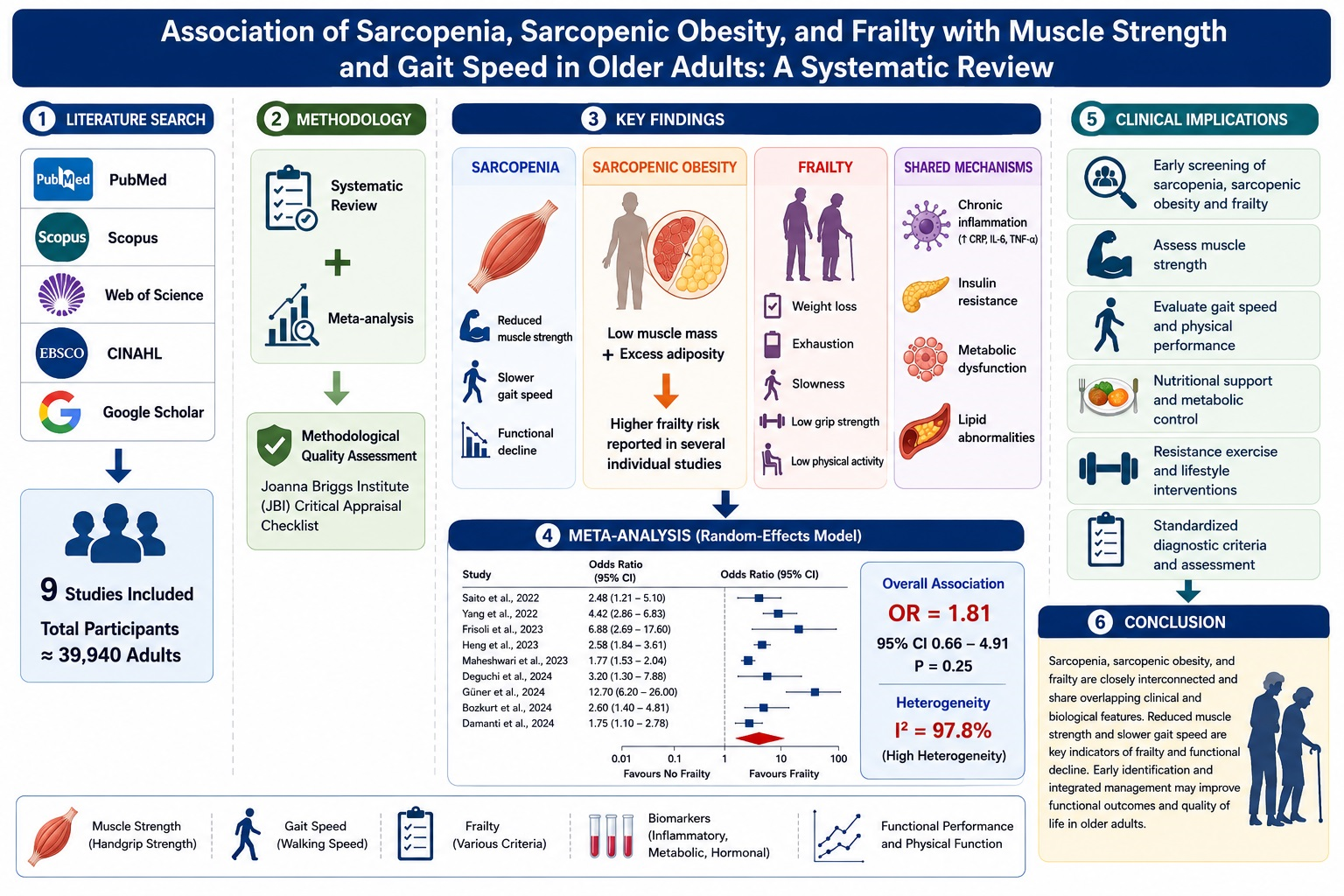
Background: Sarcopenia, sarcopenic obesity (SO), and frailty are interrelated geriatric conditions associated with adverse health outcomes and increased health risks, including reduced muscle strength, impaired gait speed, and increased morbidity. However, their shared clinical features and biomarkers remain inadequately synthesized.
Objective: This systematic review aims to evaluate the interrelationship between sarcopenia, SO, and frailty in older adults, with a particular focus on muscle strength, gait speed, and associated biomarkers.
Methods: A comprehensive literature search was performed across MEDLINE, EMBASE, Scopus, Web of Science, and CINAHL. Observational and clinical studies assessing sarcopenia, SO, and frailty were included. Data were extracted using the Population, Intervention, Comparison, Outcomes, and Study (PICOS) framework, and the findings were synthesized narratively. Risk of bias was assessed using appropriate tools.
Results: Reduced muscle strength and slower gait speed were consistently associated with a higher prevalence of sarcopenia, SO, and frailty across the included studies. The pooled analysis demonstrated a non-significant association between SO and frailty, with a pooled odds ratio (OR) indicating substantial heterogeneity among the included studies (I² = 97.8%).
Conclusion: Sarcopenia, SO, and frailty share overlapping clinical and biological characteristics, including reduced muscle strength, impaired gait speed, and common metabolic and inflammatory pathways. Although individual studies frequently reported positive associations between SO and frailty, the pooled meta-analysis did not reveal a significant association (OR 1.81, 95% confidence interval 0.66–4.91; P = 0.25), likely reflecting substantial heterogeneity across the studies. Further standardized longitudinal studies are required to clarify this relationship. Muscle strength and gait speed are key indicators that provide insight into the underlying pathways. Standardized assessment and further research are required to improve clinical management.
Downloads
References
Donini LM, Busetto L, Bischoff SC, Cederholm T, Ballesteros-Pomar MD, Batsis JA, et al. Definition and diagnostic criteria for sarcopenic obesity: ESPEN and EASO consensus statement. Obes Facts 2022;15:321-35.
https://doi.org/10.1159/000521241
de Souza AF, de Oliveira DC, Ramírez PC, de Oliveira Máximo R, Luiz MM, Delinocente MLB, et al. Low gait speed is better than frailty and sarcopenia at identifying the risk of disability in older adults. Age Ageing 2025;54.
https://doi.org/10.1093/ageing/afaf104
Saito H, Matsue Y, Kamiya K, Kagiyama N, Maeda D, Endo Y, et al. Sarcopenic obesity is associated with impaired physical function and mortality in older patients with heart failure: insight from FRAGILE-HF. BMC Geriatr 2022;22:556.
https://doi.org/10.1186/s12877-022-03168-3
Yang M, Hu M, Zhang Y, Jia S, Sun X, Zhao W, et al. Sarcopenic obesity is associated with frailty among community-dwelling older adults: findings from the WCHAT study. BMC Geriatr 2022;22:863.
https://doi.org/10.1186/s12877-022-03617-z
Frisoli Jr A, Duque G, Paes AT, Diniz AR, Lima E, Azevedo E, et al. Sarcopenic obesity definitions and their associations with physical frailty in older Brazilian adults: data from the SARCOS study. Arch Endocrinol Metab 2023;67:361-71.
https://doi.org/10.20945/2359-3997000000587
Heng MW, Chan AW, Man RE, Fenwick EK, Chew ST, Tay L, et al. Individual and combined associations of sarcopenia, osteoporosis and obesity with frailty in a multi-ethnic Asian older adult population. BMC Geriatr 2023;23:802.
https://doi.org/10.1186/s12877-023-04500-1
Maheshwari V, Basu S. Sarcopenic obesity burden, determinants, and association with risk of frailty, falls, and functional impairment in older adults with diabetes: a propensity score matching analysis. Cureus 2023;15:e49601.
https://doi.org/10.7759/cureus.49601
Deguchi N, Tanaka R, Akita T. Association between sarcopenic obesity and frailty risk in community-dwelling older women with locomotive syndrome: a cross-sectional survey. Cureus 2024;16:e64612.
https://doi.org/10.7759/cureus.64612
Güner M, Öztürk Y, Ceylan S, Okyar Baş A, Koca M, Balci C, et al. Evaluation of waist-to-calf ratio as a diagnostic tool for sarcopenic obesity: a cross-sectional study from a geriatric outpatient clinic. Eur Geriatr Med 2024;15:1469-75.
https://doi.org/10.1007/s41999-024-01024-8
Bozkurt ME, Vardal TO. Prevalence of sarcopenic obesity and associated factors in older adults. Med Bull Haseki 2024;62:149-53.
https://doi.org/10.4274/haseki.galenos.2024.9807
Damanti S, Citterio L, Zagato L, Brioni E, Magnaghi C, Simonini M, et al. Sarcopenic obesity and pre-sarcopenia contribute to frailty in community-dwelling Italian older people: data from the FRASNET study. BMC Geriatr 2024;24:638.
https://doi.org/10.1186/s12877-024-05216-6
Sutil DV, Parentoni AN, Da Costa Teixeira LA, de Souza Moreira B, Leopoldino AA, Mendonça VA, et al. Prevalence of sarcopenia in older women and level of agreement between the diagnostic instruments proposed by the European Working Group on Sarcopenia in Older People 2 (EWGSOP2). BMC Musculoskelet Disord 2023; 24:182.
https://doi.org/10.1186/s12891-023-06287-z
Prado CM, Batsis JA, Donini LM, Gonzalez MC, Siervo M. Sarcopenic obesity in older adults: a clinical overview. Nat Rev Endocrinol 2024; 20:261-77.
https://doi.org/10.1038/s41574-023-00943-z
Lim WS, Cheong CY, Lim JP, Tan MM, Chia JQ, Malik NA, et al. Singapore clinical practice guidelines for sarcopenia: screening, diagnosis, management and prevention. J Frailty Aging 2022;11:348-69.
Downloads
Published
How to Cite
Issue
Section
License
Copyright (c) 2026 Chulalongkorn Medical Journal

This work is licensed under a Creative Commons Attribution-NonCommercial-NoDerivatives 4.0 International License.